What Is an E-Commerce Business? 2026 Guide
What Is an E-Commerce Business? A Real Founder’s 2026 Guide
An e-commerce business is any commercial enterprise that buys and sells goods or services over the internet, reaching global customers 24/7 without a physical storefront. With global online retail sales projected to hit nearly $7 trillion in 2025, the opportunity is real and growing fast.
Key Takeaways
- commerce businesses operate entirely online, using digital platforms to sell products or services to consumers and businesses worldwide.
- Global e-commerce retail sales are projected to hit $7 trillion in 2025, with 2.71 billion people shopping online.
- Starting an this type of business requires careful niche selection, a solid business plan, and the right technology stack.
- Popular models include dropshipping, print-on-demand, digital products, and selling on marketplaces like Amazon.
- Success depends on effective marketing, streamlined logistics, and continuous adaptation to consumer trends.
What Is an E-Commerce Business?
The Core Definition
An this kind of business is any commercial operation that conducts transactions over the internet. According to Wikipedia, e-commerce covers “commercial activities including the electronic buying or selling products and services which are conducted on online platforms or over the Internet.” That definition stretches from a solo founder selling handmade jewelry on Etsy all the way to a multinational managing a complex B2B supply chain.
I’ve built products across both ends of that spectrum. The mechanics differ, but the core challenge is the same: get the right product in front of the right person at the right moment, and make the transaction frictionless.
How E-Commerce Differs from Traditional Retail
Unlike brick-and-mortar stores, an e commerce operates without geographic limits. Customers browse and buy at any hour, from any country. Overhead is typically lower because there’s no rent for physical premises. As the Coursera e-commerce guide notes, “one key benefit is reduced costs compared to a traditional store.” Beyond cost, data analytics let online sellers personalize the shopping experience in ways physical retailers simply can’t match.
E-Commerce Market Growth in 2026
The numbers are hard to ignore. According to a GoDaddy report, 2.71 billion people shopped online in 2024, representing roughly 33% of the global population. In the United States alone, more than 80% of adults (273 million people) made purchases online. Globally, 57% of consumer spending now happens digitally. Sales are projected to reach nearly $7 trillion in 2025 and $8 trillion by 2027. These aren’t abstract projections. They represent real buyers with real money, looking for products you could be selling today.
“The shift to online commerce isn’t a trend anymore. It’s the default buying behavior for most of the world’s connected population.” – Based on GoDaddy’s 2024 e-commerce market analysis
Types of E-Commerce Business Models
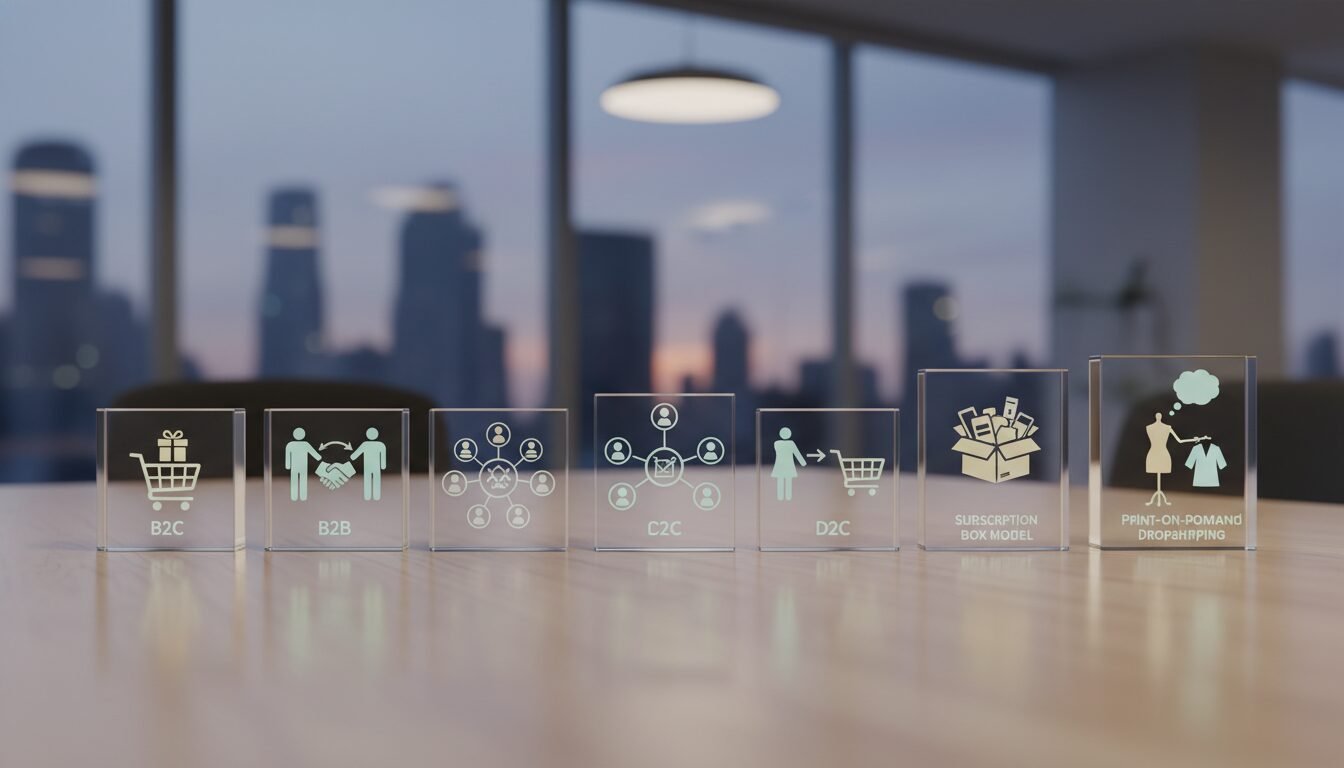
Business-to-Consumer (B2C)
The B2C model is what most people picture first. It means selling products or services directly to end consumers. Clothing brands, electronics stores, and subscription box services all fit here. B2C transactions are typically lower in value but higher in volume, which means your marketing funnel and conversion rate matter enormously.
Business-to-Business (B2B)
B2B e-commerce covers transactions between businesses: wholesale distributors, manufacturers selling to retailers, or software companies offering enterprise solutions. Deals are larger and more complex, but the global B2B e-commerce market is growing faster than B2C in many sectors. If you can solve a real operational problem for other businesses, margins tend to be stronger and churn lower.
Consumer-to-Consumer (C2C) and Other Models
C2C platforms like eBay and Facebook Marketplace let individuals sell to one another. Other models worth knowing: consumer-to-business (C2B), where freelancers offer services to companies, and direct-to-consumer (D2C), where manufacturers cut out intermediaries entirely. Each model requires a different approach to pricing, logistics, and customer acquisition.
Pros and Cons of Running an E-Commerce Business
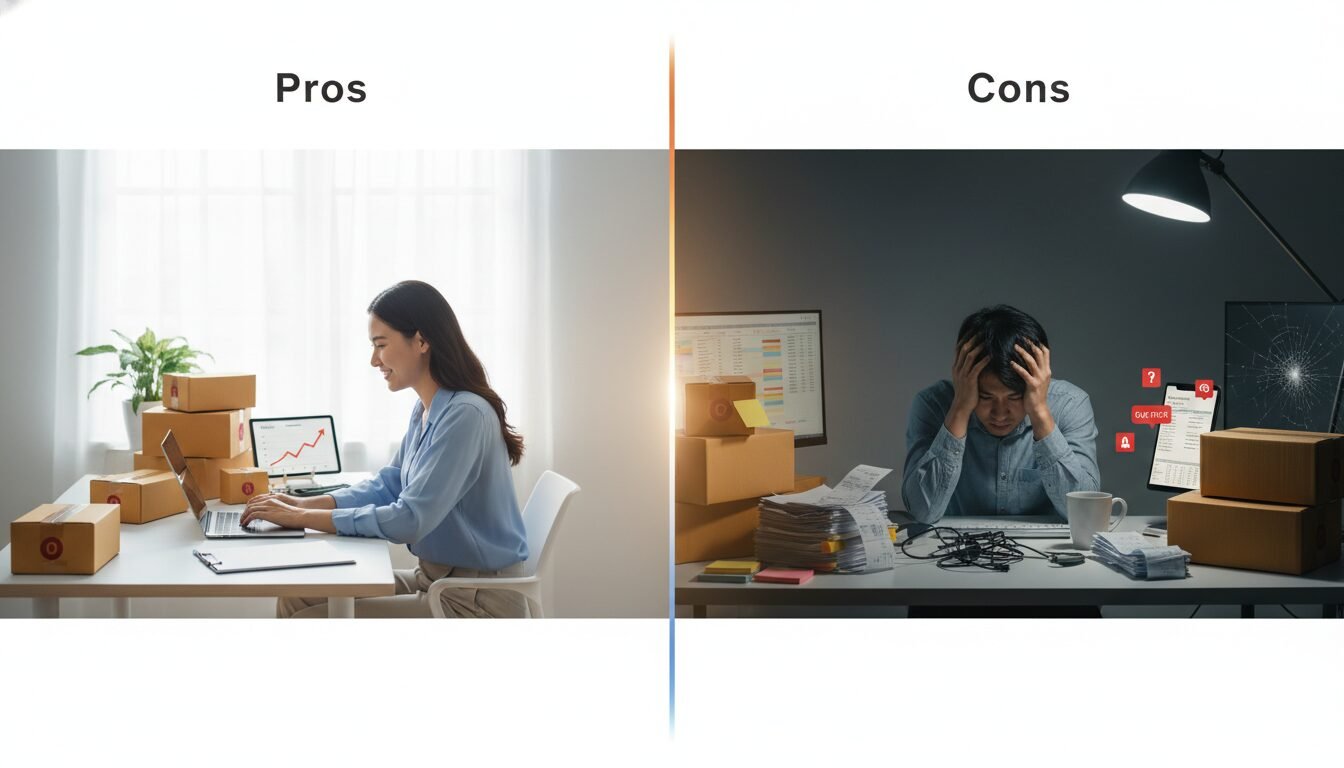
Pros
- Low overhead: No physical storefront means no rent, utilities, or in-store staff costs.
- Global reach: You can sell to customers in dozens of countries from day one.
- Data-driven decisions: Every click, cart add, and purchase is trackable, giving you feedback loops traditional retail can’t match.
- Flexible business models: Dropshipping, digital products, and subscriptions let you start lean and scale selectively.
- 24/7 revenue: Your store works while you sleep. Automated fulfillment and email sequences run without you.
Cons
- Intense competition: Low barriers to entry mean crowded niches and constant price pressure.
- Customer trust takes time: Without a physical presence, building credibility requires consistent branding and social proof.
- Logistics complexity: Shipping, returns, and inventory management get complicated fast as you scale.
- Platform dependency: Relying on Amazon or Shopify means policy changes can disrupt your business overnight.
- Marketing costs: Organic growth is slow. Paid acquisition on Google and Meta can eat margins if you’re not careful.
How to Start an E-Commerce Business in 2026: Step-by-Step

Step 1: Research a Profitable Niche
The foundation of any successful commerce business is a well-chosen niche. Analyze market trends, search volume, and competition before committing. Tools like Google Trends and Jungle Scout help identify products with real demand and manageable competition. Focus on a category you understand and where you can offer something genuinely different. I’ve watched founders skip this step and spend months building stores nobody wanted.
Step 2: Write a Business Plan and Register Your Company
Formalize your idea with a lean business plan. Outline your target audience, value proposition, revenue streams, and marketing channels. Then choose a business structure (LLC, sole proprietorship, or corporation) and register your this type of business with local authorities. Get an EIN for tax purposes. A clear plan isn’t just bureaucracy. It forces you to stress-test assumptions before you spend real money.
Step 3: Build Your Online Storefront
Pick a platform and build your store. Platforms like Shopify, BigCommerce, and WooCommerce offer user-friendly interfaces and customizable templates. Make sure your site is mobile-responsive, fast-loading, and optimized for SEO. Integrate secure payment gateways like PayPal and Stripe. Set up your core pages (About, Contact, Policies) and test the checkout process end-to-end before you go live. A broken checkout on launch day is a painful lesson I’ve seen too many founders learn firsthand.
Step 4: Source or Create Your Products
Your sourcing strategy shapes your margins and your risk profile. Dropshipping keeps upfront costs near zero but compresses margins. Holding your own inventory gives you more control over quality and shipping speed. Digital products have near-zero marginal cost once created. Choose the model that fits your capital position and your tolerance for operational complexity.
Step 5: Launch, Market, and Iterate
Launch with a focused marketing push, not a whisper. Run targeted ads, activate your email list, and reach out to relevant communities. Track your cost per acquisition from week one. Most this kind of businesses that fail do so because founders underestimate how much consistent marketing effort the business needs. Set aside at least 20% of revenue for marketing and treat it as a non-negotiable operating expense.
Comparing the Top Platforms for Your E-Commerce Business
Choosing the right platform is one of the most consequential early decisions you’ll make. Below is a comparison of the most popular options:
| Platform | Starting Price | Best For | Key Feature |
|---|---|---|---|
| Shopify | $29/month | Beginners, DTC brands | All-in-one ease, extensive app store |
| BigCommerce | $29.95/month | Growing businesses, scaling | No transaction fees, built-in B2B |
| WooCommerce | Free (plus hosting) | WordPress users, full control | Open-source, unlimited customization |
| Amazon | Per item or $39.99/month | Massive reach, FBA users | Access to millions of Prime members |
Shopify vs. BigCommerce vs. WooCommerce
Shopify wins on simplicity and its third-party app ecosystem, making it the default choice for first-time e commerce owners. BigCommerce offers stronger built-in SEO tools and charges no additional transaction fees, which matters a lot at high volume. WooCommerce gives you maximum flexibility if you’re already on WordPress, but it demands more technical upkeep. Pick based on where you are today, not where you hope to be in three years.
Selling on Amazon: FBA and Seller Central
Amazon gives you access to a massive built-in audience. Through Fulfillment by Amazon (FBA), you store products in Amazon warehouses and the company handles packing, shipping, and returns. According to Amazon’s seller guide, new sellers can access over $50,000 in credits and incentives. The process is straightforward: sign up and create a selling account, list your products, then choose between FBA or self-fulfillment. The catch is that Amazon fees and competition can compress margins fast if you’re not disciplined about unit economics from the start.
Niche Platforms and Marketplaces
Beyond Amazon, consider niche marketplaces: Etsy for handmade goods, eBay for auctions, or Facebook Marketplace for local sales. These platforms work well as secondary channels to diversify revenue and test new products without a full website investment. I’ve seen founders build six-figure businesses purely on Etsy before ever launching their own storefront.
Profitable E-Commerce Business Ideas for 2026
Dropshipping and Print-on-Demand
Dropshipping is a fulfillment method where you sell products without holding inventory. The supplier ships directly to the customer. It’s low-risk but competitive, and margins are thin. Print-on-demand lets you customize white-label products (t-shirts, mugs, phone cases) with your designs, and the provider handles printing and shipping. Both models require minimal upfront capital, which makes them popular starting points.
Digital Products and Online Courses
Digital goods like ebooks, templates, software, and online courses have near-zero marginal cost. Once created, you sell them indefinitely. The Coursera e-commerce guide highlights that many entrepreneurs start with digital products specifically because they sidestep inventory and shipping complexity. Platforms like Gumroad and Teachable handle delivery. If you have expertise worth packaging, this is one of the highest-margin models available.
Handmade Crafts and Subscription Boxes
If you’re a maker, an commerce business built around handmade items can carve out real differentiation in a crowded market. Subscription boxes, where curated products are delivered monthly, continue to grow. The BigCommerce business ideas guide ranks subscription boxes among its top 20 profitable ventures, specifically because the recurring revenue model builds stable, predictable cash flow.
“Recurring revenue is the closest thing to a cheat code in e-commerce. A subscription box with 500 active subscribers at $40/month is $20,000 in predictable monthly revenue before you acquire a single new customer.” – Based on BigCommerce’s analysis of subscription commerce models
Marketing Your E-Commerce Business for Growth
SEO and Content Marketing
Search engine optimization drives organic traffic without ongoing ad spend. Write high-quality product descriptions, blog posts, and guides that answer real customer questions. Tools like SEMrush and Ahrefs help you find keywords worth targeting. A well-executed content strategy reduces paid ad dependency over time and builds brand authority that compounds. This is a long game, but it’s the one that pays off most reliably at scale.
Social Media and Influencer Partnerships
As of 2026, social commerce on Instagram, TikTok, and Facebook has matured into a primary sales channel, not just a brand awareness play. Partnerships with micro-influencers whose audiences match your target market consistently outperform broad celebrity deals in conversion rate. User-generated content and live shopping events drive engagement and lower your cost per acquisition meaningfully.
Email Marketing and Retargeting
Email remains one of the highest-ROI channels for any this type of business. Build your subscriber list from day one. Use automated sequences to nurture leads, recover abandoned carts, and upsell existing customers. Retargeting ads on Google and Meta keep your brand visible to shoppers who’ve already shown interest. The combination of email plus retargeting is where most of my own highest-converting campaigns have come from.
Managing Operations and Overcoming Challenges
Inventory Management and Fulfillment
Efficient inventory tracking prevents stockouts and overselling, both of which destroy customer trust fast. Integrate your platform with tools like ShipStation to automate order processing. Offer multiple shipping options with transparent delivery timelines. If order volume grows past what you can handle in-house, partnering with a 3PL (third-party logistics provider) is often the right move. The cost is real, but so is the time you get back.
Customer Service as a Competitive Advantage
Great customer service differentiates your this kind of business in ways that are genuinely hard to copy. Provide live chat, clear FAQs, and hassle-free return policies. Respond to inquiries within 24 hours. Amazon built its entire reputation on customer obsession, and that standard has shaped what online shoppers expect everywhere. Meeting that bar isn’t optional anymore.
Legal Requirements and Compliance
Most jurisdictions require a general business license to operate an e commerce legally. Depending on your location and product category, you may need additional permits, sales tax registrations, or import/export compliance documentation. If you sell internationally, trade laws vary significantly by country. Address legal and tax requirements early. The penalties for getting this wrong are far more expensive than the cost of getting it right upfront. Consult a business attorney or accountant before you scale across borders.
Success Rates and Common Pitfalls
Precise failure rate statistics are hard to verify, so I won’t invent a number. What I can tell you from experience: the most common killers are choosing the wrong product, underestimating marketing costs, and neglecting customer retention after the first sale. Validate your niche before you invest heavily. Set aside at least 20% of revenue for marketing. Build a loyalty program early. These aren’t glamorous moves, but they’re the ones that keep businesses alive past year two.
Building a Sustainable E-Commerce Business in 2026
The market is projected to hit $8 trillion by 2027. That’s not a reason to rush in without a plan. It’s a reason to build something real, with strong unit economics, a defensible niche, and a customer experience worth coming back to. The founders I’ve seen succeed aren’t the ones who moved fastest. They’re the ones who stayed focused longest.
If you’re serious about building an commerce business, start with the niche research, get your legal structure right, pick a platform that fits your current stage, and market consistently from day one. The tools have never been better. The audience has never been larger. What’s left is execution.
Connect with Amin to discuss AI strategy and growth tactics for your e-commerce business.
Frequently Asked Questions
What is an e-commerce business?
An e-commerce business is any commercial enterprise that conducts transactions over the internet. It can sell physical goods, digital products, services, or subscriptions without requiring a physical storefront.
How much does it cost to start an e-commerce business?
Startup costs vary widely. A basic dropshipping store can launch for under $500, while a custom-branded site with inventory may require $5,000 or more. Platforms like Shopify start at $29 per month, and Amazon provides new seller incentives worth over $50,000.
What are the most profitable types of e-commerce businesses?
Digital products, subscription boxes, and niche B2B services tend to carry the strongest margins. According to BigCommerce’s analysis of 20 profitable ideas, print-on-demand and handmade goods also perform well due to low overhead and strong differentiation potential.
Do I need a business license for an e-commerce business?
Yes, in most jurisdictions. You typically need a general business license, and depending on your location and product category, may require additional permits. Registering your business legitimizes operations and protects your personal assets from liability.
How long does it take to become profitable?
Profitability timelines depend on niche, marketing investment, and competition. Some businesses break even within 3 to 6 months. Many take over a year. Consistent effort in branding and customer acquisition is the variable that matters most.
Is Amazon FBA worth it for a new e-commerce business?
Amazon FBA can be highly beneficial for new businesses looking to use Amazon’s customer base and logistics network. Fees and competition can compress margins if you’re not disciplined about unit economics from the start. Most experienced sellers treat it as one channel among several, not the entire strategy.