Content Strategy: Build a Plan That Actually Works

Key Takeaways
- Content strategy is a documented plan for creating, delivering, and governing content that serves both user needs and business goals.
- Without a defined strategy, organizations waste resources on fragmented content that drives no measurable outcomes.
- A solid content strategy integrates audience research, measurable KPIs, and ongoing governance across the full content lifecycle.
- Free frameworks from Adobe, HubSpot Academy, and industry experts give you a real starting point without a big budget.
- Regular audits every 6 to 12 months keep your content strategy aligned with shifting market demands and audience behavior.
- In 2026, AI tools and modular content design are reshaping how teams execute and scale their strategies.
Defining Content Strategy: The Core Framework
Content strategy is the high-level plan for creating, delivering, and governing useful content that aligns with both user needs and business objectives. It turns scattered content efforts into a purposeful, measurable system.
The average internet user now spends 6 hours and 40 minutes online daily, according to Harvard Business School Online. For brands, that means every piece of content must compete for attention while driving measurable outcomes. A content strategy ensures those efforts aren’t wasted.
What Content Strategy Is Not
People constantly confuse content strategy with content tactics: writing blog posts, designing infographics, scheduling social updates. As the Nielsen Norman Group (NN/g) research team clarifies, strategy comes before tactics. It defines purpose, voice, structure, and distribution channels before a single piece of content gets created.
“Content strategy is the ongoing practice of planning for the creation, delivery, and governance of useful, usable, and effective content.” — Kristina Halvorson, author of Content Strategy for the Web (2009)
The Four Pillars of Content
MarketMuse’s widely referenced framework breaks content down into four core elements: information (the message), context (why it matters to the audience), medium (the channel), and format (text, video, infographic, etc.). A content strategy addresses each of these to prevent disjointed customer experiences.
Why Content Strategy Matters for Business Growth

Without a content strategy, brands publish content that connects to nothing. NN/g warns that organizations “waste money and resources creating and maintaining content that’s pointless for users and profitless for organizations.” A documented plan flips that dynamic and focuses resources on what actually drives growth.
Builds Brand Authority and Trust
High-quality, strategically planned content signals expertise. Per Coursera’s content strategy overview, well-executed content helps “establish your business as an authority, builds trust with your audience, and attracts and retains customers.” The Adobe Marketing Specialist certificate on Coursera, which covers content strategy in depth, holds a 4.7-star rating from over 3,000 learners and has attracted more than 24,000 enrollments. That demand is a signal worth paying attention to.
Creates a Consistent Customer Journey
When content is planned across touchpoints — social media, blog, email, product pages — the brand voice stays coherent. A content strategy maps these interactions so a prospect receives a consistent narrative from first click to purchase. Without that map, you’re just publishing into a void.
Improves SEO and Discoverability
Search engines reward clusters of relevant, well-structured content. Harvard Business School Professor Sunil Gupta puts it plainly: “Content is key when it comes to SEO and owned media more generally. This is why developing a content strategy is critical for making effective use of these techniques.”
“Content is key when it comes to SEO and owned media more generally. This is why developing a content strategy is critical for making effective use of these techniques.” — Sunil Gupta, Professor, Harvard Business School
Pros and Cons of Building a Formal Content Strategy
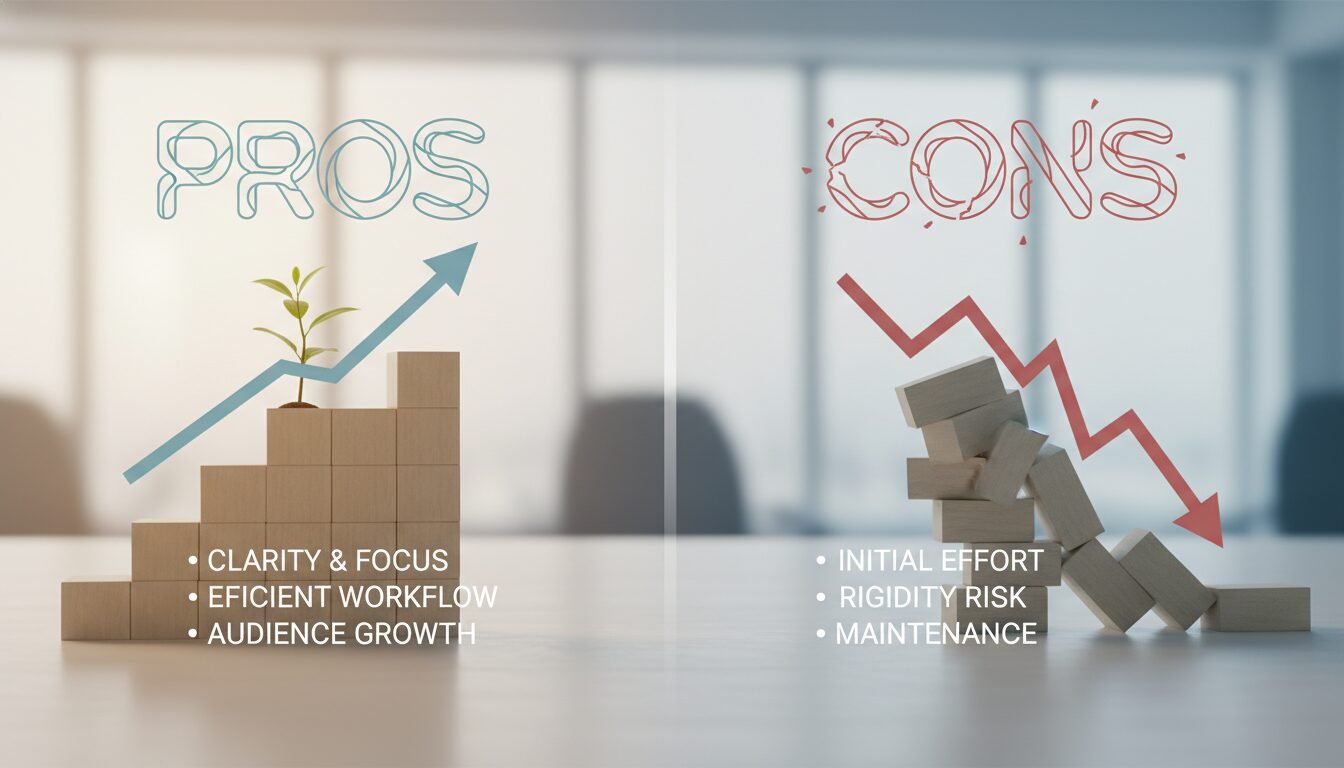
A formal content strategy delivers real advantages, but it also demands real commitment. Here’s an honest look at both sides before you invest the time.
Pros
- Focused resource allocation: Every content dollar and hour maps to a specific business goal instead of guesswork.
- Consistent brand voice: Documented guidelines keep messaging coherent across every channel and every team member.
- Measurable ROI: Defined KPIs make it possible to prove what’s working and cut what isn’t.
- Improved SEO performance: Topic clusters and structured content planning directly support search visibility.
- Scalability: A documented strategy lets you onboard new writers, designers, or agencies without losing quality.
Cons
- Upfront time investment: Building a real strategy takes weeks of research, auditing, and planning before you publish a single piece.
- Requires ongoing maintenance: A strategy that isn’t reviewed quarterly becomes outdated fast and can actively mislead your team.
- Cross-functional buy-in is hard: Getting marketing, product, and leadership aligned on content goals is often the hardest part of the whole process.
- Can slow early execution: Teams eager to ship content sometimes find the planning phase frustrating before momentum builds.
Key Components of a Successful Content Strategy
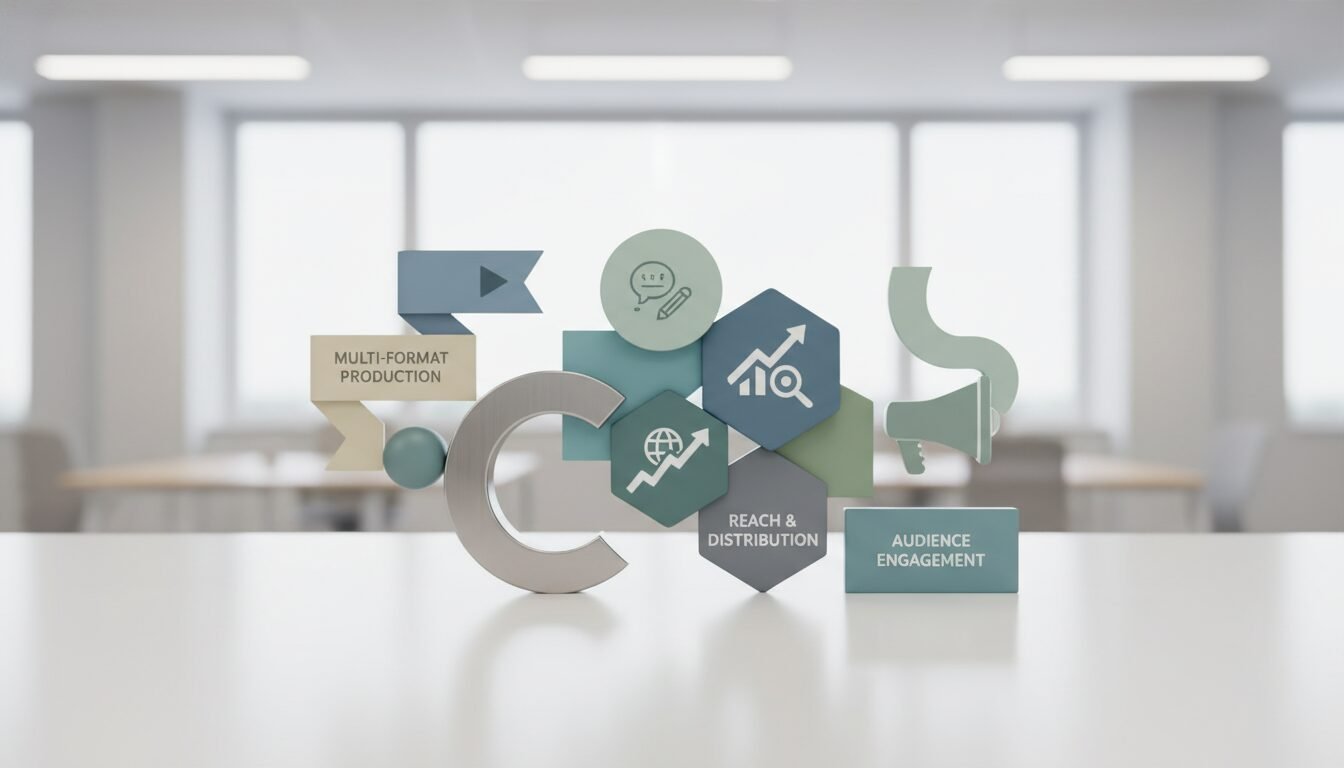
A robust content strategy has several interdependent parts. Drawing from HBS, NN/g, and MarketMuse frameworks, these are the foundational building blocks every plan needs.
Clear Business Goals and KPIs
Before creating a single post, define what success looks like. Typical goals include brand awareness, lead generation, customer retention, or market expansion — each tied to specific metrics like organic traffic growth, conversion rates, or engagement time. HBS advises benchmarking current performance first, then tracking KPIs consistently over time.
Audience Research and Personas
Understanding demographics, behaviors, and motivations is non-negotiable. A content strategy should differentiate between audience segments and tailor content for each one. Adobe’s free template opens with a “Who is your content targeting?” section that forces you to document exact personas, including preferred channels and consumption habits.
B2B vs. B2C Content Strategy Differences
B2B and B2C content strategies share the same structural bones but diverge sharply in execution. B2B content typically targets longer buying cycles, multiple decision-makers, and content formats like white papers, case studies, and technical guides. B2C content leans toward emotional resonance, shorter formats, and channels like Instagram or TikTok where purchase decisions happen faster. Knowing which mode you’re operating in shapes every downstream choice: tone, format, channel, and cadence.
Content Lifecycle Governance
NN/g’s four-phase model — planning, creation, maintenance, unpublishing — ensures content stays relevant over time. Each piece moves through these cycles: planned, created, regularly reviewed, and eventually retired. This ongoing governance prevents outdated or off-brand material from quietly eroding your credibility.
Comparing Popular Content Strategy Frameworks
| Framework | Focus | Number of Steps/Phases | Target Audience | Key Highlight |
|---|---|---|---|---|
| HBS 7 Steps | General business strategy | 7 | Business leaders, marketers | Covers goals to retention, includes KPI benchmarking |
| NN/g Phases | UX-centered lifecycle | 4 | UX designers, content pros | Ongoing governance with unpublishing phase |
| Adobe 9 Steps | Small business marketing | 9 | Small business owners | Includes brand book, promotion, and campaign strategy |
| Grace Leung 5 Steps | Beginner-friendly quickstart | 5 | Startups, freelancers | Simplifies process for any brand type |
Whether you need a detailed, academically grounded approach (HBS, NN/g) or a rapid execution plan (Adobe, Grace Leung), there’s a framework that fits your situation. The common thread: every single framework starts with defining goals and audience, then builds outward from there.
Step-by-Step Process to Build Your Content Strategy
The following steps synthesize the essentials from multiple authoritative sources. A structured process reduces the chance of producing random content and increases alignment with business objectives.
Step 1: Align Content with Business Objectives
List your top 2 to 3 business goals. Then define the role content will play in each. An awareness goal might require an educational blog series and shareable infographics. A lead generation goal might call for gated white papers and email nurture sequences. Be specific — vague goals produce vague content.
Step 2: Profile Your Target Audience
Use surveys, website analytics, and social listening to build detailed personas. Document their pain points, preferred channels, and consumption habits. Adobe’s template dedicates an entire section to this, asking you to specify demographics, imagery preferences, and brand-voice notes. The more specific the persona, the more useful the content you’ll create for them.
Step 3: Perform a Content Audit
Inventory all existing content. Evaluate performance, relevance, and alignment with your new strategy. NN/g’s maintenance phase emphasizes that reviewing content regularly prevents the slow accumulation of outdated or inaccurate material that quietly hurts your authority.
Step 4: Brainstorm Topics and Conduct Keyword Research
HBS’s seventh step recommends generating topics that match user intent and business expertise. Use tools like Google Keyword Planner, Ahrefs, or MarketMuse to identify terms your audience actually searches for. Cluster related topics to build topical authority rather than chasing isolated keywords.
Step 5: Choose Formats and Channels
Decide whether each piece will be a blog post, video, infographic, or podcast. MarketMuse’s “medium” and “format” dimensions come into play here. Match the channel — LinkedIn, YouTube, email — to where your personas actually spend time. A B2B audience on LinkedIn needs different content than a consumer audience on Instagram.
Step 6: Create a Content Calendar and Workflow
Assign owners, due dates, and review stages. Adobe’s template includes a dedicated calendar section. HubSpot Academy’s free course uses 6 lessons, 15 videos, and 4 quizzes across 2 hours and 49 minutes to teach production workflows that prevent bottlenecks and keep publishing consistent.
Step 7: Measure, Learn, and Iterate
Track the KPIs you set in Step 1. Whether it’s organic traffic, lead conversions, or time on page, use the data to refine topics, CTAs, and distribution. Grace Leung’s framework ends with a measurement loop that continuously feeds back into planning. That loop is what separates a living strategy from a document that collects dust.
Social Media Content Strategy: What’s Different
Social media content strategy follows the same principles as broader content planning but demands faster iteration and platform-specific thinking. Each platform has its own algorithm, content format, and audience behavior. What works on LinkedIn rarely translates directly to Instagram or TikTok.
A few principles I’ve found essential when building social-specific strategies:
- Platform-native formats win: Short-form video dominates TikTok and Instagram Reels. Long-form thought leadership performs on LinkedIn. Forcing the same format everywhere dilutes both.
- Posting cadence matters more than volume: Consistent publishing at a sustainable pace outperforms burst-and-burnout cycles. Most teams find 3 to 5 posts per week per platform is the practical ceiling before quality drops.
- Engagement is a metric, not a vanity stat: Comments and shares signal algorithmic relevance. Track them alongside reach and impressions, not instead of them.
- Social content should connect back to owned channels: Drive traffic to your blog, email list, or product pages. Social reach you don’t own can disappear overnight with an algorithm change.
Free Tools and Resources to Jumpstart Your Strategy
You don’t need a big budget to start building a real content strategy. Several platforms offer free templates and training that accelerate the process significantly.
Adobe Express Content Strategy Template
Adobe offers a free PDF template that walks you through 9 clearly defined sections, from goal setting to calendar building. It’s part of the Adobe Express toolkit and can be edited directly in the browser. Good starting point for any team that’s never documented a strategy before.
HubSpot Academy’s Content Strategy Course
HubSpot’s free course packs 6 lessons, 15 videos, and 4 quizzes into 2 hours and 49 minutes of practical learning. Instructors like Crystal King and Meghan Keaney Anderson (VP Marketing at Jasper) deliver real know-how on aligning content with brand messaging. It’s one of the most efficient free resources available for this topic.
Coursera’s Adobe Marketing Specialist Certificate
For a more in-depth credential, this program spans approximately 4 months and covers content strategy within a broader digital marketing context. Over 24,000 learners have enrolled, and it holds a 4.7 rating from more than 3,000 reviews. Worth the time if you’re building this as a core professional skill.
Grace Leung’s YouTube Framework
Grace Leung’s 5-step video, from a channel with 138K subscribers, distills content strategy creation into simple actions: define goals, know your audience, plan topics, choose formats, and schedule. It works for any brand size and takes under 20 minutes to watch.
Common Content Strategy Mistakes to Avoid
Even with a solid framework, predictable pitfalls can derail your content strategy. I’ve made most of these myself. Recognizing them early saves real time and budget.
Treating Strategy as a One-Time Task
NN/g’s four-phase model explicitly shows that content strategy is continuous. Plans must evolve as markets shift, new channels emerge, and audience behaviors change. Set a recurring quarterly review cycle and put it on the calendar now, not later.
Ignoring the Unpublishing Phase
Most organizations neglect to remove outdated content. This dilutes information architecture and hurts SEO. The unpublishing phase in NN/g’s lifecycle is as important as creation. Retire or redirect legacy pages to maintain authority rather than letting them drag down your site’s overall quality signals.
Overloading on Tactics Without a Cohesive Plan
Businesses jump straight to producing TikTok videos or SEO blogs without a connecting strategy. Content becomes disjointed and unmeasurable. As NN/g notes, content cleanup after the fact takes more time than strategic planning upfront. Slow down, map the big picture, then execute fast.
Not Defining Roles and Workflow
Without clear ownership — who drafts, who approves, who publishes — deadlines slip and quality becomes inconsistent. HubSpot’s course emphasizes assigning content owners and using editorial calendars to maintain steady, predictable output.
Measuring and Optimizing Content Strategy Performance
Ongoing measurement is the feedback loop that turns a good content strategy into a great one. Without it, you’re flying blind and optimizing based on gut feel rather than data.
KPIs That Matter
Choose metrics tied directly to your goals. For awareness, track impressions, reach, and social shares. For conversions, monitor click-through rates and form submissions. For retention, measure repeat visits and content engagement depth. Keep these visible in a shared dashboard so the whole team stays aligned on what’s working.
The Role of Content Audits in Optimization
Conduct a full content audit every 6 to 12 months. Evaluate each asset’s performance, update or consolidate underperformers, and identify gaps. NN/g’s maintenance phase includes conscious measurement — this is where your strategy proves its worth or reveals where it’s falling short.
Technical SEO Integration
Content strategy and technical SEO aren’t separate disciplines. They depend on each other. A well-planned content strategy should account for site architecture, internal linking, page speed, and structured data from the start. Specifically: cluster your content around pillar pages and link supporting articles back to them. Use schema markup on how-to guides and FAQ sections to improve your chances of appearing in rich results. Tools like Ahrefs and Google Search Console give you the data to identify which content clusters are gaining authority and which need reinforcement. Most content teams treat SEO as an afterthought. The ones that build it into the strategy from day one consistently outperform those that bolt it on later.
AI-Driven Insights
Tools like MarketMuse use AI to analyze content gaps and suggest topic clusters. Jasper, where HubSpot course instructor Meghan Keaney Anderson serves as VP Marketing, helps teams scale quality output while preserving brand voice. These tools layer data on top of your strategy to sharpen decisions — but they work best when the underlying strategy is already solid. AI amplifies good strategy. It doesn’t replace the absence of one.
Future-Proofing Your Content Strategy in 2026
As platforms evolve and generative AI becomes mainstream, a resilient content strategy adapts while staying anchored to brand purpose. Several principles will keep your approach relevant through the next wave of change.
Embrace Multidisciplinary Approaches
Wikipedia recognizes content strategy as a field that draws from “information architecture, content management, business analysis, digital marketing, and technical communication.” As of 2026, cross-functional teams combining marketing, UX, and data analytics are building the most durable strategies. Siloed content teams are losing ground to integrated ones.
Integrate AI Ethically and Effectively
AI can draft outlines, repurpose content, and personalize recommendations, but human oversight remains essential. HubSpot Academy’s AI for Marketing course, often taken alongside its content strategy course, teaches prompting and output evaluation to keep AI-generated material on-brand. The risk isn’t that AI produces bad content. The risk is that it produces generic content at scale, which is worse than publishing less.
Focus on Content Reusability and Structuring
Design content in modular formats that can be reused across channels. A single white-paper summary becomes a blog post, a video script, and an infographic. This approach, rooted in NN/g’s back-end strategy thinking, maximizes ROI and reduces production overhead. Teams that build for reuse from the start typically produce 2 to 3 times more distribution from the same core research investment.
Frequently Asked Questions
What is a content strategy?
A content strategy is a documented plan that outlines how content will be created, managed, and distributed to meet business objectives and audience needs. It ensures every piece of content serves a defined purpose rather than existing for its own sake.
Why do I need a content strategy?
Without one, content efforts become scattered, wasting time and money on materials that don’t support business goals. A strategy aligns all content with measurable outcomes and prevents the resource drain that comes from publishing without direction.
How often should I update my content strategy?
Review and update your content strategy at least quarterly, or whenever major business goals, audience research, or market conditions shift significantly. NN/g’s lifecycle model treats strategy as continuous, not a one-time document.
Can a small business use a content strategy?
Yes. A simple one-page content strategy template, like Adobe’s free PDF, can guide consistent, effective content marketing for businesses of any size. The framework scales down without losing its core value.
What’s the difference between content strategy and content marketing?
Content strategy is the overarching plan and governance structure, while content marketing is the execution: creating and promoting content to attract and retain customers. Strategy without execution is just a document. Execution without strategy is just noise.
What tools help build a content strategy?
Adobe Express offers a free template, HubSpot Academy provides a free course with 6 lessons and 15 videos, MarketMuse aids in topic planning and gap analysis, and Google Analytics helps measure performance against your defined KPIs.
Enjoyed this article?
Connect with me for collaboration, ventures, or just a good conversation about building things.
Get in Touch