What a Brand Consultant Actually Does (And When to Hire One)

A brand consultant is a strategic advisor who helps organizations define their identity, differentiate in the market, and turn that clarity into measurable growth. The role spans research, strategy, and creative execution – far beyond logo design.
Key Takeaways
- A consultant is a strategic advisor who helps organizations clarify their identity, differentiate in the market, and translate vision into measurable growth.
- Brand consulting bridges research, strategy, and creative execution, going far beyond logo design to drive enterprise performance.
- Companies typically engage a this type of consultant during inflection points such as stalled growth, mergers, market shifts, or leadership realignment.
- Data-driven work from a this kind of consultant has generated concrete results: one client saw a 40% increase in new member acquisition, another tripled in size after repositioning.
- Choosing the right brand requires vetting their ability to integrate strategy with implementation and their experience in your specific market dynamics.
- As of 2026, AI is reshaping how consultants gather insight and test positioning, compressing timelines without replacing strategic judgment.
What Is a Brand Consultant?
A this type of consultant is an advisor who helps organizations define who they are, why they matter to customers, and how they outmaneuver competitors – then turns that clarity into actionable, growth-driving initiatives. Drawing on deep market analysis and leadership acumen, a this kind of consultant aligns internal teams around a shared vision and builds systems that sustain momentum long after the engagement ends.
“After scaling three companies, I’ve learned that the right brand doesn’t just deliver a strategy document; they become an accountability partner who ensures alignment sticks across every function.” – Amin Ferdowsi
The Core Functions of a Brand Consultant
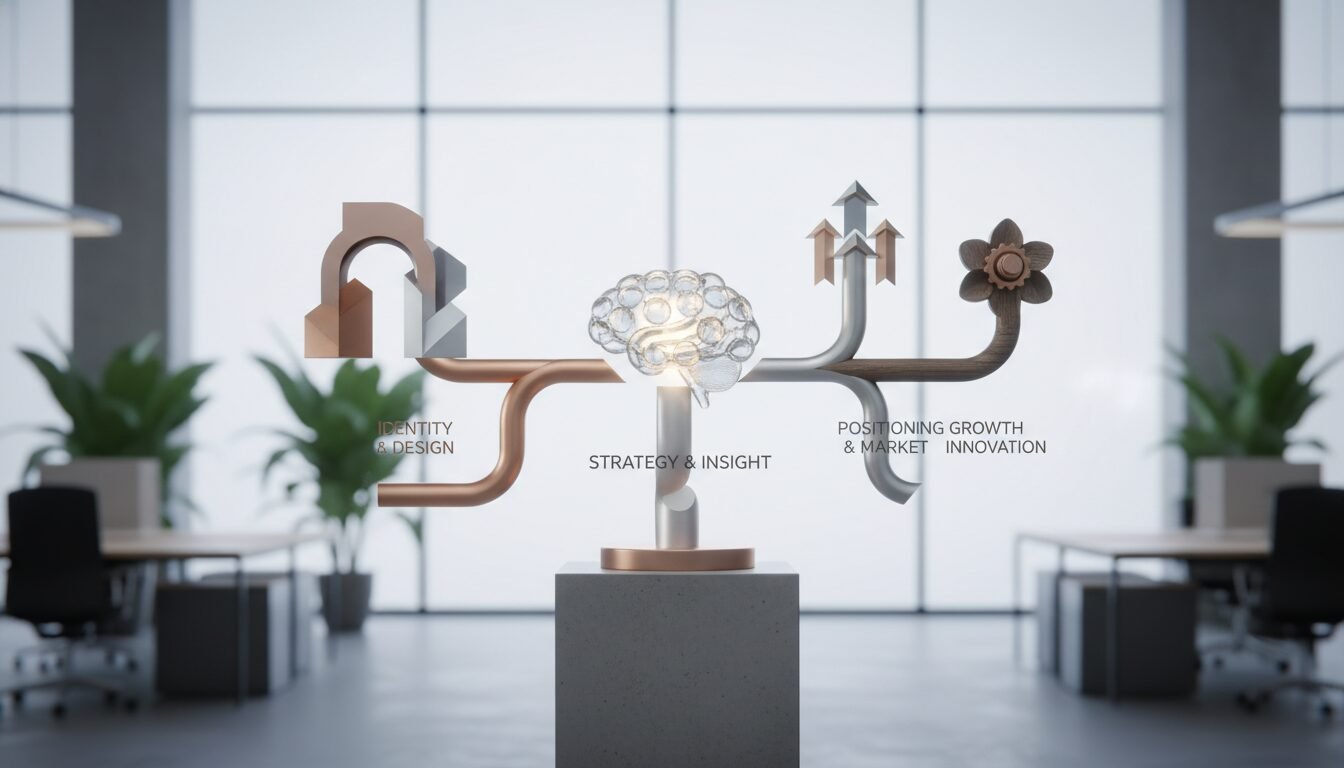
After founding and scaling three technology companies, I’ve learned that branding is never a one-time project. It is a dynamic system of interconnected decisions. The best consultant engagements operate across three pillars: research and insight, strategy development, and activation. Each pillar demands rigor, not opinion.
Research and Insight
Solid branding builds on evidence, not instinct. A this type of consultant starts by mining data – voice-of-customer interviews, competitive audits, cultural trend analysis – to surface unexpressed needs and hidden threats. According to Finch Brands, “decisions based on intuition alone are increasingly risky.” By quantifying perception gaps and market whitespace, the consultant reduces the risk of costly misalignment. In my own ventures, skipping rigorous insight was the single biggest reason early growth stalled.
Strategy Development
Insight alone is just information. A this kind of consultant translates findings into a cohesive strategy that answers five questions: Where do you compete? What makes you uniquely valuable? What do you say yes to – and no to? How do your sub-brands fit together? What immediate growth levers can you pull? The output is not a thick deck but a razor-sharp framework that guides everything from product roadmaps to CEO messaging. At The Brand Consultancy, this process helped a credit union reposition and capture a 40% increase in new member acquisition. That’s strategy turning into traction.
Creative Activation and Experience Design
Strategy without activation is a hallucination. A brand ensures that positioning manifests across every touchpoint – visual identity, digital presence, customer service scripts, packaging, and environmental design. They don’t stop at guidelines; they create living systems that internal teams can run with. According to Material Plus, brand consulting “helps organizations bridge the gap between how they want to position themselves and how they’re actually showing up to consumers.” When I led a B2B software firm through a pivot, the consultant’s activation playbook ensured that every sales conversation, demo, and support email echoed the same sharp promise. It closed deals faster.
Brand Consultant vs. Brand Strategist: Understanding the Difference
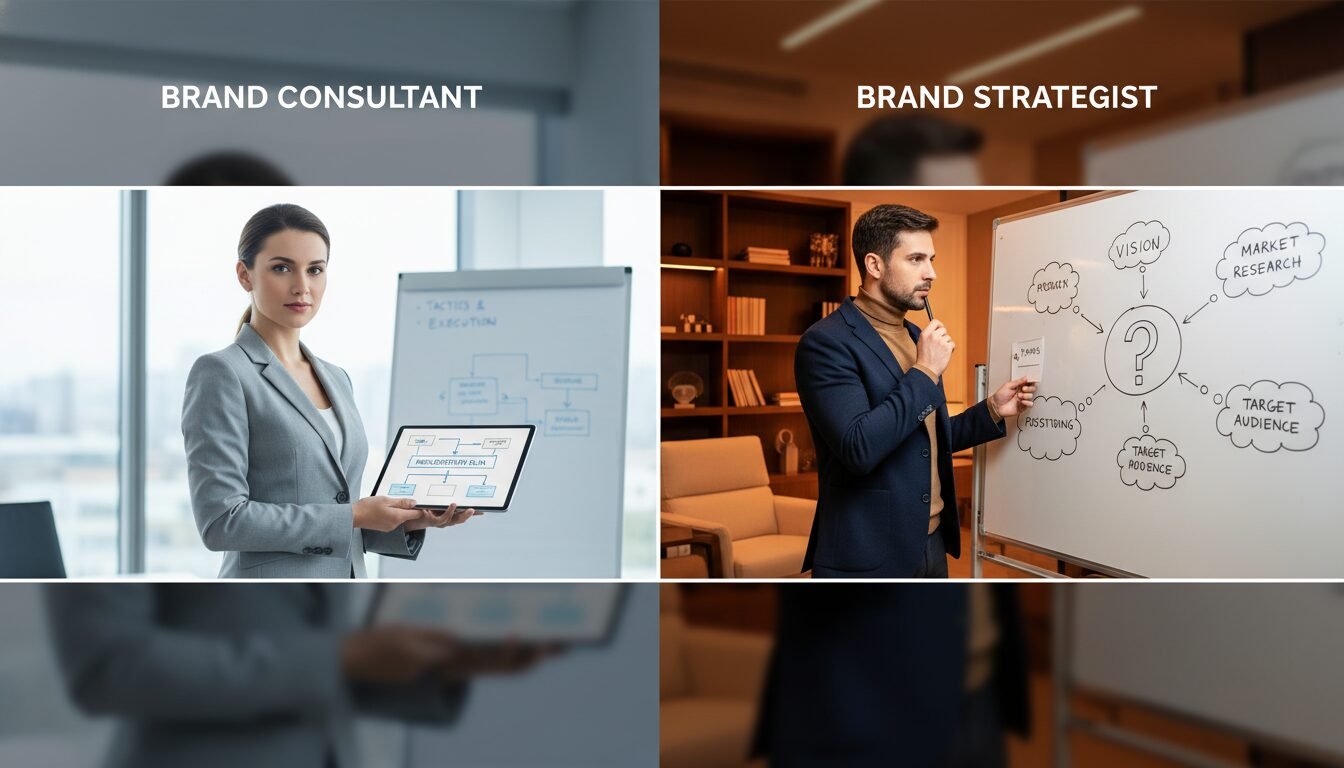
The terms get used interchangeably, but the distinction matters when you’re writing a check. A consultant typically carries a broader mandate – diagnosing organizational challenges, facilitating executive alignment, and supporting execution. A brand strategist may focus more narrowly on positioning frameworks and long-term roadmaps. Below is a comparison of common branding support roles.
| Role | Primary Focus | Typical Engagement | Key Outcome |
|---|---|---|---|
| this type of consultant | Full brand diagnosis, strategy, and activation | Project-based or retainer, 3–12 months | Alignment, differentiation, and measurable growth |
| Brand Strategist | Positioning frameworks and long-term roadmaps | Often embedded or retained for ongoing guidance | Clear positioning and future-state vision |
| In-House Brand Manager | Day-to-day brand governance and campaign execution | Full-time employee | Consistency and operational efficiency |
| Traditional Marketing Agency | Campaign-centric deliverables (ads, content, design) | Project or retainer | Creative output without deep strategic integration |
The real question isn’t the title. It’s whether the partner can see your whole system, ground decisions in data, challenge groupthink, and move from theory to implementation. I’ve hired both types, and the ones who changed my trajectory were always the ones who acted like an extension of my leadership team, not a service provider.
Brand Consulting Firms vs. Independent Consultants

Independent this kind of consultants and established firms each serve different needs. Knowing which to hire can save you months of misaligned effort and tens of thousands of dollars.
Independent consultants typically charge $150–$300 per hour and offer direct access to senior-level thinking without agency overhead. They work well for focused engagements: a positioning sprint, a messaging overhaul, or a pre-launch brand audit. The tradeoff is bandwidth – one person can only move so fast.
Established brand consulting firms like The Brand Consultancy, Finch Brands, or the brand practices inside firms like Bain and Company bring multi-disciplinary teams, proprietary research tools, and deep category databases. Project fees at this level typically run $25,000 to $150,000+ depending on scope. The upside is speed and depth. The risk is that junior staff end up doing the work while senior partners take the credit.
My rule: for a $5M business, an independent consultant is usually the smarter bet. For a $50M+ company navigating a major rebrand or acquisition, a firm’s infrastructure pays for itself.
When Do You Need a Brand Consultant? 5 Critical Scenarios
Most CEOs don’t wake up thinking, “I need a brand.” They wake up to flat revenue curves, confused messaging, or a team pulling in different directions. Here are the moments when bringing in outside brand expertise is not a luxury but a survival lever.
Growth Has Stalled
When the market shifts faster than your story, prospects stop listening. A consultant diagnoses whether the problem is your offering, your category position, or your communication. In my first SaaS company, we hit a growth plateau at $8M ARR. The consultant’s research revealed we were fighting on features, not on the transformational outcome we enabled. Repositioning unlocked the next phase of growth.
You’ve Made an Acquisition
M&A creates a tangle of overlapping brands, cultures, and promises. Without a clear brand architecture, customer confusion and internal friction skyrocket. A this type of consultant helps decide what to keep, what to sunset, and how to unify the go-to-market narrative. The Brand Consultancy’s work with Aramark enabled expansion into three new verticals by aligning acquired entities under a cohesive master brand strategy.
Leadership Isn’t Aligned
When the executive team can’t articulate a single, crisp mission, every function runs on its own script. A this kind of consultant facilitates the tough conversations that forge alignment. I’ve sat in those sessions: it’s uncomfortable, but the clarity that emerges is the foundation for all downstream decisions.
You’re Entering a New Market or Category
Crossing borders or adjacencies means your existing brand equity may not translate. Consultants conduct cultural research, competitive landscaping, and stakeholder interviews to reduce expansion risk. Trane Technologies leveraged brand consulting to launch a new tech solutions brand under its global master brand, opening entirely new revenue streams.
Your Brand Experience Is Inconsistent
When your website whispers luxury but your call center shouts discount, customers feel cognitive dissonance. A brand audits all touchpoints and builds a unified experience architecture. This often yields immediate lifts in NPS and conversion rates because people trust what they can predict.
Pros and Cons of Hiring a Brand Consultant
Like any high-stakes engagement, hiring a consultant has distinct advantages and real drawbacks. I’ve weighed these decisions multiple times; clarity on both sides prevents mismatched expectations.
Pros
- Brings an objective, outside-in perspective that challenges internal bias
- Provides specialized research methodologies not available in-house
- Accelerates strategic clarity, often compressing what would take 18 months internally into 12–16 weeks
- Delivers an integrated system – strategy, creative, and training – not just a document
- Generates measurable business outcomes: client results include a 40% lift in member acquisition and companies tripling in size post-repositioning
Cons
- Top-tier consultants charge $15,000–$50,000+ per engagement, which is a real barrier for early-stage companies
- Requires significant leadership time for knowledge transfer and alignment workshops
- Outcomes depend heavily on internal buy-in; a brilliant strategy ignored is wasted capital
- Some consultants overpromise and under-deliver on execution support – always check references
The Brand Consulting Process: How the Best Work Gets Done
Having been on both sides – as a client and as a strategist – I’ve seen what separates transformative engagements from expensive slide decks. A rigorous this type of consultant follows a disciplined, yet flexible process.
Step 1: Immersion and Audit
The consultant dives into your world: reviews existing research, interviews 15–30 internal and external stakeholders, mystery-shops your customer experience, and benchmarks competitors. The goal is to map reality, not the C-suite’s wishful version of it.
Step 2: Synthesis and Insight Generation
Data is synthesized into a handful of strategic insights. These are the “aha” moments that reframe the challenge. A this kind of consultant presents these to leadership not as a report, but as a decision catalyst. I remember one engagement where the insight was that our brand wasn’t about the product’s tech specs; it was about giving control back to operational managers. That unlocked a completely new messaging architecture.
Step 3: Strategy Co-Creation
Strategy shouldn’t be handed down; it should be built with the people who will execute it. Through working sessions and scenario planning, the consultant guides the team toward a sharp positioning, purpose statement, and brand architecture. The deliverable is a crisp one-page brand framework that everyone in the company can internalize.
Step 4: Creative Translation and System Design
Now the strategy gets a visual and experiential shape. A brand consultant works with designers and writers to produce identity systems, but more importantly, defines the principles that will govern all future brand decisions. This system prevents the slow drift into inconsistency that plagues most growing companies.
Step 5: Activation Roadmap and Launch
The best strategy fails without a launch plan. The consultant builds a 90-day activation calendar, trains internal ambassadors, and often embeds with the team during the first high-stakes moments – a product launch, a rebrand announcement, a new website rollout. This phase is where the consultant model shines: they don’t just leave a blueprint; they help you build the house.
How to Become a Brand Consultant
This question shows up constantly in related searches, and for good reason. The path into brand consulting is less linear than, say, accounting – but there are clear patterns among the practitioners who build lasting careers.
Most working brand consultants come from one of three backgrounds: brand management inside a major consumer company (Procter and Gamble, Unilever), strategy consulting (McKinsey, Bain), or agency-side creative and planning roles. What they share is a combination of analytical rigor and communication skill that’s hard to fake.
Formal education helps but isn’t required. An MBA with a marketing concentration or a degree in communications, psychology, or business gives you vocabulary and frameworks. More important is a portfolio of real work – repositioning projects, brand audits, messaging overhauls – that demonstrates you can connect strategy to outcomes.
On certifications: the American Marketing Association offers a Professional Certified Marketer credential, and several brand-focused programs exist through institutions like the Brand Master Academy. These signal commitment and provide structured frameworks, but clients ultimately hire based on demonstrated results, not credentials alone. Expect to spend 2–5 years building credibility before commanding premium project fees.
Brand Consultant Salary and Earning Potential
If you’re considering this as a career path, the economics matter. According to data aggregated from platforms like LinkedIn and Glassdoor, in-house brand consultants and brand strategists at mid-size companies typically earn $80,000–$130,000 per year in the United States. Senior roles at larger organizations or consulting firms can reach $150,000–$200,000+.
Independent consultants have a wider range. Early-stage independents often bill $100–$150 per hour while building their client base. Established practitioners with a strong track record charge $200–$400 per hour or structure project-based fees in the $25,000–$100,000 range. The ceiling is high – a handful of top-tier brand consultants command retainers that exceed $500,000 annually – but that level requires years of proven impact and a strong referral network.
AI and the Future of Brand Consulting
Brand consulting is not immune to the AI wave reshaping every industry. In fact, I’ve directly integrated AI into my consulting stack. The brand consultant of 2026 is data-augmented: using AI to analyze thousands of customer reviews in hours, simulate positioning scenarios, and generate creative territories for rapid testing. But make no mistake – AI amplifies; it doesn’t replace the judgment that comes from years of entrepreneurial scar tissue.
How AI Enhances Insight Velocity
Traditional qualitative research might take 6–8 weeks. Today, a brand consultant can pair AI-powered conversational analysis with expert interviews to compress the insight phase while expanding sample sizes. At my firm, we’ve used large language models to surface emotional connotations buried in customer language that a focus group might miss. This has led to positioning pivots that directly boosted retention by double digits.
Where Human Intuition Still Wins
AI can’t sit in a room with a CEO and see the fear behind the optimism. It can’t read the unspoken power dynamics that block alignment. The brand consultant who wins in the AI era will be the one who uses machine intelligence to clear the underbrush so human wisdom can focus on what’s hardest: making courageous strategic choices.
“Brand consulting is the applied art of turning complex human and market signals into a coherent, compelling go-to-market identity. AI makes the signal-gathering faster; the art is still entirely human.” – Amin Ferdowsi
How to Select the Right Brand Consultant
Not all consultants are created equal. After hiring and firing a few, here’s my vetting playbook.
Look for a Systems Mindset, Not Just a Creative Portfolio
Many “brand consultants” are really designers with a strategy veneer. Ask to see case studies where the work tied directly to a business metric – revenue, share of wallet, employee engagement. A real brand consultant will talk about P&L impact, not just aesthetic choices.
Demand Proof of Insight Rigor
Ask: What research methods will you use? How large a sample? How will you validate findings with the market? If they can’t describe a disciplined methodology, you’re buying opinions dressed up as data. According to Finch Brands, the best consultants ground their recommendations in “deep understanding of customers, category dynamics, and cultural shifts.”
Evaluate Their Facilitation Skills
Brand strategy often lives or dies in the boardroom. The consultant must be able to manage strong personalities, surface hidden objections, and build consensus without forcing it. Press them for stories where leadership was divided and how they navigated it. Their answer tells you everything about your own project’s odds of success.
Check Their Execution DNA
Will they hand you a PDF and vanish, or will they walk alongside your team during rollout? The best brand consultant has a bias toward implementation. They offer coaching, checkpoint calls, and often a diagnostic revisit at the 6-month mark to ensure the strategy has taken root.
Frequently Asked Questions
What does a brand consultant do day-to-day?
A brand consultant’s day typically involves analyzing data, conducting stakeholder interviews, facilitating strategy workshops, and collaborating with creative teams to translate positioning into tangible assets. They move between high-level thinking and hands-on problem-solving, often shifting from a boardroom presentation to a customer journey mapping session within the same afternoon.
How much does a brand consultant cost?
Fees vary widely: independent consultants may charge $150–$300 per hour, while established firms command project fees from $25,000 to $150,000+ for a comprehensive engagement. The investment should be proportional to the revenue at stake; a rebrand that impacts a $100M enterprise warrants a much higher budget than a local startup refresh.
What is the difference between a brand consultant and a branding agency?
A brand consultant often works as an individual advisor or small team embedded with leadership, focusing on strategic diagnosis and alignment. A branding agency generally delivers a wider range of execution services – design, advertising, digital campaigns – and may treat brand strategy as a prelude to those services. The consultant model tends to be more nimble and leadership-focused.
Can a brand consultant help my small business?
Absolutely. For small businesses, a brand consultant can bring the same rigor that larger competitors use, compressing months of trial-and-error into a clear positioning and a practical go-to-market blueprint. Many consultants offer scaled-down sprints specifically for growing companies.
How long does a brand consulting engagement take?
A full engagement, from audit to activation, usually spans 8 to 16 weeks. Lighter strategy sprints can be completed in 4–6 weeks. The timeline depends on the complexity of the organization, the number of decision-makers, and the depth of research required.
What industries need brand consultants most?
Brand consultants bring value to any sector facing commoditization, rapid change, or high customer churn. Heavy demand exists in technology and SaaS, financial services, healthcare, professional services, and consumer packaged goods. Industries undergoing digital transformation rely on brand consultants to redefine their relevance and reconnect with shifting customer expectations.
If you’re thinking through brand strategy for your business or want to pressure-test your current positioning, connect with Amin at aminferdowsi.com to discuss what’s possible.
Enjoyed this article?
Connect with me for collaboration, ventures, or just a good conversation about building things.
Get in Touch