Strategy and Content: Build a Plan That Works

Strategy and content is a planning discipline that guides how organizations create, manage, and govern content to meet real business goals. Without a documented plan, content burns budget and delivers nothing measurable.
Key Takeaways
- and content must be built together from day one, not bolted on after publishing starts.
- Effective content strategies align business goals, audience research, and continuous optimization into one system.
- AI tools accelerate drafting and analysis, but human judgment drives strategic direction and brand voice.
- Content has four core elements: information, context, medium, and format. Miss any one and the whole piece suffers.
- Measuring success through specific KPIs, including cost per lead and customer lifetime value, separates serious operators from content hobbyists.
- As of 2026, optimizing for AI answer engines and voice search is no longer optional. It belongs in every content framework.
What Is Content Strategy?
Content Strategy? – strategy and content | Amin Ferdowsi” class=”wp-image-2684″ loading=”lazy” width=”1792″ height=”1024″ />Defining Content Strategy According to Industry Experts
Content strategy is the ongoing practice of planning for the creation, delivery, and governance of useful, usable, and effective content. That definition comes from Kristina Halvorson, who formalized the discipline in her 2009 book and whose work Nielsen Norman Group still cites as the foundational reference for practitioners worldwide. In 2007, Rachel Lovinger offered a structural framing that stuck: content strategy relates to copywriting the same way information architecture relates to design. The comparison highlights that this work is intentional and structural, not just wordsmithing.
The Brain Traffic framework expands the definition into four operational areas: user experience design, editorial strategy, content engineering, and content workflow and governance. That four-part model is useful because it forces teams to think beyond the writing itself. Every piece of content sits inside a system. Strategy is what makes that system intentional.
The Evolution of Content Strategy: From 2009 to 2026
Since Halvorson’s book, the scope of this discipline has expanded dramatically. The average internet user now spends 6 hours and 40 minutes online daily, according to data cited by Harvard Business School Online. That number alone explains why content has become a primary business asset rather than a marketing afterthought. What started as a niche UX concern now spans social platforms, AI-powered search, voice interfaces, and personalized product experiences. The teams that treated this type of content as a core competency in 2015 are the ones with durable organic traffic today.
Why Content Strategy Matters More Than Ever
Organizations that skip strategic planning end up with duplicate articles, outdated landing pages, and content that never converts. According to Nielsen Norman Group, many companies treat content as an afterthought, which leads to expensive cleanup efforts down the road. A well-built this kind of content framework ensures every video, article, or interactive tool directly supports a measurable business outcome, whether that is brand awareness, lead generation, or customer retention. The cost of skipping the plan is always higher than the cost of building it.
Why Strategy and Content Must Work Together
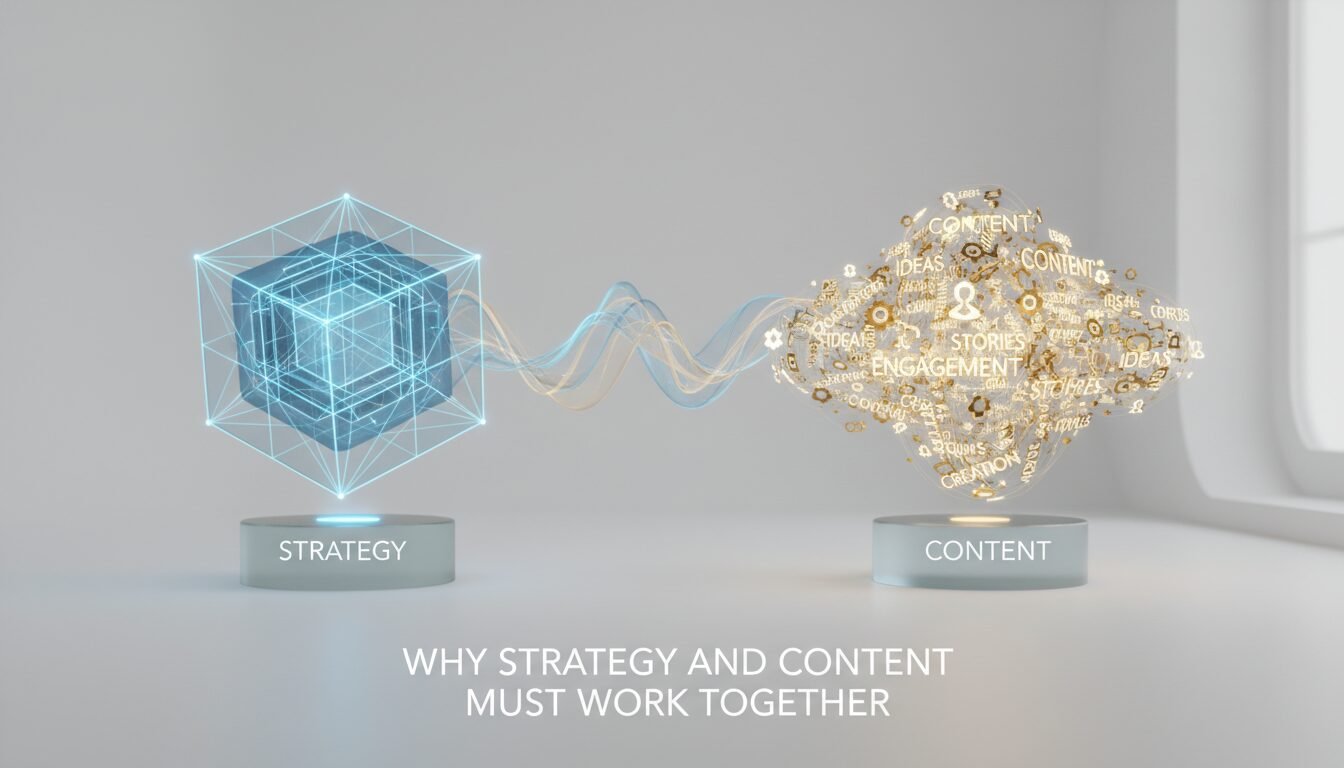
The Consequences of Content Without Strategy
Content created without a plan produces inconsistent messaging, poor SEO performance, and wasted budget. I have seen this firsthand: teams publishing three blog posts a week with no keyword research, no audience alignment, and no defined conversion goal. The result is a content library that looks busy but moves no metrics. strategy and must be intertwined from the start. Otherwise, teams spend their time firefighting instead of building.
How Strategy Elevates Content from Noise to Signal
A solid content strategy acts as a filter. It forces you to answer three questions before a single word gets written: Who is this for? What action should it drive? Which channel fits best? HBS Professor Sunil Gupta has noted that effective digital marketing requires content designed intentionally to solve audience problems, not just content that exists. That distinction matters. and content together become a deliberate system. Without strategy, you are just adding to the noise.
Real-World Examples of Strategy-Driven Content Success
A B2B SaaS company I studied shifted from random blogging to a topic-cluster model guided by keyword research. By aligning this type of content around pillar pages, they tripled organic traffic within 12 months. A separate example: a retailer redesigned product descriptions around user pain points after a full content audit, and conversion rates improved by roughly 15-20%. In both cases, strategy came before execution. That sequencing is everything.
Core Elements of an Effective Content Strategy

Audience Research and Persona Development
Your this kind of content are only as strong as your understanding of the people you are trying to reach. Detailed personas built on demographics, behavior, and motivations ensure content speaks directly to real needs. Use surveys, analytics, and social listening to refine these profiles on a rolling basis. A persona that was accurate in 2023 may be stale today, especially in fast-moving technology categories.
The Four Core Elements of Content
Every piece of content has four core elements: information, context, medium, and format. Information is what you are communicating. Context is why it matters to the audience at that moment. Medium is where it lives, whether that is a blog, a podcast, or a product page. Format is how it is structured, a listicle, a long-form guide, a short video. Missing any one of these elements weakens the whole piece. Strong strategy and planning accounts for all four before production starts.
Content Audits and Gap Analysis
A content audit is a systematic review of every existing asset. It reveals what is performing, what needs updating, and where gaps exist. This step is foundational for any and content initiative because it prevents duplication and surfaces quick wins. I run audits on a rolling quarterly basis across my own projects. The findings almost always reveal at least 3-5 high-traffic pages that need a refresh to maintain rankings.
Editorial Planning and Content Operations
An editorial calendar schedules production. But true content operations go deeper: they establish workflows, assign ownership, and set quality standards. This operational backbone ensures your this type of content can scale without chaos. Without defined workflows, quality degrades as volume increases. That is a pattern I have watched kill otherwise solid content programs.
“Content strategy is to copywriting as information architecture is to design.” – Rachel Lovinger, 2007, as cited in the Wikipedia entry on content strategy
Pros and Cons of a Formal Content Strategy
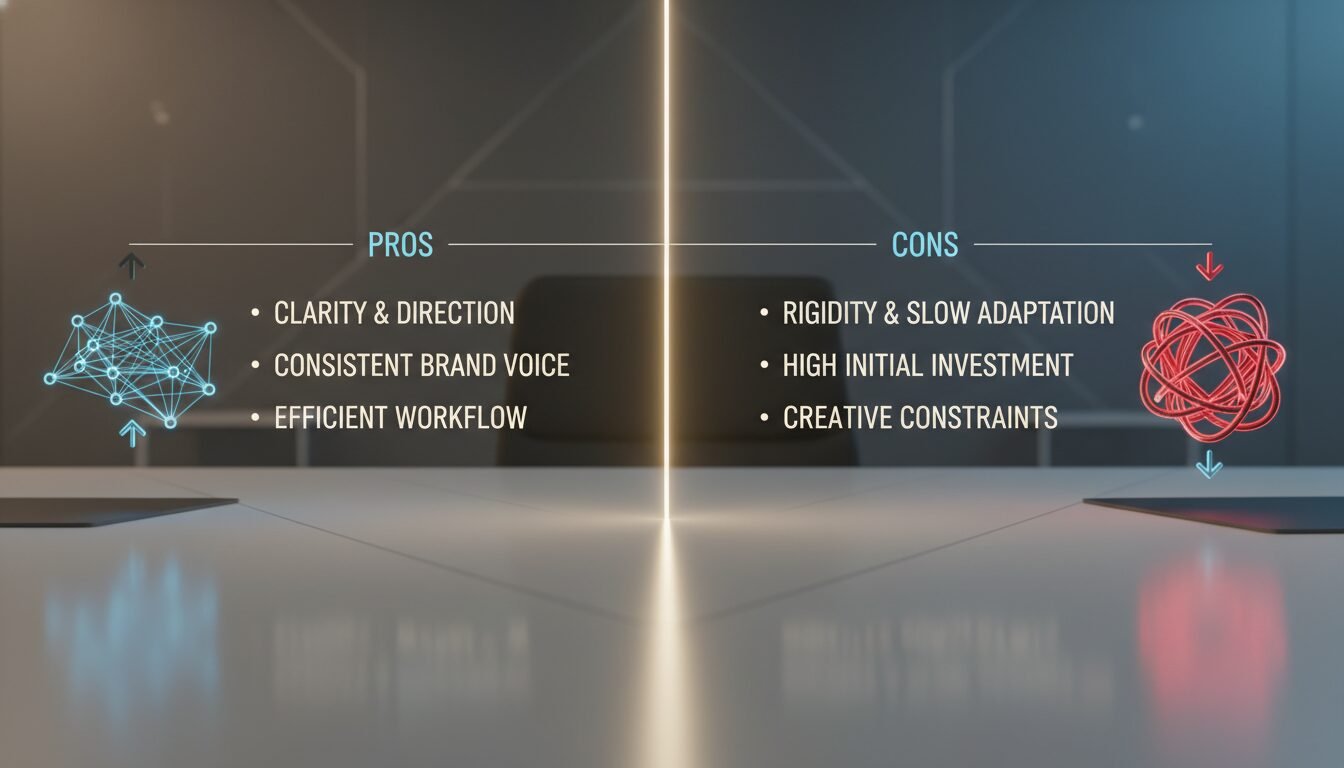
Pros
- Measurable ROI: A documented plan ties every content asset to a specific business goal, making performance tracking straightforward.
- Team alignment: Shared editorial calendars, style guides, and governance policies reduce miscommunication across writers, designers, and marketers.
- Scalability: Defined workflows let you increase publishing volume without sacrificing quality or consistency.
- Competitive advantage: Brands with mature content strategies build durable organic traffic that paid channels cannot replicate at the same cost.
- Better audience targeting: Persona-driven content consistently outperforms generic content on engagement and conversion metrics.
Cons
- Upfront time investment: Building a proper strategy, including audits, persona research, and governance docs, takes weeks before a single piece publishes.
- Requires ongoing maintenance: A strategy that is not revisited quarterly becomes outdated and can actively mislead the team.
- Organizational resistance: Getting buy-in across departments, especially for governance and workflow changes, is often harder than the content work itself.
- Measurement complexity: Attributing revenue to specific content assets requires solid analytics infrastructure that many teams lack.
A Step-by-Step Guide to Creating Your Strategy and Content Plan
Step 1: Define Clear Business Goals and KPIs
Start by aligning content objectives with company goals. Specificity matters here. Vague goals like “increase awareness” produce vague results. Instead, define targets like generating 500 qualified leads per month or reducing support ticket volume by a measurable amount. KPIs such as organic traffic, engagement rate, and cost per acquisition give your this kind of content a real scoreboard.
Step 2: Conduct Deep Audience Research
Go beyond basic demographics. Interview customers, analyze support tickets, and use heatmap tools to understand on-page behavior. If your target audience is mid-career professionals, your content should address their time constraints and career progression priorities directly. Surface-level personas produce surface-level content.
Step 3: Perform a Content Audit and Identify Gaps
Catalog all existing content and score each asset against criteria like relevance, accuracy, and traffic performance. Identify topics where you have zero coverage but competitors rank on page one. This gap analysis directly shapes your upcoming strategy and content roadmap. Most audits I run surface at least a dozen high-opportunity gaps within the first review.
Step 4: Develop Topic Clusters and Keyword Strategy
Organize content around pillar pages supported by cluster topics. Conduct keyword research to find high-intent terms your audience actually searches. This approach improves SEO and positions your brand as an authoritative hub. Tools like MarketMuse and Clearscope analyze top-performing content to recommend topic gaps and semantic keywords, making this step faster and more precise than manual research alone.
Step 5: Choose Formats, Channels, and Cadence
Decide whether your audience prefers long-form guides, short videos, or interactive tools. Map content types to the buyer’s journey: blog posts for awareness, case studies for consideration, product demos for decision. A consistent publishing cadence builds trust over time. Irregular publishing, even at high quality, trains audiences not to expect you.
Step 6: Implement Governance and Workflows
Establish clear ownership for every stage: who creates, reviews, approves, and publishes each piece. Define style guides, tone of voice standards, and accessibility requirements. Governance ensures that as your strategy and content library grows to hundreds or thousands of assets, quality stays consistent. This is the step most teams skip, and it is the one they regret most.
Step 7: Measure, Iterate, and Optimize
Use analytics to track performance against your KPIs. Revisit your content audit regularly to refresh or retire outdated assets. Optimization is not a one-time task. It is an ongoing feedback loop. The content programs I have seen compound over time are the ones where teams treat measurement as a weekly habit, not a quarterly report.
Content Strategy vs. Content Marketing: What Sets Them Apart?
Strategy as the Blueprint, Marketing as the Execution
Content strategy defines the goals, audience, and structure. Content marketing focuses on creation, promotion, and measurement. According to WGContent, strategy is the architect and marketing is the builder. Both are essential, but without the blueprint, the building collapses. I have watched well-funded content marketing programs fail because they were executing without a strategy underneath them.
The Overlap and How They Complement Each Other
Content marketing amplifies the work through SEO, social media, and email. But strategy and content marketing must feed each other in both directions. Data from marketing campaigns should inform strategic pivots. Strategic insights should sharpen campaign targeting. The teams that treat these as separate silos leave significant performance on the table.
Building a Unified Content Framework
To unify these disciplines, adopt a framework that includes strategic pillars, covering audience, governance, and content models, alongside marketing activities like channels and campaigns. This integrated approach ensures every piece of content serves both immediate campaign needs and long-term business value.
| Aspect | Content Strategy | Content Marketing |
|---|---|---|
| Focus | Planning, governance, and structure of content | Execution, promotion, and distribution of content |
| Goal | Align content with business objectives and user needs | Attract, engage, and convert audiences |
| Key Activities | Audits, taxonomy, workflows, content models | Blogging, social media, email campaigns, SEO |
| Time Horizon | Long-term, ongoing lifecycle management | Campaign-based, often short to medium term |
| Output | Content framework, editorial calendar, governance policies | Articles, videos, infographics, social posts |
B2B vs. B2C Content Strategy: Key Differences
B2B and B2C content strategies share the same foundational structure but diverge significantly in execution. B2B content typically targets longer buying cycles, multiple decision-makers, and higher-stakes purchases. That means more emphasis on case studies, technical documentation, and thought leadership that builds trust over months. B2C content, by contrast, often targets emotional triggers and shorter decision windows, favoring formats like short video, social proof, and personalized product recommendations.
The measurement frameworks differ too. B2B teams track pipeline influence, sales cycle length, and cost per qualified opportunity. B2C teams focus on conversion rate, average order value, and repeat purchase rate. Both approaches require a documented strategy and content plan. The difference is in which KPIs sit at the top of the dashboard.
Content Engineering and CMS Considerations
Content engineering is the technical layer of strategy and content work. It covers how content is structured, stored, and delivered across systems. A well-designed content model in a CMS like Contentful, Sanity, or even WordPress determines whether your content can be reused across channels or whether it is locked into a single template. Structured content, built with defined fields and taxonomies, enables personalization at scale and feeds AI-powered search interfaces more effectively than unstructured HTML blobs.
For teams building serious content programs in 2026, the CMS choice is a strategic decision, not just a technical one. Headless CMS architectures allow content to be published to web, mobile, voice, and AI interfaces from a single source of truth. That flexibility directly supports the kind of omnichannel strategy and content operations that durable brands are building today.
Integrating AI Into Your Strategy and Content Operations
AI-Powered Content Creation and Curation
By 2026, generative AI tools like ChatGPT and Jasper have become standard in drafting workflows. But raw AI output lacks strategic nuance. The teams winning with AI use it to generate ideas, outlines, and first drafts, then layer human expertise to ensure alignment with broader strategy and content goals. AI accelerates production. It does not replace judgment.
Using AI for Audience Insights and Personalization
AI excels at processing large data sets to surface audience segments and content preferences. Platforms like MarketMuse and Clearscope analyze top-performing content to recommend topic gaps and semantic keywords. These insights allow for highly relevant content that strengthens the connection between strategy and content at the execution level. The best use of AI in content is not writing. It is research and analysis.
The Limits of AI: Why Human Strategy Remains Essential
AI cannot define your brand’s unique voice or make ethical calls about sensitive topics. It also cannot produce genuine thought leadership, the kind that comes from having built something, failed at something, or learned something the hard way. The core of strategy and content, understanding human emotion and cultural context, stays firmly in human hands. AI is a capable assistant. It is not a strategist.
“Effective digital marketing requires content that is not just relevant but intentionally designed to solve audience problems.” – Sunil Gupta, Professor, Harvard Business School, as cited by HBS Online
Metrics That Matter for Content Performance
Key Performance Indicators (KPIs) to Track
Traffic metrics like unique visitors and page views, engagement metrics like time on page and bounce rate, and conversion metrics like form fills and purchases are the standard starting point. But for serious strategy and content measurement, go deeper: track cost per lead, cost per acquisition, and customer lifetime value influenced by content. Those numbers connect content directly to revenue, which is the only conversation that matters in a board room.
Tools for Measuring Content ROI
Google Analytics 4, HubSpot, and SEMrush offer robust reporting across the full content lifecycle. Use UTM parameters to trace content’s role in the conversion path. For more advanced content effectiveness scoring, platforms like ContentWRX specialize in measuring how well content actually performs its intended job, not just how much traffic it attracts.
How to Use Data to Refine Your Strategy
Review underperforming content on a regular schedule. If a blog post generates traffic but no conversions, revisit the call-to-action and the offer. If a video series shows high drop-off rates, shorten future episodes and front-load the value. Data-driven iteration is what separates a living content program from a static archive. The strategy and content operations that compound over time are the ones where teams treat analytics as a creative input, not just a report card.
Avoiding the Biggest Strategy and Content Mistakes
Mistake 1: Creating Content Without a Documented Strategy
Publishing without a plan is the most common and most expensive pitfall. A documented strategy reduces guesswork and aligns teams around shared goals. Without it, your strategy and content efforts are reactive. You end up chasing trends instead of building authority.
Mistake 2: Ignoring Content Maintenance and Governance
Content decays. Statistics, product details, and brand messaging all change over time. Nielsen Norman Group’s content lifecycle model emphasizes that maintenance and eventual unpublishing are as important as creation. Neglecting governance turns your site into a content graveyard, full of outdated pages that confuse users and dilute SEO equity.
Mistake 3: Failing to Align with Business Objectives
Content that does not support a clear business goal is a hobby, not an asset. Every piece should trace back to a strategic objective, whether that is reducing support tickets, driving demo requests, or shortening the sales cycle. Revisit your strategy and content map at least quarterly to confirm alignment persists as business priorities shift.
Trends Shaping the Future of Strategy and Content
The Rise of Generative AI and Agentic Content
AI agents that autonomously create, schedule, and personalize content are moving from prototype to production. Forward-thinking brands are already building guardrails, including ethical guidelines and human oversight checkpoints, to use this capability without losing brand integrity. This trend will fundamentally reshape how we think about strategy and content governance over the next 2-3 years.
Content for Voice and AI Answer Engines
With the growth of voice search and AI-driven answer engines, content must be optimized for natural language queries. Structured data, concise direct answers, and FAQ sections become essential signals. Your strategy and content framework must now account for visibility in ChatGPT-style interfaces, not just Google’s blue links. The brands building for this today will have a significant head start.
The Growing Importance of First-Party Data
As third-party cookies disappear, first-party data becomes the primary fuel for personalization. Content that encourages sign-ups, downloads, and community participation builds a proprietary data asset that no platform change can take away. This directly ties your strategy and content to sustainable, privacy-compliant growth. It is one of the most important strategic shifts happening in content right now.
Frequently Asked Questions
What is content strategy in simple terms?
Content strategy is the planning and governance of content to ensure it is useful, usable, and aligned with business goals. It answers why, who, and how before any content is created. Think of it as the blueprint that every piece of content is built from.
How is content strategy different from content marketing?
Content strategy focuses on the framework, covering goals, audience, and governance structures. Content marketing executes the plan through creation, distribution, and promotion. You need both, but strategy comes first. Without it, marketing efforts lack direction and measurable purpose.
Why do I need a documented content strategy?
A documented strategy provides clarity, consistency, and measurable targets for every team member involved in content. Without it, content efforts become fragmented and fail to deliver ROI. Documentation also makes onboarding new team members significantly faster.
Can AI replace human content strategists?
No. AI assists with data analysis, keyword research, and first-draft generation, but it cannot replicate human judgment, brand voice, or ethical reasoning. The optimal approach combines AI efficiency with human strategic oversight. That combination consistently outperforms either working alone.
What are the first steps to create a content strategy?
Start by defining specific business goals, researching your audience in depth, and auditing all existing content. These three foundational steps shape every decision that follows. Most teams that skip them end up rebuilding their strategy within 6-12 months anyway.
How often should a content strategy be updated?
Revisit your content strategy at least quarterly, or whenever business goals, audience behavior, or market conditions shift in a meaningful way. A strategy that is not updated becomes a liability rather than an asset. Treat it as a living document, not a one-time deliverable.
If you are building a content program and want to think through the strategy side, connect with me at aminferdowsi.com. I work with founders and operators on AI strategy for their businesses, and content is almost always part of that conversation.
Enjoyed this article?
Connect with me for collaboration, ventures, or just a good conversation about building things.
Get in Touch