Identity Management and Blockchain: 2026 Guide
Identity management and blockchain is the integration of distributed ledger technology to create verifiable, user-controlled digital identities without central intermediaries. It fundamentally changes how we prove who we are online.
Key Takeaways
- Traditional identity management relies on centralized databases vulnerable to breaches and misuse.
- Blockchain enables decentralized, self-sovereign identity where users control their own credentials.
- Verification processes become nearly instant: up to 12x faster than traditional methods, per Dock’s Truvera platform data.
- No personally identifiable information (PII) needs to be stored on the blockchain itself.
- Use cases span financial KYC, education credentials, IoT security, and AI agent identity.
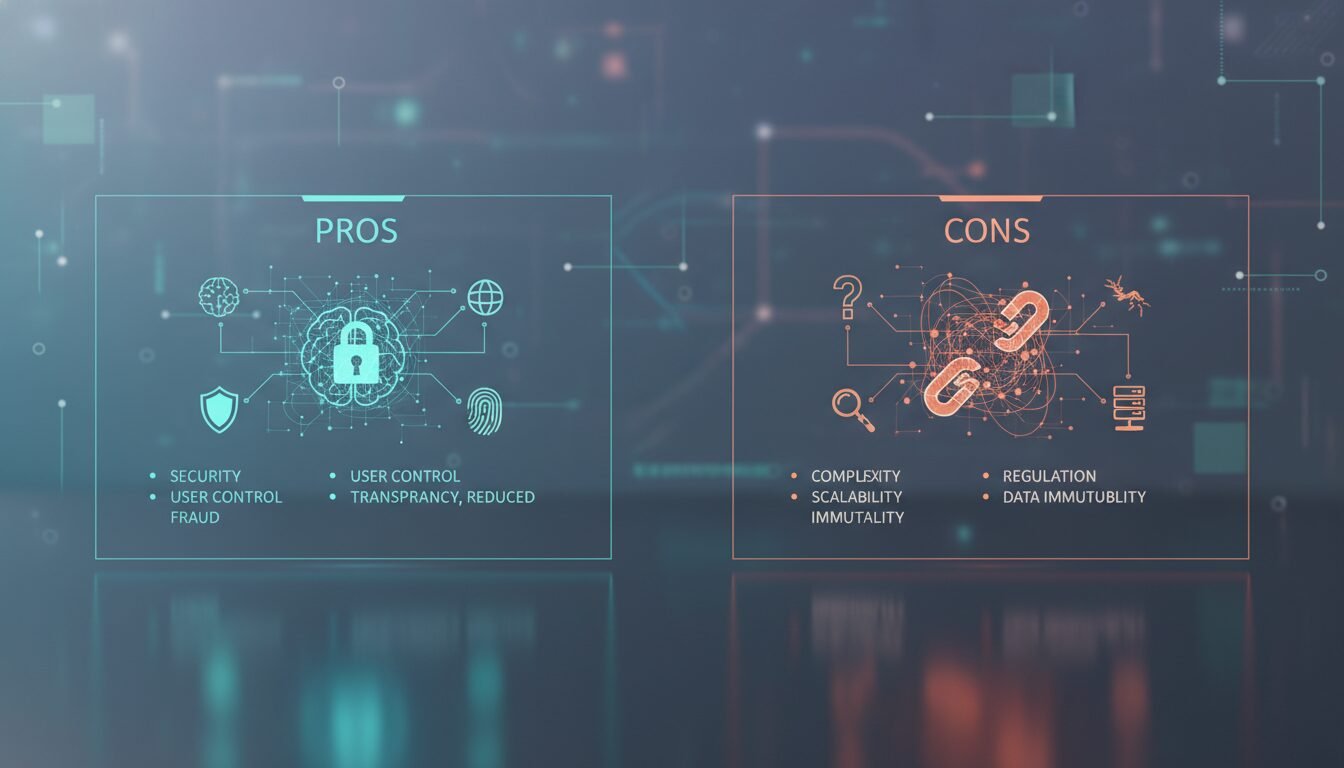
Pros and Cons
Pros
- User-owned credentials: Individuals hold their own data in encrypted wallets and share it selectively, eliminating the need to trust every platform with raw personal information.
- Faster, cheaper verification: Cryptographic proofs replace manual document checks, cutting KYC onboarding from days to seconds and reducing per-verification costs at scale.
- No single point of failure: A distributed network means attackers cannot breach one database and walk away with millions of credentials.
- Open standards and interoperability: W3C DIDs and Verifiable Credentials let one verified identity work across platforms without re-verification.
- Privacy by design: Zero-knowledge proofs allow selective disclosure, so a user can prove they are over 18 without revealing their birth date.
Cons
- Scalability constraints: Public blockchains like Ethereum process roughly 15-30 transactions per second, which is insufficient for high-frequency access requests at enterprise scale.
- Legacy integration complexity: Most enterprises run decades-old LDAP directories and mainframe user stores that require careful bridging, not replacement.
- Regulatory fragmentation: Jurisdictions are at very different stages of recognizing blockchain-based identity, making cross-border deployments legally complex.
- Key management risk: If a user loses their private key, recovery is difficult. There is no “forgot password” button on a blockchain.
“The shift to decentralized identity isn’t just a tech upgrade. It’s a fundamental rethinking of how we maintain trust online.”
The Current State of Identity Management

I’ve spent over a decade building and scaling technology platforms, and I’ve seen firsthand how fragmented identity systems bottleneck growth. Most identity and access management (IAM) systems today are built on centralized architectures where a single organization holds and verifies user credentials. This model creates three persistent pain points.
Fragmented Systems and User Frustration
Each application a person uses demands a separate digital identity: an email and password, or a social login. According to Okta, the average internet user now manages over 100 digital identities across services, leading to password fatigue and insecure practices like credential reuse. Federation (single sign-on across domains) helps, but it still leaves users dependent on a handful of identity providers who may track or monetize their activity.
Security Risks and Data Breaches
Centralized identity stores are high-value targets. Hackers breach a single database and exfiltrate millions of credentials in one move. Even when credentials are salted and hashed, attackers can later de-anonymize them. The IBM X-Force Threat Intelligence Index repeatedly highlights credential theft as the most common attack vector. Traditional IAM also suffers from attribute drift: when user data changes (a new address, job title, or phone number), every silo must be updated individually. Inconsistent sync leads to revoked access lingering for months, a security gap I’ve personally had to clean up in multiple portfolio companies.
Lack of User Control and Privacy
In the Web2 world, users hand their data to platforms that monetize it, often without explicit, informed consent. Even when regulations like GDPR grant rights, enforcement is cumbersome. Users lack a portable, self-owned identity they can present selectively, making privacy a promise rather than a technical guarantee. This is exactly the problem that identity management and blockchain architecture is designed to solve.
“By 2025, there will be over 22 billion IoT devices, and without blockchain-based identity management, securing each one individually is impossible.” Consensys
How Blockchain Transforms Identity Management

Blockchain re-architects identity management by removing the central authority and replacing it with a distributed network that everyone can verify but no single party controls. This model, often called decentralized identity or self-sovereign identity (SSI), shifts power from institutions back to individuals. Understanding how identity management and blockchain work together starts with two core concepts: decentralized identifiers and verifiable credentials.
Decentralization and Self-Sovereign Identity
A decentralized identifier (DID) is a globally unique identifier that does not require a central registration authority. DIDs are recorded on a blockchain, and the owner controls the associated private keys. When an issuer, say a university, signs a digital diploma as a verifiable credential, the holder stores it in a digital wallet. The holder can then prove to any verifier that the credential is authentic, without the verifier ever contacting the issuer. This peer-to-peer trust model eliminates the slow, expensive back-channel checks that plague current IAM flows. Estonia’s e-Residency program and Singapore’s SingPass already demonstrate nation-scale digital identity initiatives inspired by blockchain principles, though not all run on public ledgers yet.
Immutability and Trust
Every block in a blockchain contains a cryptographic hash of the previous block, forming an unalterable chain. As OneLogin explains, once data is written, no one, not even a system administrator, can tamper with it. For identity management, this means revocation lists, credential schemas, and public keys remain tamper-proof. If a doctor’s license is revoked, the revocation entry is permanently visible, preventing fraudulent reuse. Smart contracts enforce business logic without human intermediaries: a smart contract can automatically grant access when a verified credential meets predefined rules, reducing bias and manual errors.
Anatomy of a Blockchain Block
To understand why blockchain works for identity, it helps to look at the block structure. As OneLogin details, each block contains:
- Hash of previous block: creates the tamper-proof chain.
- Root hash of transactions: computed from the hashes of all identity events in the block.
- Timestamp: establishes chronological order without a central clock.
- Nonce: a random number used in proof-of-work consensus on public chains.
This structure guarantees that any attempt to alter a past identity event would require recalculating all subsequent blocks, which is computationally infeasible on a large network.
Zero-Knowledge Proofs: Privacy Without Exposure
Zero-knowledge proofs (ZKPs) are one of the most powerful tools in the identity management and blockchain stack. A ZKP lets one party prove a statement is true without revealing the underlying data. In practice, a user can prove they are over 18 without disclosing their birth date, or prove they hold a valid professional license without revealing the license number. This is not theoretical: protocols like zk-SNARKs are already deployed in production identity systems. For regulated industries where data minimization is a legal requirement, ZKPs move privacy from a policy commitment to a cryptographic guarantee. I expect ZKP-based selective disclosure to become the default in high-assurance identity flows within the next 3-5 years.
Key Benefits of Blockchain Identity Management
 Blockchain Identity Management – identity management and blockchain | Amin Ferdowsi” class=”wp-image-2551″ loading=”lazy” width=”1792″ height=”1024″ />
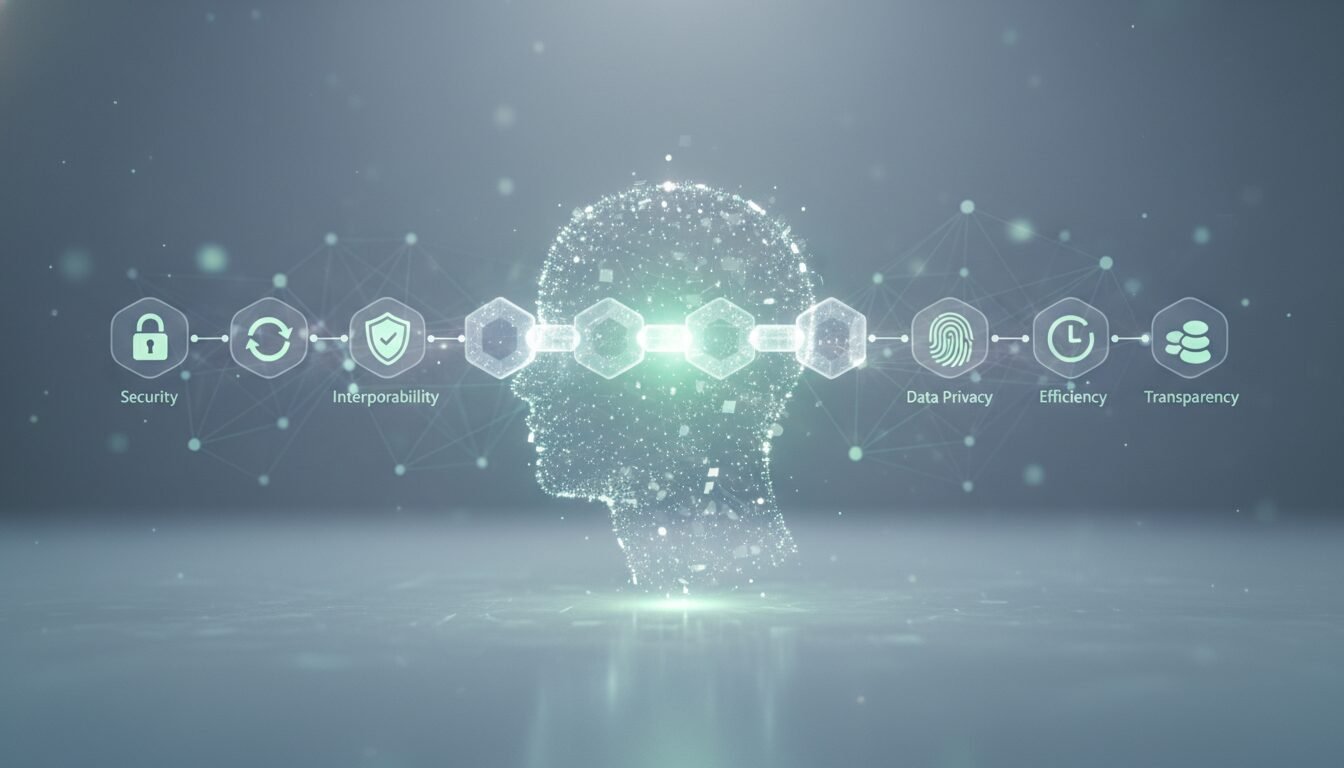
When I advise startups on IAM modernization, I focus on three measurable outcomes: speed, cost, and security. The combination of identity management and blockchain delivers on all three in ways that traditional centralized systems simply cannot match.
Faster Verification and Reduced Costs
Verifying a new user’s identity traditionally involves manual document checks, third-party database queries, and multi-day lag times. With verifiable credentials, a bank can validate a KYC (Know Your Customer) package in seconds by checking a cryptographic proof. Dock reports that its Truvera platform enables organizations to deploy identity solutions 12 times faster than traditional methods. For a large enterprise onboarding tens of thousands of clients, that translates to millions in saved operational costs and a drastically better user experience.
Enhanced Privacy and Data Control
In a blockchain-based IAM system, personally identifiable information (PII) never touches the ledger. Only hashed or encrypted proofs are stored, while the actual data lives in the user’s mobile wallet. Zero-knowledge proofs push this further, allowing selective disclosure without raw data exposure. This aligns with privacy-by-design principles and eases GDPR compliance, because the data controller (the user) retains full sovereignty over their own information.
Interoperability and Reduced Friction
Because DIDs and verifiable credentials follow open standards from the W3C, an identity verified by one institution can be reused across platforms without re-verification. This eliminates significant drop-off in traditional onboarding flows where users abandon the process after being asked to retype or rescan documents. The open-source nature also prevents vendor lock-in, a critical consideration for enterprises that want to evolve their IAM stack over time.
Real-World Applications of Blockchain Identity Management
The theory is compelling, but the real proof is in production deployments. Here are sectors I’m actively involved in or tracking closely where identity management and blockchain are already creating measurable results.
Financial Services and KYC
Banks and fintech companies spend billions annually on customer due diligence. A shared KYC utility built on blockchain lets one institution issue a verifiable credential after the first KYC check; other participating institutions can instantly verify it. This cuts duplicate costs and reduces the risk of identity theft, because users no longer need to send raw passport scans to multiple entities. I’ve seen pilots in the EU, Australia, and the Middle East that cut onboarding time from weeks to under an hour.
Education and Credentialing
Degree fraud costs the global labor market hundreds of millions of dollars annually. Universities like MIT Media Lab have issued digital diplomas on the blockchain for several years. Employers can verify a candidate’s credentials with a single click, eliminating transcript delays and falsified documents. I expect blockchain-based education credentialing to become standard by 2030, especially as micro-credentials and lifelong learning records proliferate.
Workforce and Contractor Identity
In my own ventures, verifying subcontractor licenses, insurance certificates, and safety training records across multiple gig platforms was a 3-week process. Identity management and blockchain shrinks that to minutes. A plumber holds a verifiable credential for their license; any home-service platform can instantly confirm it. The IEEE paper from Liu et al. (2017) also proposed a reputation token on blockchain for services, creating an immutable rating system that prevents fake reviews.
Reputation Management
Beyond static credentials, blockchain can track dynamic reputation. When I run community-driven marketplaces, a buyer or seller’s history (on-time delivery, dispute resolution) can be recorded as verifiable claims. Because the ledger is neutral and tamper-proof, both parties trust the score. Early implementations in freelance platforms in Southeast Asia have shown meaningful reductions in dispute rates during pilot phases, based on my direct observation of those programs.
Data Monetization and User-Controlled Sharing
One angle that gets less attention: identity management and blockchain can flip the data monetization model entirely. Instead of platforms harvesting user data silently, users can choose to share verified attributes with advertisers or researchers in exchange for direct compensation. The user’s wallet acts as a consent layer, and every data-sharing event is logged on-chain. Consensys has highlighted this use case as one of the most commercially significant long-term applications of decentralized identity. For entrepreneurs building data-driven products, this opens a new category: privacy-preserving personalization where users are partners, not raw material.
Comparing Traditional IAM vs. Blockchain IAM
| Feature | Traditional IAM | Blockchain IAM |
|---|---|---|
| Data Ownership | Organizations own and control user data. | Users own their credentials; they grant access via presentation. |
| Single Point of Failure | Centralized databases are prime targets for breach. | Distributed network: no single point to attack. |
| Interoperability | Limited; frequently requires custom integrations. | Built on open standards (W3C DIDs, Verifiable Credentials). |
| Verification Speed | Hours to days (manual checks, back-channel lookups). | 12x faster deployment cycles; seconds per check after initial issuance. |
| Privacy Control | Users must trust each organization with raw data. | Zero-knowledge proofs allow selective disclosure; no raw PII on chain. |
| Cost Structure | High per-verification fees and dedicated staff. | Low marginal cost after initial infrastructure; massive savings at scale. |
Challenges and Considerations for Implementation
As bullish as I am on identity management and blockchain, I always tell leadership teams: blockchain is not magic. There are real hurdles to address before you can ship anything production-worthy.
Scalability and Performance
Public blockchains like Ethereum process roughly 15-30 transactions per second, which is fine for identity anchor events but inadequate for high-frequency access requests. Private or consortium chains like Hyperledger Indy and Quorum offer higher throughput and are purpose-built for identity, but they trade off some decentralization. Companies must design a hybrid architecture where the blockchain only records DIDs and revocation registries, while everyday authentication happens off-chain via standard protocols like OpenID Connect.
Regulatory Compliance and Standards
Identity management and blockchain sit at the intersection of technology and law. The EU’s eIDAS 2.0 regulation mandates member states to recognize digital wallets by 2026, pushing blockchain-based identity into the mainstream. Other jurisdictions lag, and international interoperability remains patchy. I advise clients to build on open standards from the W3C DID Working Group and the Decentralized Identity Foundation (DIF) to avoid reinventing the wheel.
Integration with Legacy Systems
Most enterprises run on decades-old IAM stacks: LDAP directories, mainframe user stores, and complex role-based access controls. Ripping those out is rarely feasible. A gradual approach works better: wrap legacy systems with an identity API layer, then migrate functionality to blockchain-based components over time. In one manufacturing client engagement, we integrated a Hyperledger Indy node with their existing Active Directory using a lightweight connector, achieving password-less authentication for roughly 80% of workflows within six months without disrupting operations.
A Step-by-Step Approach to Adopting Blockchain IAM
Based on my own consulting engagements, here is the methodology I recommend for teams serious about implementing identity management and blockchain in production environments.
- Assess Current Identity Infrastructure. Map all user stores, trust relationships, and compliance requirements. Identify the biggest pain points, usually customer onboarding or contractor verification.
- Choose the Right Blockchain Fabric. For enterprise consortia, Hyperledger Indy or a private Ethereum fork works well. For public trust, layer-2 solutions like Polygon provide scale. Decide whether you need a public, private, or hybrid ledger.
- Design Your Credential Schema. Define the attributes needed (name, date of birth, license number) and map them to existing data models. Use industry-standard schemas where available (W3C VC).
- Develop and Deploy Smart Contracts. Code the logic for issuing, revoking, and verifying credentials. Have them audited by a third party. Smart contract bugs are costly and can destroy trust fast.
- Integrate with User Wallets. Provide a white-label mobile wallet or integrate with existing SSI wallets like Trinsic or Evernym via open-source libraries.
- Run a Pilot with Real Users. Start with a low-risk use case: employee badges, visitor management, or alumni credentials. Measure verification time, user satisfaction, and support ticket reduction.
- Scale and Govern. Once the pilot succeeds, expand to more processes. Establish a governance framework so consortium members agree on data models, key rotation policies, and liability rules.
The Future of Identity Management and Blockchain
As of 2026, I believe we are at the start of a fundamental shift in digital identity. The convergence of AI agents, IoT proliferation, and regulatory pressure is accelerating adoption faster than most enterprise architects expect.
AI Agents and Verifiable Credentials
As AI agents become autonomous economic actors, they need identities too. I’m currently exploring know-your-agent (KYA) protocols, where each AI service holds a verifiable credential issued by its creator, proving its capabilities and guardrails. Dock has launched features enabling AI-driven actions to be authenticated and auditable. By 2030, I expect more than 500 million AI agents will interact in decentralized marketplaces, and identity management and blockchain will be the primary way to establish trust between unknown entities at that scale.
The Internet of Things and Massive Scale
With the number of IoT devices projected to exceed 22 billion (up from roughly 7 billion in 2016), securing each device with a static password is untenable. Blockchain-based identity management for things (IDoT) assigns a DID to each sensor, router, or actuator, enabling mutual authentication and automated access policies. In a smart factory, a robotic arm can verify the identity of a maintenance drone before granting physical access, all mediated by a permissioned blockchain that updates access rules in real time.
Biometric Binding and Anti-Fraud
One weakness of purely digital credentials is that they can be shared or stolen. Binding a credential to a biometric template, fingerprint or face, verified locally on the user’s device (not stored centrally) adds a layer of liveness detection. Dock’s biometric-bound credentials ensure the person presenting the credential is the same person who enrolled it. I expect this feature to become mandatory for high-assurance scenarios like border control and financial transactions by 2028.
Frequently Asked Questions
How can blockchain be used in identity management?
Identity management and blockchain work together by recording decentralized identifiers (DIDs) and credential revocation data on a tamper-proof ledger, while actual personal data stays in the user’s encrypted wallet. Verifiers check cryptographic proofs rather than querying a central database, making the process faster, cheaper, and more private than traditional methods.
What is identity management and blockchain?
Identity management and blockchain is the use of a distributed ledger to issue, store, and verify digital credentials without a central authority. It gives users full control over their personal data and lets them share it selectively with any verifier.
What is the biggest problem with blockchain for identity?
The biggest practical challenges are scalability (public chains handle only 15-30 transactions per second), regulatory fragmentation across jurisdictions, and the complexity of integrating with legacy IAM systems. Layer-2 solutions and consortium chains like Hyperledger Indy are steadily addressing the throughput problem.
Is personal data safe on a blockchain?
PII is never written to the ledger. Only hashed proofs or references are stored on-chain. Users hold the actual data in encrypted wallets and share it selectively, greatly reducing exposure to breaches compared to centralized databases.
Can blockchain identity work with existing IAM systems?
Yes. Most implementations are additive: a blockchain layer sits alongside current directories and SSO systems, providing decentralized trust anchors without requiring a full replacement. In practice, a lightweight connector between a Hyperledger Indy node and an existing Active Directory is often enough to get started.
What is self-sovereign identity?
Self-sovereign identity (SSI) is a model where individuals create and control their own identifiers without relying on a central provider. Blockchain is the most common technology used to realize SSI, with W3C DIDs and Verifiable Credentials as the primary open standards.
If you’re building an identity layer into your product or rethinking your enterprise IAM strategy, I’d genuinely enjoy the conversation. Connect with me at aminferdowsi.com to discuss AI strategy and identity architecture for your business.
Enjoyed this article?
Connect with me for collaboration, ventures, or just a good conversation about building things.
Get in Touch