Finance and Management: The 2026 Builder’s Guide

Key Takeaways
- Finance and management is the strategic discipline of planning, organizing, directing, and controlling financial resources to achieve business goals.
- Modern financial management uses AI, automation, and real-time data to sharpen forecasting accuracy and cut operational waste.
- Effective finance and management requires balancing profitability, liquidity, and risk while staying aligned with long-term strategy.
- Integrated ERP systems and continuous financial education are the two best investments any growing business can make in 2026.
- From solo founders to enterprise CFOs, structured finance and management frameworks scale to any business size or complexity level.
Finance and management is the strategic discipline of planning, organizing, directing, and controlling financial resources to achieve organizational goals, maintain liquidity, and maximize long-term value. Without it, even high-revenue businesses collapse under cash crunches or misallocated capital.
What Is Finance and Management?
Defining the Discipline
and management is the framework organizations use to allocate resources, evaluate investment opportunities, and monitor financial performance. According to IBM, it guides resource allocation, investment decisions, and operational efficiency (IBM Think). The scope runs from daily cash flow monitoring to long-term capital structuring. In practice, that means setting financial targets, building budgets, and making decisions that align with the company’s strategic vision.
Why It Matters for Every Business
this type of management is not just about keeping the books. It directly determines whether a business survives or scales. Oracle highlights that the finance team’s primary role is to guarantee the company never runs out of cash (Oracle ERP Financials). Beyond solvency, strong financial management drives value creation, helping businesses seize opportunities, weather downturns, and deliver returns to stakeholders. A 2025 IBM study found that 53% of executives already use automation in financial analysis and management reporting, a clear signal that data-driven decision-making is now the baseline, not the exception.
Key Stakeholders in Financial Management
Responsibility for this kind of management typically falls to a dedicated team led by a Chief Financial Officer (CFO) or Head of Finance. In smaller organizations, a single financial manager or outsourced accountant handles all functions. Stakeholders also include department heads who provide budget inputs, investors who expect transparency, and regulatory bodies that require compliance. Each group depends on accurate financial reporting and prudent management to make informed decisions.
Core Objectives of Finance and Management
Profit Maximization vs. Wealth Maximization
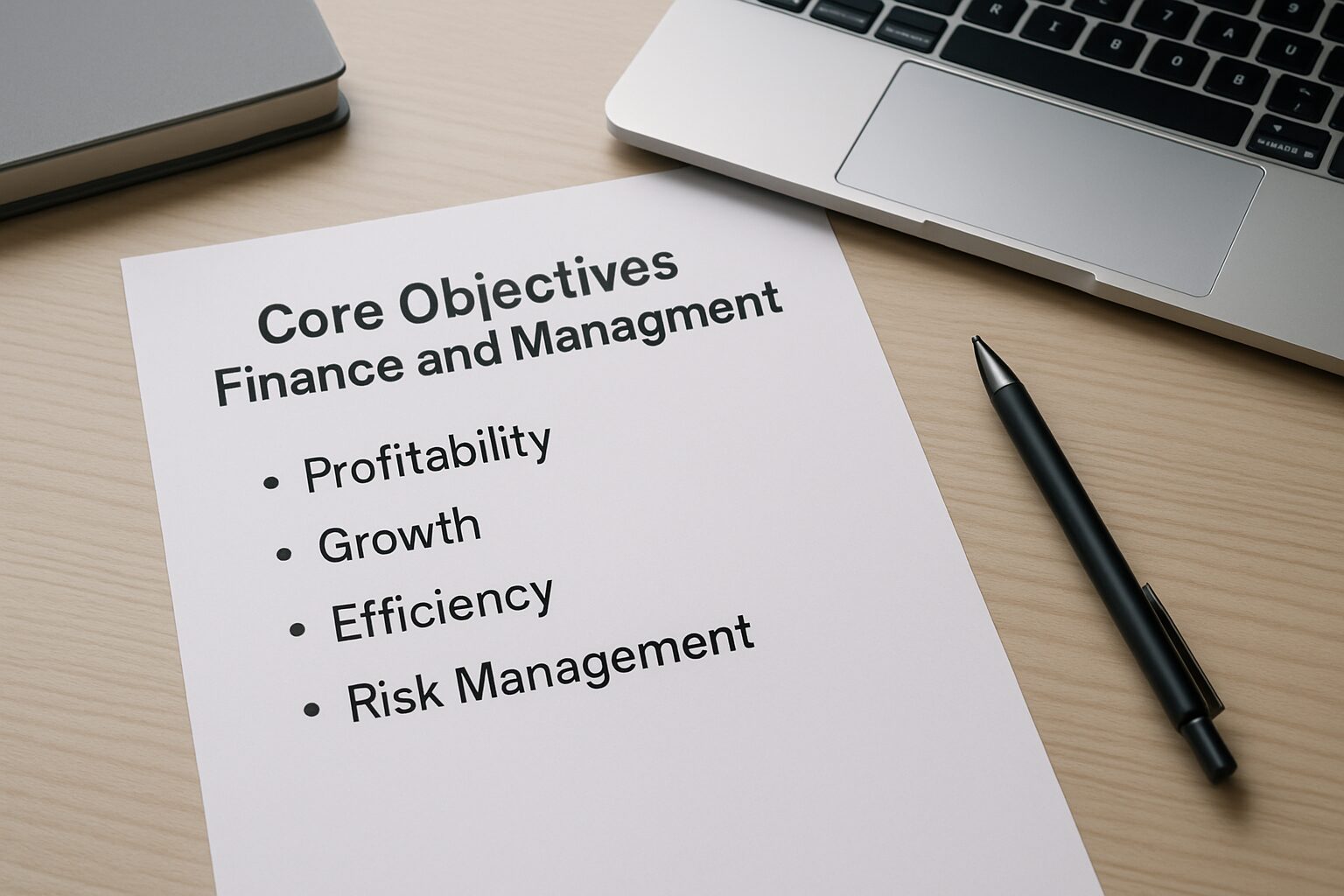
Traditional finance and often chased profit maximization, but modern approaches prioritize wealth maximization: enhancing the long-term value of the firm. Profit maximization ignores timing and risk. Wealth maximization considers the present value of future cash flows. As noted in academic resources from California State University, Northridge (CSUN Finance 303), the goal of a firm is to maximize shareholder wealth, not just short-term earnings.
Ensuring Liquidity and Solvency
A fundamental objective is maintaining enough liquidity to meet short-term obligations and enough solvency for long-term viability. Financial managers must forecast cash requirements, negotiate credit lines, and manage working capital efficiently. Without adequate liquidity, even profitable companies face bankruptcy. Regular cash flow monitoring prevents such crises and supports uninterrupted operations.
Risk Management
Identifying and reducing financial risks, including market risk, credit risk, liquidity risk, and operational risk, sits at the center of and management. Teams develop contingency plans, diversify investments, and implement hedging strategies. IBM emphasizes that financial managers must quantify threats and make informed decisions on risk retention and transfer (IBM Think). This protective function safeguards both assets and reputation.
Key Functions of Finance and Management

Planning and Budgeting
Financial planning projects resource needs to maintain positive cash flow and fund growth. Budgeting assigns available funds to cover payroll, rent, materials, and other costs. Both functions require collaboration with department leaders to create realistic targets and adjust allocations as conditions shift. Effective planning anchors every other financial activity in the business.
Investment Decisions
Evaluating capital opportunities, whether technology upgrades, market expansions, or acquisitions, is a core function of this type of management. Financial managers analyze return on investment (ROI), assess risks, and prioritize projects that align with strategic goals. The Coursera specialization on Financial Management highlights that managers must determine the optimal mix of fixed and long-term assets based on working capital needs (Coursera). Getting this mix wrong is one of the most common reasons growth-stage companies stall.
Financing Decisions
Raising capital through equity, debt, or hybrid instruments requires careful structuring. The debt-equity analysis weighs cost of capital, dilution, and repayment ability. Financial managers decide when to tap credit markets, issue shares, or reinvest profits. This function directly shapes the company’s capital structure and financial leverage, two variables that determine how much risk the business can absorb.
Dividend Policy
For corporations, dividend disbursement plans balance rewarding shareholders and retaining earnings for reinvestment. Financial managers craft flexible policies that adapt to growth phases and profitability cycles. Coursera notes that companies need a formal dividend plan, with modifications guided by the financial manager (Coursera). Early-stage companies almost always reinvest; mature businesses must decide how much to return.
Cash Flow Management
Monitoring money in and out is non-negotiable. Sage defines financial management as monitoring and controlling the flow of funds so the organization remains on solid ground (Sage Blog). This covers invoicing, payables, bank reconciliations, and closing the books on time. Unified cash flow visibility prevents surprises and supports faster, more confident decisions.
Types of Financial Management
Strategic Financial Management
Strategic this kind of management focuses on long-term goals: market positioning, mergers and acquisitions, and capital structure optimization. It involves scenario modeling, multi-year forecasting, and aligning financial resources with the corporate vision. Tools like Business Performance Management (BPM) platforms integrate financial and operational data into a single planning layer.
Tactical Financial Management
Tactical management bridges strategy and day-to-day operations. It includes annual budgeting, performance tracking, and variance analysis. Finance managers work with mid-level leaders to keep departmental spending on target and trigger corrective actions when needed. This level demands robust reporting and frequent communication across the organization.
Operational Financial Management
Operational finance and handles routine transactions: accounts payable and receivable, payroll, and bank reconciliations. Efficiency and accuracy are everything here. Automation plays a critical role. IBM found that over half of executives use automation in reporting, freeing teams to focus on analysis rather than manual data entry (IBM Think).
The Role of Technology in Modern Finance and Management
AI and Automation
Artificial intelligence is reshaping and management faster than most finance teams realize. Agentic AI can digest historical data to build predictive models, enabling more accurate forecasting. IBM highlights that AI frees CFOs to focus on mitigating risks and uncertainties rather than chasing down data (IBM Think). Automation streamlines invoicing, reconciliations, and compliance checks, cutting processing time dramatically and reducing human error. I’ve watched teams that once spent 3-4 days closing the books each month get that down to under 24 hours after deploying the right automation stack.
“AI is not replacing the CFO. It’s replacing the CFO’s least valuable hours.” Based on conversations with finance leaders across multiple portfolio companies, the pattern is consistent: AI handles the data; humans handle the judgment.
Cloud-Based ERP Systems
Integrated enterprise resource planning (ERP) platforms like Oracle Cloud ERP and SAP S/4HANA centralize financial data from every department. These systems provide real-time dashboards, automated workflows, and full audit trails. Oracle emphasizes that such platforms transform this type of management by unifying accounting, planning, and procurement into one source of truth (Oracle ERP Financials). Companies like DHL Group rely on IBM Planning Analytics for fast, flexible planning across complex global operations (IBM Think). For mid-market businesses, tools like NetSuite and Sage Intacct offer similar integration at a lower entry cost.
Real-Time Data Analytics
Waiting for month-end reports is a liability. Modern this kind of management demands real-time insight into KPIs. Dashboards track cash positions, profitability by segment, and budget variances as they happen. This agility allows proactive adjustments, like pausing underperforming campaigns or accelerating successful ones, before the damage compounds. Real-time data also powers dynamic scenario modeling, which is essential in volatile markets.
According to Sage, disconnected financial systems increase both operational vulnerability and cybersecurity exposure, making integrated platforms a business continuity issue, not just a convenience (Sage Blog).
Comparative Table: Financial Management Functions by Business Size
| Function | Small Business | Mid-Sized Business | Large Enterprise |
|---|---|---|---|
| Planning & Budgeting | Simple spreadsheets; owner-led annual budget | Departmental budgets; quarterly rolling forecasts | Integrated enterprise planning; scenario modeling; AI-driven forecasts |
| Cash Flow Management | Daily bank monitoring; manual invoicing | Weekly cash forecasts; automated receivables | Real-time treasury management; multi-currency cash pools |
| Risk Management | Basic insurance; limited hedging | Formal risk assessments; credit limits | Enterprise risk management (ERM) framework; dedicated risk officers |
| Technology Use | Cloud accounting (QuickBooks, Xero) | ERP light (Sage Intacct, NetSuite) | Full-suite ERP (SAP, Oracle) with AI and advanced analytics |
| Reporting | Monthly P&L, annual tax prep | Monthly financial statements; KPI dashboards | Real-time dashboards; sustainability (ESG) reports; SEC filings |
| Compliance | Tax compliance; local regulations | GAAP/IFRS; multi-state tax | SOX, cross-border tax treaties; strict regulatory oversight |
Common Challenges in Finance and Management
Market Volatility
Fluctuating interest rates, currency swings, and economic downturns create real uncertainty. Financial managers must continuously update forecasts and stress-test plans against multiple scenarios. Companies with strong cash reserves and diversified revenue streams absorb turbulence far better than those running lean. The COVID-19 pandemic made one thing clear: liquidity buffers are not optional.
Regulatory Compliance
Evolving tax codes, data privacy laws like GDPR and CCPA, and industry-specific regulations demand constant vigilance. Non-compliance results in hefty fines and lasting reputational damage. finance and teams must stay current on changes and adjust reporting processes accordingly. Automated compliance checks reduce the burden significantly, especially for teams operating across multiple jurisdictions.
Cybersecurity Risks
As financial systems become more digital, cyberattack exposure grows with them. Ransomware, phishing, and data breaches can cripple operations overnight. According to Sage, disconnected systems increase vulnerability (Sage Blog). Financial managers must invest in robust security protocols, regular audits, and employee training to protect sensitive data. This is no longer an IT problem. It’s a and management problem.
Pros and Cons
Pros
- Improved decision-making: Structured this type of management gives leaders accurate, timely data to make confident calls on investment, hiring, and growth.
- Risk reduction: Formal risk frameworks catch problems early, before they become existential threats to the business.
- Investor confidence: Transparent financial reporting builds trust with investors, lenders, and partners, opening doors to better capital terms.
- Scalability: A solid financial management foundation makes it far easier to scale operations without losing control of costs or cash flow.
- Regulatory protection: Proper compliance processes reduce exposure to fines, audits, and legal liability.
Cons
- Implementation cost: Deploying ERP systems like SAP or Oracle requires significant upfront investment, often ranging from tens of thousands to millions of dollars depending on scale.
- Complexity at scale: As businesses grow, this kind of management processes multiply in complexity, requiring specialized talent that can be expensive to hire and retain.
- Over-reliance on models: Predictive models and AI forecasts are only as good as the data feeding them. Garbage in, garbage out.
- Change resistance: Finance teams accustomed to legacy processes often resist new tools and workflows, slowing adoption and ROI.
Best Practices for Effective Finance and Management
Implement a Robust Internal Control Framework
Segregation of duties, approval hierarchies, and regular reconciliations prevent fraud and errors. Small businesses can start with simple measures like dual signatures on checks. Larger firms use automated approval workflows. Strong controls also ensure reliable financial reporting, which is non-negotiable for investor confidence and audit readiness.
Use Integrated Technology
Moving from siloed spreadsheets to a unified ERP system transforms visibility and efficiency. Cloud-based solutions enable remote access, automatic updates, and scalability without major infrastructure investment. When selecting software, prioritize integration with existing tools and the ability to handle complex reporting requirements. Oracle, NetSuite, and Sage Intacct are proven choices for growing businesses at different budget levels.
Conduct Regular Financial Audits
Annual external audits matter, but monthly internal audits catch discrepancies before they compound. Audit checklists, variance analysis, and spot checks keep teams accountable. Sage recommends completing regular financial audits to identify inefficiencies and potential fraud early (Sage Blog). Build this into your operating rhythm, not just your year-end checklist.
Invest in Continuous Education
Financial regulations, tools, and best practices shift fast. Encouraging team members to pursue certifications like CMA, CPA, or financial modeling courses keeps skills current. Coursera’s Financial Management Specialization from Duke University offers a structured path for upskilling finance professionals at any level (Coursera). A learning culture reduces costly mistakes and builds the institutional knowledge that protects the business long-term.
Career Paths in Finance and Management
finance and opens doors to some of the most impactful roles in any organization. Entry-level analysts typically progress to financial manager roles, with experienced practitioners often reaching CFO or VP of Finance positions. According to industry data, financial managers typically bring around 7 years of experience before stepping into senior leadership. Relevant certifications like the CPA, CMA, or CFA significantly accelerate career progression and command higher compensation. For those building toward entrepreneurship, a background in and management is one of the most practical foundations you can have. Understanding how money moves through a business is the difference between founders who scale and founders who run out of runway.
The Future of Finance and Management
Agentic AI and Autonomous Finance
The next frontier in this type of management is agentic AI: systems that not only analyze data but also execute decisions within predefined boundaries. Imagine AI agents autonomously rebalancing investment portfolios, optimizing payment terms, or flagging vendor contracts for renegotiation. IBM’s research suggests these agents will soon handle complex financial modeling, dramatically reducing manual work (IBM Think). As of 2026, early adopters are already running pilot programs with measurable results in forecasting accuracy and close cycle time.
Sustainability and ESG Reporting
Environmental, Social, and Governance (ESG) criteria are now central to investment decisions. Financial managers must integrate non-financial metrics into their reporting frameworks. Standards like the ISSB (International Sustainability Standards Board) are becoming mandatory in multiple jurisdictions. Companies that transparently track carbon footprint and social impact will attract capital more easily than those that don’t.
Decentralized Finance (DeFi) and Tokenization
Blockchain-based DeFi offers new ways to raise capital, borrow, and trade assets without traditional intermediaries. While still early, tokenization of real-world assets could transform liquidity management for businesses of all sizes. Forward-thinking this kind of management teams are exploring smart contracts for automated compliance and settlement. Regulatory clarity remains the main hurdle, but the direction of travel is clear.
finance and is an ever-evolving discipline that sits at the heart of every successful organization. Whether you’re a startup founder or a multinational CFO, mastering the core principles, including planning, budgeting, risk assessment, and technology adoption, will determine your ability to thrive in 2026 and beyond. I’ve seen firsthand how a disciplined approach to finance and management can turn a struggling venture into a scalable enterprise. The integration of AI, real-time data, and a strategic focus on wealth maximization are no longer optional. They are the new standard. Apply these frameworks, stay attuned to technological shifts, and you’ll build a financial foundation that actually holds.
Want to talk through how these principles apply to your specific business? Connect with me to discuss AI strategy and financial management for your venture.
Frequently Asked Questions
What is the difference between finance and financial management?
Finance is a broad field covering capital markets, investments, and money management across public and private contexts. Financial management specifically refers to the strategic planning and control of an organization’s monetary resources. Think of finance and management as the applied, operational layer of the broader finance discipline.
What are the main objectives of financial management?
The primary objectives are wealth maximization (not just short-term profit), ensuring liquidity and solvency, and managing financial risks across the business. The ultimate goal is to increase the long-term value of the business for shareholders and stakeholders alike.
How does financial management differ for small vs. large businesses?
Small businesses often handle finance and management with a single accountant or bookkeeper using tools like QuickBooks or Xero. Large enterprises deploy entire finance teams, full-suite ERP systems like SAP or Oracle, and AI-driven analytics. The core principles remain the same; the complexity and tooling scale with the business.
What role does AI play in modern finance and management?
AI automates routine tasks like data entry and reconciliation, generates predictive models for forecasting, and surfaces real-time insights that would take human analysts days to compile. It allows finance professionals to focus on strategic analysis and risk mitigation rather than manual processing, which is where the real value gets created.
What can I do with a finance and management degree?
A finance and management degree prepares you for roles including financial analyst, budget manager, CFO, investment banker, and startup founder. The combination of financial acumen and management skills is especially valuable for entrepreneurs and operators who need to understand both the numbers and the people behind them.
Enjoyed this article?
Connect with me for collaboration, ventures, or just a good conversation about building things.
Get in Touch