Equipment Finance Business Guide: Loans vs Leases in 2026

Equipment finance business is a specialized lending sector that offers loans and leases so companies can acquire machinery, vehicles, and technology without draining cash reserves.
Key Takeaways
- finance business lets companies borrow or lease machinery, vehicles, and technology, preserving cash flow.
- Loan and lease options have distinct tax, ownership, and monthly payment implications, choose based on asset type and business goals.
- Most lenders require a minimum credit score of 650, at least two years in business, and sufficient cash flow to cover payments.
- Section 179 and bonus depreciation can turn equipment costs into immediate tax deductions, offsetting up to 100% of the purchase price.
- Digital lenders now provide same‑day decisions and funding in as little as 48 hours for deals up to $250,000.
What Is an Equipment Finance Business?
An these business acts as the intermediary that enables commercial entities to purchase or use equipment without paying the full price upfront. Instead, a lender or leasing company provides the capital for the asset, and the business repays the amount plus interest or fees over a set term. This arrangement covers everything from heavy construction machinery to IT hardware and fleet vehicles. According to the Equipment Leasing & Finance Association, nearly 80% of U.S. businesses finance some or all of their equipment acquisitions each year.
Who Participates in Equipment Finance?
The such business ecosystem includes several key players. On one side are the borrowers, small and mid‑sized businesses across industries like manufacturing, healthcare, transportation, and agriculture. On the other side are lenders: traditional banks such as U.S. Bank and J.P. Morgan, independent leasing firms like Crest Capital, and online alternative funders like National Funding. Original equipment manufacturers (OEMs) and dealers often partner with finance companies to offer point‑of‑sale financing, making it easier for buyers to close deals. A notable example is Wells Fargo’s vendor financial services, which designs private‑label programs for equipment distributors.
How Big Is the Industry?
The equipment finance business is a cornerstone of capital investment in the United States. In 2025, businesses financed more than $1.2 trillion in equipment and software, with loans and leases accounting for over 55% of all capital expenditures on plant and machinery. The sector’s resilience comes from its ability to help companies upgrade assets without draining working capital, a critical need during both expansion and contraction phases. Data from the ELFA shows that even during economic downturns, equipment finance business volume remains remarkably stable, dipping only 5‑7% while other credit products see far sharper declines.
How Equipment Financing Works
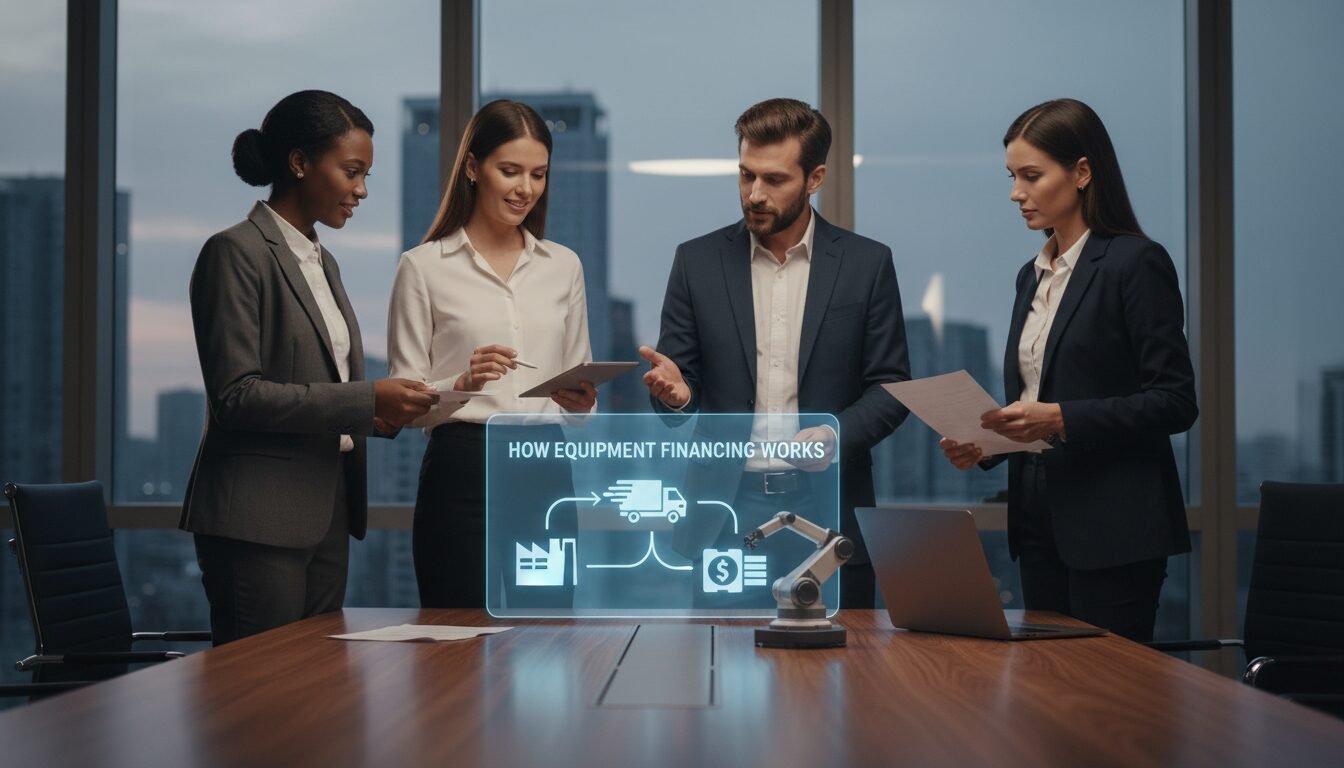
Most equipment finance business providers have streamlined their application processes to deliver decisions quickly. For example, Crest Capital’s online form adds no inquiry to personal credit, and U.S. Bank offers an application‑only route for deals up to $200,000 with a $375 origination fee. Typically, you will need to provide your business tax ID, gross annual sales, the date your business was established, and a description and estimated price of the equipment. For used equipment, lenders may require appraisals, photos, and serial numbers to determine value.
Step‑by‑Step: From Inquiry to Funding
- Submit an application. Fill out a one‑page form online or in person. Include ownership details for anyone with 25% or more stake.
- Receive a decision. Many providers respond within hours on amounts up to $250,000, and larger requests may take a few days.
- Sign documents electronically. Once approved, minimal paperwork is required. Crest Capital, for instance, prides itself on a no‑hassle signing process.
- Lender pays the vendor directly. The finance company remits payment to the equipment supplier, and you can start using the asset immediately.
- Set up payments. Repayment terms typically range from 24 to 60 months, with options for seasonal or balloon payments based on cash flow cycles.
Funding Speed and Amounts
Speed is a major differentiator among providers. U.S. Bank can deliver funding in as little as 48 hours for qualified borrowers. Crest Capital emphasizes same‑day decisions without the paperwork demands of traditional banks. Funding amounts vary widely: small‑ticket loans of $5,000 to $150,000 (National Funding), mid‑range transactions up to $250,000 or $500,000 (Crest Capital), and large corporate deals from $1 million to $20 million or more for industrial equipment (J.P. Morgan). The flexibility to choose the funding size makes equipment finance business solutions accessible to startups and Fortune 500 firms alike.
Equipment Loan vs. Lease: Key Differences
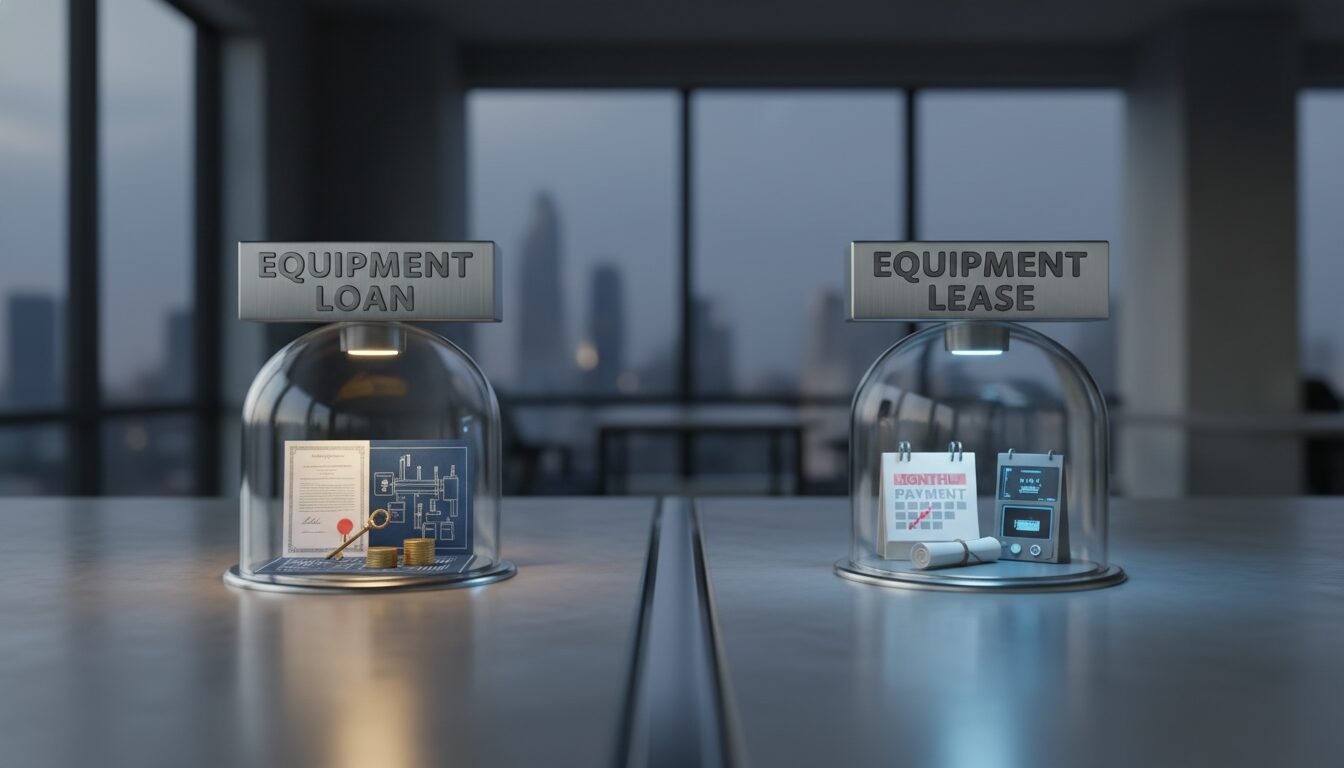
An equipment loan gives the borrower ownership after the final payment. Loans may require a down payment, often 10‑20% of the equipment’s cost, but some lenders offer 100% financing, including soft costs like delivery and installation. A lease, in contrast, requires little to no upfront cash because the lessor buys the asset and rents it to you. At the end of the lease, you can return the equipment, extend the agreement, or purchase it under a fixed‑price option. This difference is critical when planning your balance sheet: loans add an asset and a liability, while an operating lease may be treated as an off‑balance‑sheet expense.
Monthly Payments and Tax Treatment
Monthly payments on a loan are typically higher because you are paying off the entire principal plus interest. Lease payments are often lower because the lessor retains a residual interest in the equipment. Tax treatment also diverges. With a loan, you can deduct interest expense and claim depreciation (or even expense the full cost under Section 179). Lease payments, for a true tax lease, are fully deductible as an operating expense. This makes leasing especially attractive for assets that become obsolete quickly, like computers and medical devices, where you plan to upgrade every three to five years.
Comparison: Equipment Loan vs. Equipment Lease
| Feature | Equipment Loan | Equipment Lease |
|---|---|---|
| Ownership | Borrower owns after final payment | Lessor owns; option to buy |
| Upfront Cost | 0–20% down payment common | Minimal upfront cash |
| Monthly Payment | Higher (principal + interest) | Lower (rental for use) |
| Tax Benefits | Deduct interest; depreciate or expense under Section 179 | Deduct full lease payment as operating expense |
| End of Term | Own equipment free and clear | Return, extend, or purchase at fair market value or fixed price |
| Best For | Long‑lived assets with stable value | Technology or equipment that becomes obsolete quickly |
Pros and Cons
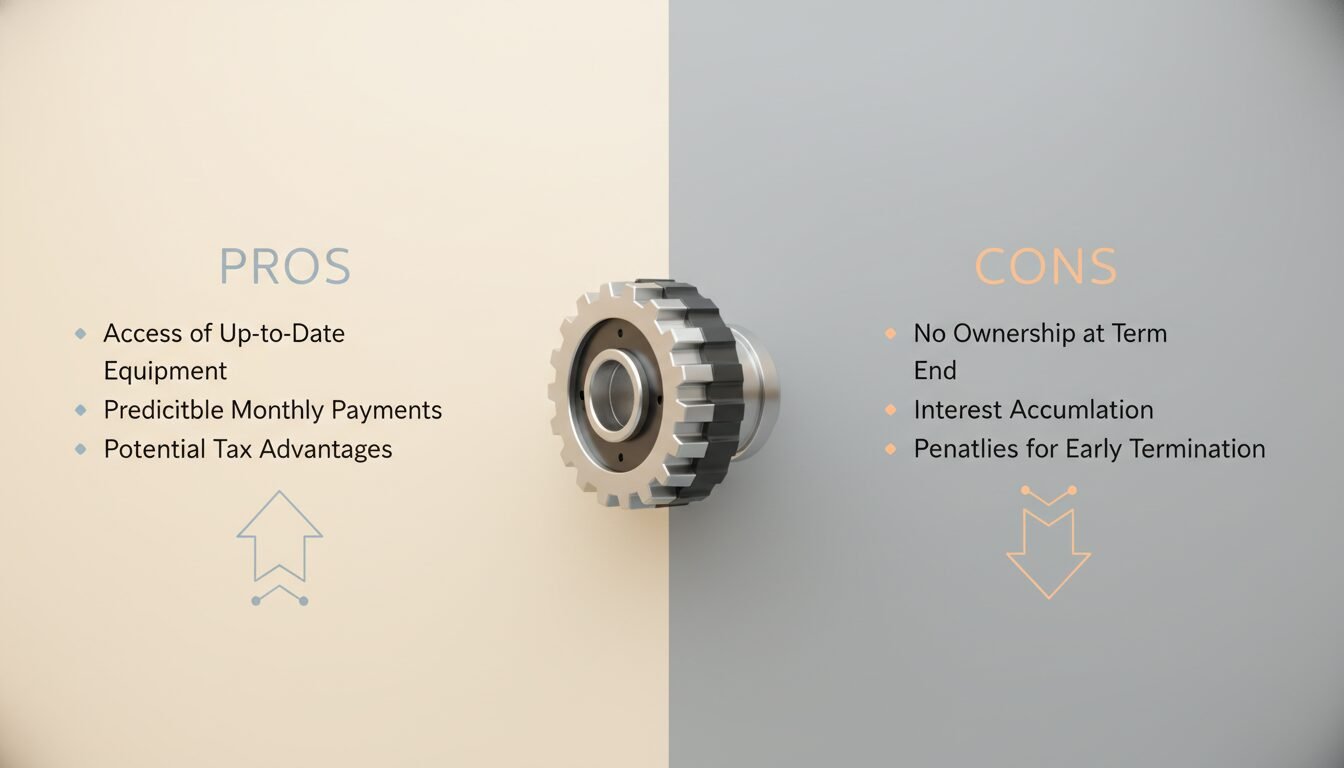
Pros
- Preserves cash flow and working capital for operations
- Enables immediate tax deductions through Section 179
- Flexible payment structures for seasonal businesses
- No dilution of equity compared to raising capital
- Fast approval and funding, often within 48 hours
Cons
- Interest costs increase total equipment expense over time
- Personal guarantees may be required for smaller businesses
- Credit requirements can exclude newer companies
- Equipment serves as collateral and can be repossessed
Benefits of Equipment Financing for Business Owners
Paying cash for a $100,000 piece of machinery drains working capital that could fuel marketing, hiring, or inventory. Equipment finance business solutions spread the cost across years, leaving core liquidity intact.
“When businesses purchase new equipment, it often takes years to realize the full benefits of that upfront cost. With equipment financing, business leaders can spread the costs over a period of time and better align the cost with the benefit of the equipment.” – Mark Bearden, Senior Vice President at First American Equipment Finance
This alignment turns a large capital outlay into a manageable operating expense.
Accelerate Growth Without Dilution
For startups and growing firms, equity capital is precious. Rather than selling a stake in your company to fund a fleet upgrade, equipment finance business options allow you to use assets to unlock growth.
“Those businesses can save and make more money than the interest they’re paying on the loan. Companies can get so much more out of what the asset can do for them than what the debt does.” – David Feldser, East Region Sales Leader for Equipment Financing at J.P. Morgan
This means the productivity gain from new equipment often exceeds the borrowing cost, making financing a net‑positive decision.
Flexible Structures for Seasonal Businesses
Many equipment finance business providers offer seasonal payment plans, balloon payments, or skip‑a‑pay options. Wells Fargo’s commercial vehicle group, for example, structures loans around freight cycles so that repayments align with high‑revenue months. This flexibility reduces the strain of fixed obligations during slow periods. Construction companies often use step‑up leases that start low and increase as project revenues grow, matching cash outflow with inflow.
Eligibility and Requirements for Equipment Finance
Most equipment finance business lenders set a minimum credit score of 650. While this is lower than many conventional bank loans, lenders also weigh the time your company has been operating, typically at least two years under the same ownership. They will examine your borrowing history, including any previous equipment loans or leases, to gauge reliability. For newer businesses, some niche lenders and online platforms accept scores as low as 600 if the equipment itself holds significant collateral value, though rates will be higher.
Financial Statements and Debt Service Coverage
When a deal exceeds a certain threshold, often $250,000, lenders require tax returns and financial statements. A key metric is the debt service coverage ratio (DSCR), which measures your business’s ability to pay its current debt obligations from operating income. A DSCR above 1.25 is typically expected, demonstrating that you generate at least 25% more cash flow than needed to cover payments. For smaller transactions, many equipment finance business providers skip this step entirely; Crest Capital advertises no financial statements up to $250,000, while U.S. Bank uses a streamlined application‑only process up to $200,000.
Equipment Valuation and Soft Costs
Lenders will evaluate the equipment’s value to determine loan size. For new equipment, the sale price is usually accepted. For used equipment, an appraisal may be required, along with photos and serial numbers. Some equipment finance business companies will include soft costs such as delivery, installation, training, and sales tax into the financing package. U.S. Bank allows up to 25% of additional costs to be rolled into the agreement, while Crest Capital states it will finance 100% of soft costs. This comprehensive approach reduces the immediate cash burden even further.
Tax Advantages and Section 179 Deductions
The IRS’s Section 179 enables businesses to deduct the full purchase price of qualified equipment in the year it is placed in service. Both new and used equipment qualify, making it a powerful incentive for small and medium businesses. Financing amplifies this benefit: you can deduct the entire cost even though you have only made a fraction of the payments. National Funding emphasizes that by financing equipment before December 31, you can claim a 100% tax deduction for the current year while preserving cash.
Bonus Depreciation and Lease Deductions
In addition to Section 179, businesses can take advantage of bonus depreciation, which for 2026 allows 60% immediate write‑off of new and used assets with a recovery period of 20 years or less. When using an equipment lease, the full lease payment is generally deductible as an operating expense, providing a predictable, front‑loaded tax benefit. The choice between loan and lease can be influenced by whether you want the deduction tied to depreciation (loan) or to the rental payment (lease). Consult a tax advisor to optimize the strategy for your specific situation.
Real‑World Example of Tax Savings
Consider a construction business that finances a $100,000 excavator. By making a minimal down payment and using Section 179, the company can deduct the full $100,000 in year one, potentially saving $21,000 in federal taxes (assuming a 21% corporate rate). The loan repayments over 48 months would total about $110,000 with interest, but the net after‑tax cost is far lower. This immediate write‑off incentives timely equipment upgrades and supports capital‑intensive industries like manufacturing and transportation.
Choosing the Right Equipment Finance Business Partner
Large banks such as J.P. Morgan and Wells Fargo offer equipment finance business services as part of a broader relationship, often with lower rates for established customers. They also provide complex structures for specialized assets like rail cars or aircraft. Independent lenders like Crest Capital focus on speed and simplicity, often promising no liens on other business assets and no annual re‑qualification. For small businesses, the bank may require blanket liens and personal guarantees, while a specialized finance company leaves your home and other assets untouched. Evaluating your priorities, lowest rate versus least hassle, will guide the decision.
Technology and Digital Service
Modern equipment finance business providers have invested heavily in digital platforms. Online applications, instant soft‑pulls, and automated underwriting now deliver decisions in minutes, not weeks. This shift is driven by fintech integration and the demand for transparency. When selecting a partner, check whether they offer a self‑service portal for managing payments, viewing documents, and requesting additional funding. A true differentiator is whether the lender places a hard inquiry on your personal credit; Crest Capital explicitly does not, preserving your score for other needs.
Sustainability and ESG‑Linked Financing
An emerging trend is financing solutions that reward sustainability. Some equipment finance business lenders offer lower rates for energy‑efficient or low‑emission assets. For example, a logistics company acquiring electric delivery vans may receive a 50‑basis‑point discount from a bank’s green lending program. Equipment leases can also facilitate the circular economy by enabling easy upgrades and returns of technology, reducing e‑waste. As ESG (environmental, social, and governance) mandates grow, aligning your financing choices with sustainability goals can strengthen your brand and potentially lower costs.
Trends Shaping the Future of Equipment Finance Business
Artificial intelligence is reshaping how equipment finance business providers assess risk. Instead of relying solely on credit scores and tax returns, lenders now analyze bank transaction data, online reviews, and even social media sentiment to predict repayment capacity. This allows thinner‑file businesses, such as startups or sole proprietorships, to access financing that was previously out of reach. According to a 2025 McKinsey report, AI‑driven underwriting reduces default rates by 15‑20% while expanding approval rates by 10%.
Platform Business Models and Embedded Finance
Equipment finance business solutions are increasingly offered at the point of sale through embedded finance platforms. When you order a SaaS subscription or buy a tractor, the vendor can instantly present a financing offer powered by a behind‑the‑scenes lending API. Companies like Stripe and Square have entered the space, enabling any equipment seller to offer monthly payment plans. This integration shortens the sales cycle and makes equipment finance business options more accessible to micro‑enterprises. By 2027, over 40% of equipment transactions are expected to include embedded finance options.
Globalization of Equipment Finance
As supply chains become more global, equipment finance business operations follow. U.S. lenders are increasingly financing assets that will be deployed abroad, and multinational corporations use multi‑country leasing structures to centralize procurement. For exporters, having a finance partner that can handle cross‑border collateral and multi‑currency cash flows is a major advantage. The Equipment Leasing & Finance Association now tracks international volume, which grew 12% annually over the past three years, reflecting the sector’s borderless evolution.
Frequently Asked Questions
What is equipment financing?
Equipment financing is a loan or lease that lets a business acquire tools, machinery, or technology by making periodic payments instead of paying the full amount upfront. It can fund new or used assets and often includes soft costs like delivery and installation.
Can I finance used equipment?
Yes, most equipment finance business providers fund both new and pre‑owned equipment. For used assets, lenders may require an appraisal, and the financing amount may be capped at a percentage of the appraised value. This makes it possible to upgrade operations even with a limited budget.
What credit score do I need for equipment financing?
A credit score of 650 is the common minimum, though some online lenders accept scores as low as 600. Since this is business financing, factors like time in business (usually two years), revenue history, and the equipment’s value also influence approval.
How is equipment leasing different from a loan?
With a lease, you rent the equipment for a set period and may have the option to buy it at the end. With a loan, you own the equipment after the final payment. Leases typically have lower monthly payments but no ownership stake unless you exercise a purchase option.
What types of equipment can be financed?
Virtually any business asset can be financed, including construction machinery, commercial vehicles, manufacturing equipment, medical devices, IT hardware, software, and office furniture. Even intangible items like customized software and installation costs often qualify.
How fast can I get funded?
Many online lenders provide same‑day decisions and can fund within 48 hours for amounts up to $250,000. Banks may take a few days to a week for larger deals. Having your documentation ready, tax ID, bank statements, equipment quote, speeds up the process considerably.
Connect with Amin to discuss AI strategy for your business.
Enjoyed this article?
Connect with me for collaboration, ventures, or just a good conversation about building things.
Get in Touch