Content Production Process: Build a Scalable System in 2026

Content production is the systematic process of developing and managing visual or written assets, videos, blog posts, infographics, to engage a target audience. It covers planning, creation, editing, and distribution, ensuring consistent, scalable output.
Key Takeaways
- Content production is the operational backbone of content marketing, turning creative ideas into polished, publish-ready assets.
- A documented, repeatable process helps teams scale output from 5 to 50+ pieces per month without sacrificing quality.
- Understanding the divide between content creation (what you make) and content production (how you make and deliver it) aligns strategy for greater impact.
- Leveraging the right tools and AI can cut production cycles by automating repetitive tasks, freeing teams for higher-value creative work.
What Is Content Production?
A Clear Definition
Content production is the end-to-end process of developing and creating visual or written assets, such as videos, eBooks, blog posts, whitepapers, or infographics, as Kapost by Upland Software defines it. It is the operational engine that turns creative ideas into finished, ready-to-publish content. Unlike one-off content creation, content production emphasizes repeatability, quality control, and alignment with strategic goals.
I learned this distinction the hard way when my first startup burned through $30K in freelance content costs in three months with nothing to show for it. We had great individual pieces but no system to turn them into a consistent marketing engine. That’s when I realized the difference between making content and producing it at scale.
Why a Systematic Approach Matters
A well-designed content production process transforms marketing from chaotic bursts of creativity into a steady, reliable output. According to Jasper, a scalable approach delivers consistent quality, increased efficiency, and faster turnaround times. Teams that standardize their workflows report fewer bottlenecks and lower costs, even as demand grows. When every team member knows their role, from initial brief to final publish, collaboration improves, and content velocity becomes a measurable asset.
Based on my experience building multiple content teams, the companies that treat production as seriously as they treat strategy consistently outperform those that wing it. They publish more, waste less, and actually hit their marketing goals.
Content Creation vs. Content Production: Understanding the Difference
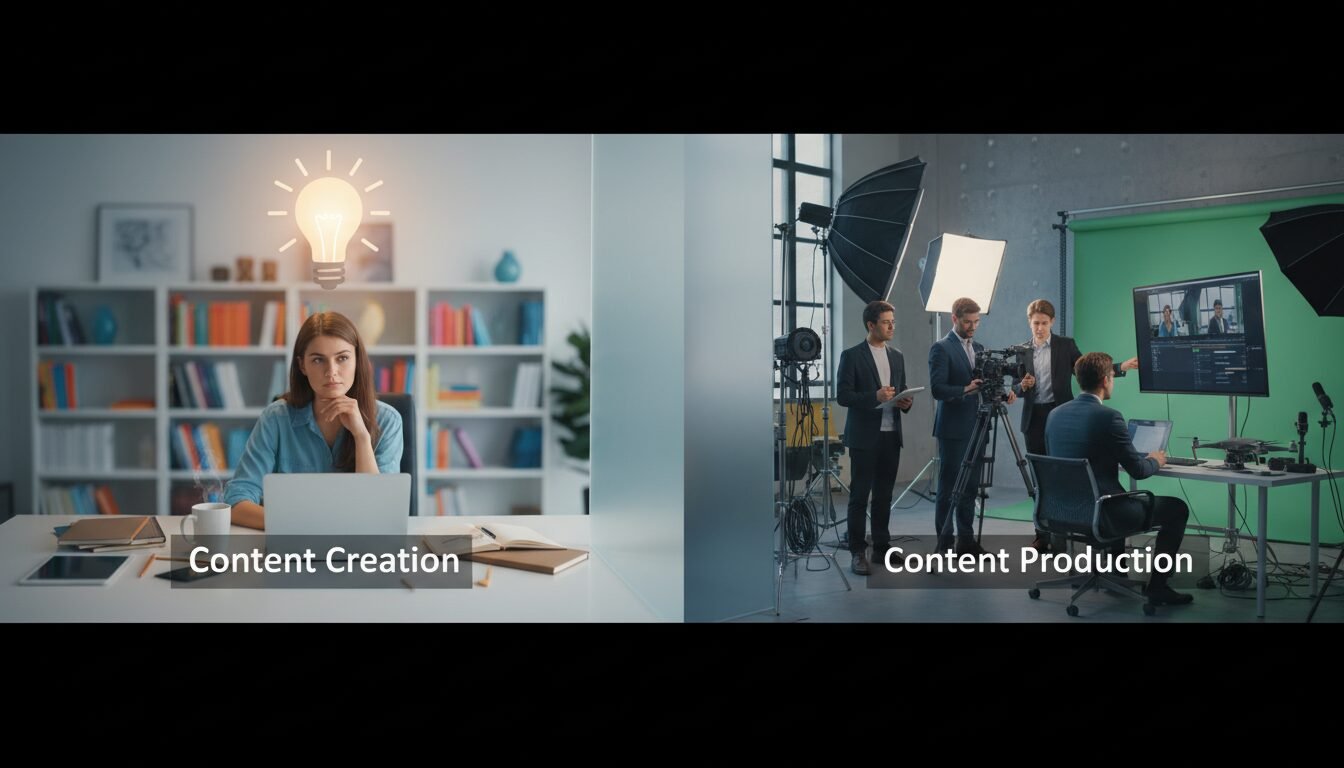
The Creative Spark: Content Creation
Content creation is the imaginative, hands-on phase where writers, designers, and videographers bring original ideas to life. It focuses on the “what” of your content: blog posts, graphics, social media snippets, or scripts. This stage is fueled by storytelling, visual design, and subject-matter expertise. While creation is undeniably important, it’s only half the picture.
The Operational Engine: Content Production
In contrast, content production is the “how” behind the scenes. It encompasses workflow setup, deadline management, editing cycles, scheduling, and multi-channel distribution. Content production ensures that a brilliant blog article doesn’t sit unpublished; instead, it gets SEO-optimized, formatted, approved, and pushed live on time. This systematic layer is what makes marketing output scalable and consistent.
| Aspect | Content Creation | Content Production |
|---|---|---|
| Focus | Generating original ideas and assets | Managing the workflow to finalize and distribute |
| Primary Activities | Writing, designing, filming, storytelling | Planning, editing, scheduling, QA, publishing |
| Goal | Creative expression that grabs attention | Consistent, on-brand, and timely delivery |
| Output | Drafts, storyboards, raw footage | Polished, publish-ready, multi-format assets |
| Required Skills | Writing ability, design sense, narrative flair | Project management, tool proficiency, QA eye |
How They Work Together
Dumpling AI explains that creation and production form a continuous cycle: content creation fuels originality, while content production ensures that originality reaches the right audience at the right time. When both sides synchronize, marketing stops being a series of isolated hits and becomes a reliable engine for long-term growth.
6 Steps to Build a Scalable Content Production Process

Laying the Foundation: Strategy and Ideation
Step 1: Define your strategy. Understand your audience, business objectives, and the content formats that match your channels. A solid plan, often captured in a creative brief, outlines project context, deliverables, timelines, and necessary resources. Step 2: Research and ideation. Dive into trending topics, keyword analysis, and competitor gaps. Generate a backlog of ideas that align with your strategic pillars. This upfront effort prevents wasted cycles down the line.
Content Creation and Review
Step 3: Assign creation tasks. Whether a blog post, a video script, or an infographic, pair the right creator with a robust brief. Step 4: Conduct structured reviews. Multiple rounds of editing ensure accuracy, brand tone, and visual consistency. Kapost emphasizes the importance of a kickoff meeting to align expectations, even introverted creatives benefit from a quick call to clarify nuance. A well-run review cycle typically involves a writer, an editor, a designer, and a subject matter expert.
Publishing and Distribution
Step 5: Final optimization. Apply SEO meta tags, compress images, embed tracking codes, and schedule the post in your CMS. Step 6: Distribute across channels. Share on social platforms, send in newsletters, and syndicate as appropriate. Then, monitor performance metrics like engagement, clicks, and conversions. This closed-loop system feeds insights back into ideation, making the next cycle smarter.
What to Look For in Content Production Tools

Choosing the right tools can make or break your production workflow. After testing dozens of platforms across multiple companies, here’s what actually matters when evaluating options.
Essential Features for Any Production Stack
First, look for workflow automation. The tool should handle task assignments, deadline reminders, and approval routing without manual intervention. Second, version control is non-negotiable, you need to see who changed what and when. Third, integration capabilities matter more than fancy features. Your production tool should connect with your CMS, social schedulers, and analytics platforms.
Real-time collaboration features separate good tools from great ones. Look for comment threads, @mentions, and live editing capabilities. If your team wastes time in email chains about content feedback, you’re using the wrong platform.
Budget vs. Premium Tool Comparison
| Tool Category | Budget Option | Premium Option | Key Difference |
|---|---|---|---|
| Project Management | Trello ($5/user/month) | Monday.com ($24/user/month) | Advanced automation and reporting |
| Asset Management | Google Drive ($6/user/month) | Bynder ($500+/month) | Brand compliance and usage tracking |
| Content Creation | Canva Pro ($15/month) | Adobe Creative Suite ($53/month) | Professional design capabilities |
| Writing Assistant | Grammarly ($12/month) | Jasper AI ($49/month) | AI content generation vs. editing only |
What I Learned About Tool Selection
Start simple and upgrade based on actual pain points, not feature lists. We spent $2,000/month on a enterprise DAM system that our team of 8 barely used. Meanwhile, a $50/month Notion workspace handled 90% of our workflow needs perfectly. The best tool is the one your team actually adopts.
Building Your Content Production Team
Core Roles in a Production Team
Effective content production relies on clearly defined roles. A content strategist owns the roadmap; writers and designers handle creation; an editor reviews for quality; a project manager keeps timelines on track; and a distribution specialist pushes assets live. For high-complexity assets like branded videos, the team can expand to over 7 specialists, including a producer, director, camera operator, gaffer, audio engineer, and editor, as outlined by Kapost.
Skills That Drive Quality
While creativity powers the writing and design stages, content production demands organization, attention to detail, and tool fluency. Production-focused roles require mastery of workflow platforms, editorial calendars, and analytics dashboards. Training team members on these systems reduces friction and accelerates output.
Hiring for Production vs. Creation
When hiring for production roles, prioritize systems thinking over creative flair. Look for candidates who’ve managed editorial calendars, coordinated cross-functional teams, or optimized workflows in previous roles. Ask specific questions: “Walk me through how you’d handle a situation where three pieces are due the same day but the designer is out sick.”
For creation roles, balance creative skills with production awareness. The best content creators understand how their work fits into the larger system. They write with SEO in mind, design for multiple formats, and communicate proactively about timeline challenges.
Tools That Streamline Content Production
Content Management Systems (CMS)
A CMS like WordPress or HubSpot serves as the central hub for publishing and organizing content. Integrated directly into the content production workflow, a CMS automates staging, scheduling, and version control.
Workflow and Collaboration Tools
Platforms such as Bynder, CELUM, and Dumpling AI bring visual collaboration, asset management, and automated approval chains into one interface. These tools cut email back-and-forth and make it easy to see exactly where a piece is stuck.
AI-Powered Content Tools
AI writing assistants like Jasper, AI image generators, and automated video editors are reshaping content production. They can draft initial copy, suggest SEO optimizations, and even produce voiceovers, slashing the earliest, and often most time-consuming, stages of creation. The Nine uses its proprietary AI tool, Vox Verba, to generate brand-specific insights that feed directly into the ideation phase, demonstrating how AI can augment strategic planning, not just execution.
Content Production Workflows That Actually Work
Most production workflows fail because they’re designed in theory, not tested in practice. Here’s what I’ve learned works across different team sizes and content types.
The 3-Phase Production Cycle
Phase 1: Planning and briefing (20% of total time). This includes strategy alignment, research, and detailed creative briefs. Rush this phase and you’ll pay for it later in revisions and missed deadlines.
Phase 2: Creation and review (60% of total time). This covers writing, design, editing, and stakeholder feedback. Build in buffer time, creative work rarely goes according to schedule.
Phase 3: Optimization and distribution (20% of total time). Final SEO tweaks, formatting for different channels, scheduling, and performance tracking. Don’t treat this as an afterthought.
Quality Gates That Prevent Disasters
Implement mandatory checkpoints at each phase transition. Before moving from planning to creation, verify that the brief answers these questions: Who is the audience? What action should they take? How does this support business goals? What success metrics will we track?
Before publishing, run through this checklist: Brand voice consistent? SEO optimized? Legal/compliance reviewed? Distribution channels confirmed? Analytics tracking enabled? These gates feel bureaucratic until they save you from a public mistake.
Measuring and Optimizing Your Content Production
Key Performance Indicators (KPIs)
Track metrics like content velocity (pieces published per week), cycle time from brief to live, error rates, and team utilization. Engagement metrics, shares, time on page, conversion rate, indicate whether your production quality resonates. Set benchmarks, then monitor them monthly.
Using Data to Improve
A data-driven content production operation never stops evolving. Review performance data quarterly to spot underperforming formats or channels. Use those insights to reallocate resources or refine templates. Even small tweaks, like adjusting headline formulas or image styles, can lift overall effectiveness by double digits.
Production Metrics That Actually Matter
Focus on leading indicators, not just lagging ones. Time-to-first-draft tells you if your briefing process works. Revision rounds per piece reveals whether your review process is effective. Cost-per-published-piece shows if you’re scaling efficiently.
Track quality metrics alongside quantity. Measure brand compliance scores, factual accuracy rates, and on-time delivery percentages. A system that produces 50 pieces per month but requires extensive rework isn’t actually scalable.
Content Production Trends Shaping 2026 and Beyond
The Rise of AI-Generated and Assisted Content
Generative AI is moving from novelty to necessity. Modern content production platforms embed AI at multiple stages: idea generation, first-draft creation, auto-tagging, and even compliance checks. Teams that adopt AI now are scaling output without expanding headcount.
As of 2026, the most successful teams use AI for speed and humans for strategy. AI handles first drafts, image generation, and data analysis. Humans focus on brand voice, strategic direction, and complex storytelling that requires emotional intelligence.
Interactive and Personalized Content
Static blog posts are giving way to quizzes, calculators, and dynamic infographics that adapt to user data. This shift places new demands on content production, requiring tighter integration between design, development, and data teams.
The Expanding Creator Economy
The creator economy was valued at £250 billion in 2023 and is projected to nearly double by 2027, according to Chrome Productions. This growth means more competition for attention, and smarter content production is the dividing line between channels that thrive and those that fade.
Common Production Mistakes and How to Avoid Them
Every production system breaks in predictable ways. Here are the mistakes I see repeatedly and how to prevent them.
The Perfectionism Trap
Teams often get stuck in endless revision cycles, trying to perfect every piece. Set clear “good enough” standards and stick to them. A published piece that’s 85% perfect beats a perfect piece that never ships.
Implement revision limits: two rounds for blog posts, three for major campaigns. After that, you’re optimizing for diminishing returns while your publication schedule suffers.
The Bottleneck Problem
Most production systems fail at the review stage. One busy executive becomes the bottleneck for all content approval. Build parallel review tracks and clear escalation procedures. If someone doesn’t respond within 48 hours, the content moves forward with documented approval from their delegate.
The Tool Sprawl Issue
Teams accumulate tools faster than they integrate them. You end up with content in Google Docs, images in Dropbox, schedules in Trello, and analytics in three different platforms. Audit your tool stack quarterly and consolidate ruthlessly.
Scaling Production: From Startup to Enterprise
Production needs change dramatically as teams grow. What works for a 3-person startup breaks at 30 people.
Startup Stage (1-10 people)
Focus on simple, flexible systems. A shared Google Drive folder and weekly planning meetings might be enough. Prioritize speed over process, you’re still figuring out what content works.
Growth Stage (10-50 people)
Invest in proper workflow tools and documentation. Create style guides, approval hierarchies, and content calendars. This is when you need dedicated production roles, not just creators wearing multiple hats.
Enterprise Stage (50+ people)
Implement governance frameworks, compliance workflows, and advanced analytics. You need systems that work across multiple teams, brands, and regions. Consider enterprise DAM platforms and dedicated production managers.
Care and Maintenance: Keeping Your Production System Healthy
Even the best production systems degrade without regular maintenance. Here’s how to keep yours running smoothly.
Monthly Health Checks
Review your key metrics: average cycle time, revision rates, on-time delivery percentage. Look for trends, not just snapshots. If cycle time is creeping up, investigate before it becomes a crisis.
Survey your team monthly about process pain points. The people doing the work often spot problems before the metrics do.
Quarterly Process Audits
Every quarter, map your actual workflow against your documented process. Where do they diverge? Why? Sometimes the workarounds your team creates are better than the official process.
Update templates, style guides, and tool configurations based on what you learn. A production system that doesn’t evolve becomes a constraint on growth.
Annual Strategic Reviews
Once per year, step back and evaluate whether your production approach still serves your business goals. Are you producing the right content types? For the right channels? With the right quality standards?
This is when you might decide to shift from blog-heavy to video-first, or from broad content to highly targeted pieces. Your production system should adapt to support these strategic pivots.
Frequently Asked Questions
What exactly is content production?
Content production is the systematic process of developing, creating, and managing visual or written assets, videos, blog posts, infographics, from initial brief to final publication. It covers planning, creation, editing, optimization, and distribution.
How is content production different from content creation?
Content creation focuses on generating original ideas and assets; content production handles the workflow, editing, scheduling, and delivery that turns those ideas into finished, published content at scale.
What are the essential steps in a content production process?
A robust process typically includes six steps: strategy and planning, research and ideation, content creation, editing and review, final optimization, and multi-channel distribution.
Which tools help with content production?
Popular tools include content management systems (WordPress, HubSpot), digital asset management platforms (Bynder, CELUM), workflow automation apps, and AI writing assistants (Jasper, Dumpling AI).
How can I scale content production without losing quality?
Document every workflow, use clear templates and style guides, invest in training, and adopt automation for repetitive tasks. A documented process lets you handle 5 or 50 pieces a month with consistent quality.
What KPIs should I track for content production?
Key metrics include content velocity (pieces per time period), cycle time from assignment to publish, error rates, team utilization, and downstream engagement metrics like shares and conversions.
How much should I budget for content production tools?
Expect to spend $50-200 per team member per month for a complete tool stack. Start with budget options and upgrade based on actual needs, not feature lists. Most teams over-buy initially.
When should I hire a dedicated content production manager?
Consider a dedicated production manager when you’re publishing 20+ pieces per month or managing 5+ content creators. The role pays for itself by reducing bottlenecks and improving quality consistency.
Enjoyed this article?
Connect with me for collaboration, ventures, or just a good conversation about building things.
Get in Touch