B2B Content Marketing Strategy That Actually Works

Content marketing for B2B is the strategic creation and distribution of valuable content to attract, educate, and convert business decision-makers. It builds trust across long sales cycles involving multiple stakeholders.
Key Takeaways
- Content marketing for B2B consistently delivers 2-3x return on investment when executed with a clear strategy.
- B2B buying committees typically include 6-10 decision-makers, so content must address multiple roles and concerns.
- Blog posts, case studies, white papers, and webinars remain the highest-performing formats for B2B audiences.
- Nine out of ten B2B marketers are actively using content marketing strategies as of 2026.
- Repurposing content across formats is the most cost-efficient way to extend reach without inflating budgets.
- Measuring content impact through CRM-linked attribution is what separates strategic programs from random publishing.
“You’re trying to out-teach your competition, not outspend them.” – TK Kader, SaaS marketing expert
I’ve built content programs from scratch at multiple companies, and the pattern is always the same: teams that treat content as a publishing calendar fail, while teams that treat it as a sales asset win. The difference isn’t budget. It’s intent.
Nine out of ten B2B marketers are using content marketing strategies, according to the Content Marketing Institute. Yet most of them are producing content that nobody reads, shares, or acts on. This guide covers what actually works, based on real programs I’ve run and studied closely.
What is Content Marketing for B2B?
Defining the Approach
Content marketing for B2B is a strategic methodology focused on creating and sharing informative, educational content to engage other businesses. It’s not about selling directly. It’s about helping prospects solve problems, understand industry trends, and make confident purchasing decisions. Unlike B2C, B2B buyers are highly informed and conduct extensive research before ever talking to a sales rep. According to Demand Gen Report, 96% of B2B buyers want content with more input from industry thought leaders. That means your content must be authoritative, data-driven, and tailored to complex buying committees, not just one person.
B2B vs. B2C Content Marketing: A Comparison
| Aspect | B2B Content Marketing | B2C Content Marketing |
|---|---|---|
| Audience | Business decision-makers, committees | Individual consumers |
| Goal | Lead generation, authority, long relationships | Direct sales, brand loyalty |
| Content Tone | Professional, data-driven, educational | Emotional, entertaining, visual |
| Typical Formats | White papers, case studies, webinars, blogs | Social media posts, videos, ads |
| Sales Cycle | Long (months), multiple touchpoints | Short (minutes to days), impulse |
Why Content Marketing for B2B Delivers Real ROI

High Returns on a Low-Cost Channel
Content marketing for B2B delivers an average return of 2 to 3 times the initial investment, according to Forbes. Paid advertising stops generating results the moment you cut the budget. A well-optimized blog post or white paper keeps generating organic traffic for years. Research from Blue Noda shows that 53% of marketers repurpose existing content to maintain momentum without ballooning budgets. That longevity turns a single piece into a perpetual lead asset.
I’ve seen this firsthand. A single technical white paper we produced for a SaaS client generated qualified inbound leads for over 18 months after publication, with zero additional spend. No paid channel comes close to that economics.
Long-Term Brand Building and Trust
Trust is the foundation of B2B sales, and content builds it faster than almost anything else. Data from Lead Forensics shows that 83% of B2B marketers achieve brand awareness goals through content marketing, and 77% report building credibility with their target audience. Educational content positions your company as the expert buyers call first, not the vendor they evaluate last.
Nurturing Leads Through Complex Sales Cycles
B2B purchasing typically involves 6-10 decision-makers and lasts months. Content nurtures leads at every stage: from initial problem recognition (top-of-funnel blog posts) to vendor comparison (case studies) and final validation (customer testimonials). The Content Marketing Institute reports that 87% of marketers credit content marketing with increased brand awareness, while 74% saw measurable gains in demand and lead generation. No other channel educates and pre-qualifies prospects so efficiently.
Pros and Cons of Content Marketing for B2B

Pros
- Compounding ROI: Quality content generates traffic and leads long after publication, unlike paid ads that stop the moment you pause spend.
- Trust and authority: Consistent educational content positions your brand as the go-to expert in your category.
- Lead qualification: Buyers who engage with your content self-select based on interest, arriving more informed and more ready to buy.
- Scalable distribution: One strong piece of content can be repurposed into blog posts, social clips, email sequences, and webinar material.
- Supports every funnel stage: From awareness blogs to decision-stage case studies, content works across the entire buyer journey.
Cons
- Slow to show results: Content marketing is a long game. Expect 6-12 months before organic traffic and lead volume become significant.
- Resource intensive: High-quality B2B content requires subject matter expertise, skilled writers, and consistent editorial investment.
- Hard to attribute precisely: Multi-touch attribution across a long sales cycle makes it difficult to tie specific content pieces to closed revenue.
- Requires ongoing maintenance: Outdated content can hurt SEO and credibility. Regular audits and updates are non-negotiable.
Building a Strategic Framework for B2B Content Marketing
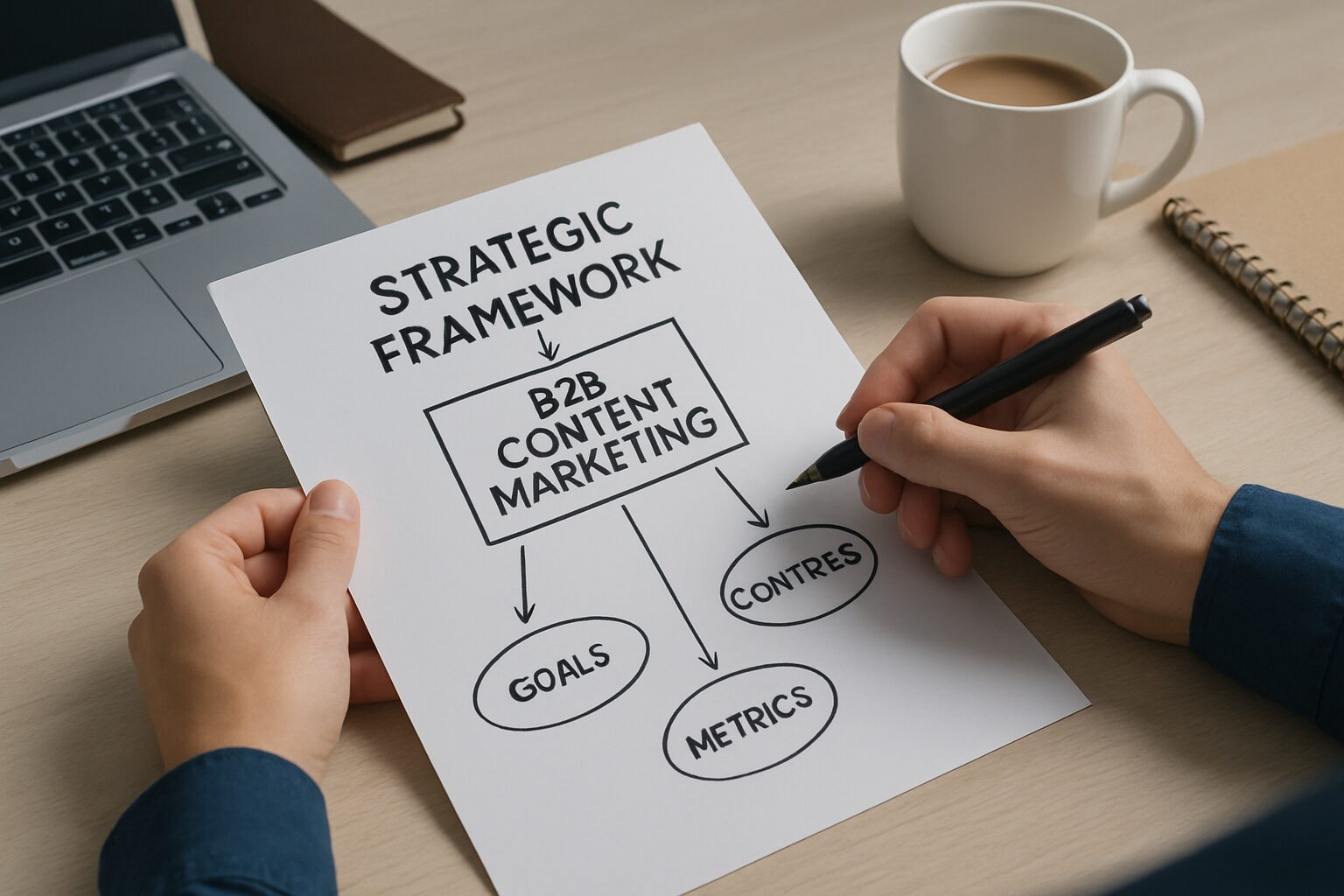
A 6-Step Framework to Launch Your Strategy
- Define Clear Objectives and KPIs: Align content goals with business outcomes. Target increases in marketing-qualified leads, organic traffic growth, or pipeline contribution. Track website traffic, lead conversion rates, and time on page from day one.
- Conduct Thorough Audience Research: Build detailed buyer personas representing real decision-makers: their roles, challenges, and information sources. Use LinkedIn Sales Navigator and direct customer interviews to map the full buying committee.
- Perform a Content Audit: Review existing assets to identify underperformers and coverage gaps. A yearly audit prevents wasted resources and sharpens your editorial plan considerably.
- Map Content to the Funnel: Create tailored content for each stage. Educational blogs for awareness, white papers and webinars for consideration, testimonials and comparison guides for the decision stage.
- Execute and Optimize: Produce high-quality, SEO-friendly content. Use tools like Google Analytics and Salesforce Marketing Cloud to monitor performance and iterate quickly.
- Distribute, Measure, and Refine: Promote via organic social, email, and paid channels. Analyze KPIs quarterly and double down on what drives pipeline.
Audience Research and Buyer Personas
Effective content marketing for B2B starts with knowing exactly who you’re writing for. Build semi-fictional buyer personas based on real data: interviews, sales team insights, and digital behavior patterns. Account-based marketing (ABM) techniques let you tailor content for specific high-value accounts, increasing relevance and engagement dramatically. A persona like “IT Director Sarah” might prioritize security white papers, while “VP of Operations Mark” needs ROI calculators. That level of specificity is what separates content that converts from content that just exists.
Content Audits: Finding Gaps and Opportunities
A systematic content audit evaluates your blog posts, case studies, videos, and other assets against performance metrics and funnel alignment. It reveals which topics drive traffic and which are missing entirely. Combined with competitive analysis, audits ensure your content occupies unique territory. Instead of copying competitors, you find angles they’ve missed: perhaps an original research report that becomes the primary source for your entire industry. This process turns content marketing for B2B from a guessing game into a data-driven engine.
Integrating CRM Tools Into Your Content Workflow
One area most teams underinvest in is connecting content activity to CRM data. Platforms like Salesforce and HubSpot allow you to track which content pieces a prospect engaged with before becoming an opportunity. This closes the attribution loop. When your sales team can see that a prospect downloaded three white papers and attended a webinar before requesting a demo, they enter that conversation with real context. Set up UTM parameters on every content asset, connect them to your CRM, and build a dashboard that shows content-influenced pipeline. It’s the difference between a content program that feels like a cost center and one that gets budget increases every quarter.
Crafting Content for Every Stage of the B2B Funnel
Top-of-Funnel: Educating and Attracting
At the awareness stage, your content must attract strangers by addressing broad business problems. Blog posts, infographics, and social content introducing industry trends work best here. A cybersecurity firm might publish “Top 5 Emerging Threats in 2026” to capture IT leaders’ attention early in their research. The goal is to inform, not sell. SEO optimization for long-tail queries ensures this content appears when decision-makers begin their search, often months before they contact any vendor.
Middle-of-Funnel: Building Trust and Qualifying Leads
After initial engagement, leads enter the consideration phase. Deeper content builds trust and demonstrates real expertise. Case studies, white papers, and webinars that showcase your methodology or ROI for similar clients are especially powerful. A marketing automation platform offering a webinar on “How Company X Increased Conversions by 30%” directly addresses evaluators’ need for proof. Gated content, requiring an email address for a white paper download, also helps qualify leads for sales follow-up without requiring a sales call.
Bottom-of-Funnel: Driving Conversions and Retention
Decision-stage buyers need validation. Customer testimonials, free trials, and personalized product demonstrations move them across the finish line. Detailed comparison guides and transparent pricing pages help procurement teams build internal business cases. Even after purchase, content marketing for B2B continues through onboarding guides and exclusive thought leadership, turning customers into advocates. This creates retention and upsell opportunities, making content a full-funnel asset rather than just a top-of-funnel play.
The Most Effective Content Types for B2B Audiences
Blog Posts and SEO-Driven Articles
Blogging remains foundational. According to OptinMonster, B2B marketers who blog consistently generate 67% more leads than those who don’t. SEO-optimized posts targeting long-tail queries attract high-intent traffic. A post optimized for “enterprise inventory management software” reaches decision-makers actively searching for solutions. Regular, high-quality publishing signals authority to search engines and feeds your email and social channels with fresh material simultaneously.
Case Studies and White Papers
Case studies provide social proof: real stories of how your solution solved a specific customer problem with measurable results. White papers offer deep analysis of complex issues, backed by data and original research. Both formats are highly trusted. According to Demand Gen Report, 96% of B2B buyers want more input from industry thought leaders, and these formats deliver exactly that. When gated behind a form, they become your most efficient lead generation tools.
Webinars and Video Content
Video is gaining serious traction in B2B. Webinars allow real-time interaction with experts, building immediate credibility with an audience that’s already opted in. Recorded webinars serve as on-demand assets for months afterward. Platforms like LinkedIn Live and YouTube enable broad distribution at low cost. Salesforce and HubSpot regularly host webinars that generate hundreds of qualified leads per event. The Content Marketing Institute reports that 60% of B2B marketers say content marketing increases engagement and leads, with video identified as a key driver of that trend.
Distribution and Promotion: Getting Your Content Seen
Organic Channels and SEO
Creating great content is only half the work. Distribution determines whether it reaches anyone. Build a B2B SEO strategy that targets high-intent keywords, optimizes meta tags, and earns backlinks from credible industry sources. Use Google Search Console to monitor performance and identify quick wins. Layer in organic channels: your company blog, email newsletters, and LinkedIn articles. Consistency across channels reinforces authority and keeps your brand visible throughout the long B2B buying cycle.
Social Media and Paid Amplification
Promote content on platforms where decision-makers spend time. LinkedIn is the primary channel for B2B, while Twitter (X) hosts active industry conversations worth joining. Paid social ads can amplify top-performing pieces to precise audiences. LinkedIn’s targeting by job title, company size, and industry is especially valuable for reaching buying committees. For ABM programs, tools like Demandbase or RollWorks deliver content directly to target accounts, increasing engagement among your highest-priority prospects.
Repurposing Content for Maximum Lifespan
High-performing content can be repurposed across multiple formats: turn a webinar into a blog post, a white paper into an infographic, or a case study into a short video series. This multiplies ROI without starting from scratch. Blue Noda research confirms that 53% of marketers repurpose content to extend its value across channels. A single original research report can yield weeks of social posts, email sequences, and even a conference speaking proposal. That’s the kind of content economics that justifies serious investment.
Outsourcing Content Creation: When and How
At some point, most B2B content teams hit a bandwidth wall. The choice is between hiring full-time writers or working with specialized agencies and freelancers. Both work, but the economics differ significantly. Freelance subject matter experts typically charge $200-$500 per article for technical B2B content, while full-service content agencies run $3,000-$10,000 per month for managed programs. The key is never outsourcing strategy. Keep editorial direction, audience research, and performance analysis in-house. Outsource execution once the strategy is locked. Teams that outsource strategy alongside execution almost always end up with generic content that doesn’t reflect their actual expertise or differentiation.
Measuring Success: KPIs for B2B Content Programs
Engagement Metrics
Monitor time on page, bounce rate, scroll depth, and social shares. High engagement signals that content resonates with the right audience. Use heatmaps and analytics tools to understand user behavior at the section level. If white papers see high download rates but low time-on-page for certain sections, adjust the structure. These signals are your feedback loop for continuous improvement.
Lead and Revenue Metrics
Content must ultimately contribute to pipeline and revenue. Track marketing-qualified leads generated, conversion rates from content to demo requests, and attributed revenue using CRM tools like Salesforce. A content marketing dashboard linking content interactions to closed-won deals proves ROI to leadership. According to the Content Marketing Institute, 60% of B2B marketers report that content marketing directly increased engagement and lead volume. That’s the number you want to replicate and then beat.
Continuous Improvement Through Data
Review KPIs quarterly and adjust your strategy accordingly. Double down on what drives pipeline and sunset content that consistently underperforms. This iterative approach ensures content marketing for B2B evolves with audience needs and market shifts. Bring sales team feedback into every quarterly review. They hear objections and questions daily that your content should be answering.
Trends Shaping B2B Content Marketing in 2026
AI-Assisted Content and Personalization at Scale
AI tools like ChatGPT and Jasper now assist in content creation, but human oversight remains essential for accuracy and authentic brand voice. Personalization at scale, using AI to tailor content to individual accounts or personas, is where the real opportunity lies. Content marketing for B2B will increasingly use AI to suggest topics, optimize headlines, and predict performance before publication. That said, original thought leadership and proprietary data still require human expertise. AI accelerates production; it doesn’t replace judgment.
The Rise of Video and Interactive Media
Video consumption keeps climbing, with platforms like TikTok and Instagram influencing even B2B buyers’ content preferences. Interactive content, including quizzes, assessments, and ROI calculators, engages users deeply and generates high-intent leads. These formats differentiate brands in a crowded content space, offering genuine value beyond static text. An ROI calculator embedded in a landing page can do more to advance a deal than three blog posts combined.
Thought Leadership and Original Research
Proprietary research sets brands apart from everyone recycling the same industry statistics. Companies that conduct original studies and share unique data become primary sources for industry media, earning backlinks and press coverage organically. B2B buyers are inundated with generic content. Original data cuts through it. If you can survey 200 practitioners in your industry and publish the findings, you’ve created an asset that competitors literally cannot replicate.
“The brands winning in B2B content aren’t publishing more. They’re publishing smarter: original research, specific use cases, and content that answers the exact questions buyers are asking six months before they talk to sales.” – Content Marketing Institute, 2025 B2B Report
As of 2026, the B2B content programs generating real pipeline share three traits: they’re built on genuine audience insight, they’re measured against revenue metrics, and they treat every piece of content as a sales asset rather than a marketing deliverable. That mindset shift is worth more than any tactic in this guide.
If you’re building or rebuilding a content program, start with the audit. Understand what you have, what’s working, and what gaps exist before producing a single new piece. Then build the strategy around those gaps. Consistency and intent beat volume every time.
Connect with Amin to discuss AI strategy and content marketing for your B2B business.
Frequently Asked Questions
What is content marketing for B2B?
Content marketing for B2B is the strategic creation and distribution of valuable, relevant content to attract and engage business decision-makers, building trust and driving profitable actions over time. It differs from B2C by addressing complex business needs, longer sales cycles, and buying committees rather than individual consumers.
How does content marketing benefit B2B companies?
It delivers 2-3x ROI on average, builds brand authority, and generates leads that arrive pre-educated and more ready to buy. Content pre-qualifies prospects and nurtures relationships throughout the extended B2B buyer journey without requiring proportional increases in sales headcount.
What are the best content types for B2B marketing?
Top formats include blog posts, case studies, white papers, webinars, and original research reports. Case studies and white papers are particularly effective for building trust with business buyers who need proof of ROI before committing to a vendor.
How do I measure the success of B2B content marketing?
Track KPIs including website traffic, lead generation volume, conversion rates from content to demo requests, and content-influenced pipeline using CRM attribution. Connect content interactions to closed-won deals in Salesforce or HubSpot to demonstrate direct revenue impact to leadership.
How often should B2B companies publish content?
Consistency matters more than volume. A sustainable cadence of weekly blog posts, monthly webinars, and case studies produced as customer wins occur outperforms sporadic bursts of high-volume publishing. Quality and funnel alignment always take priority over frequency.
What role does SEO play in content marketing for B2B?
SEO is critical for capturing high-intent organic traffic from decision-makers actively researching solutions. Optimizing content for relevant long-tail keywords ensures your content appears at the exact moment buyers are looking, driving qualified leads at a fraction of the cost of paid acquisition.
Enjoyed this article?
Connect with me for collaboration, ventures, or just a good conversation about building things.
Get in Touch