Top Business Strategy Consulting Firms 2026

Business strategy consulting firms are specialized advisory practices that partner with C-suite leaders to define vision, enter new markets, and drive measurable performance gains. The U.S. consulting market hit $412 billion in 2025, and the best firms today blend deep sector knowledge with AI-driven insights to deliver lasting competitive advantage.
Key Takeaways
- MBB firms (McKinsey, BCG, Bain) dominate prestige, but boutique firms often deliver higher ROI for specific challenges.
- The U.S. consulting market hit $412 billion in 2025 and continues to grow at over 2% annually, per IBISWorld.
- AI integration is now a core differentiator, with top consulting firms offering advanced predictive analytics and agentic automation.
- Outcome-based pricing models are disrupting traditional retainer structures, aligning incentives with client success.
- Selecting the right firm requires evaluating domain expertise, cultural fit, and implementation track record, not just brand name.
Understanding Business Strategy Consulting Firms
What Defines a Business Strategy Consulting Firm?
this type of firms are advisory practices focused on the foundational questions every executive eventually faces: “Where should we play?” and “How will we win?” They bring rigorous analytical frameworks, industry benchmarks, and an external perspective that internal teams rarely have time to develop. Unlike niche operational consultants, these firms focus on corporate strategy, portfolio optimization, market entry planning, and large-scale transformation roadmaps. The best ones don’t just hand you a slide deck. They stay until the strategy is actually moving.
The 2026 Market at a Glance
The consulting industry has experienced robust, sustained growth over the past five years. According to IBISWorld, the U.S. management consulting market generated an estimated $412 billion in revenue in 2025, expanding at a compound annual rate of more than 2%. Human capital in the sector grew at 4.5% annually, with up to 2 million management consultants now working across the country. On a global scale, the strategy consulting segment alone was valued at $38.4 billion in 2021 and is projected to reach between $45 and $53 billion by the mid-2020s, per Allied Market Research, climbing at 9-12% per year.
“The U.S. management consulting industry generated an estimated $412 billion in revenue in 2025, growing at over 2% annually for the past five years.” – IBISWorld, as reported by Forbes
Beyond the MBB Trifecta
McKinsey, Boston Consulting Group (BCG), and Bain collectively known as MBB remain the gold standard. But the field of this kind of consulting firms is far broader than three names. The Forbes 2026 list of America’s Best Management Consulting Firms features 183 companies across 33 categories, collectively earning 930 star ratings. Notably, 90% of last year’s awardees made the list again, but the AI category saw a double-digit increase in awards, signaling a real shift in what clients now demand from their advisors.
“The Forbes 2026 Best Management Consulting Firms list saw a double-digit increase in AI category awards year-over-year, reflecting how rapidly client priorities are shifting toward technology-integrated strategy.” – Forbes, 2026 Best Management Consulting Firms methodology
The Continued Dominance of MBB: McKinsey, BCG and Bain
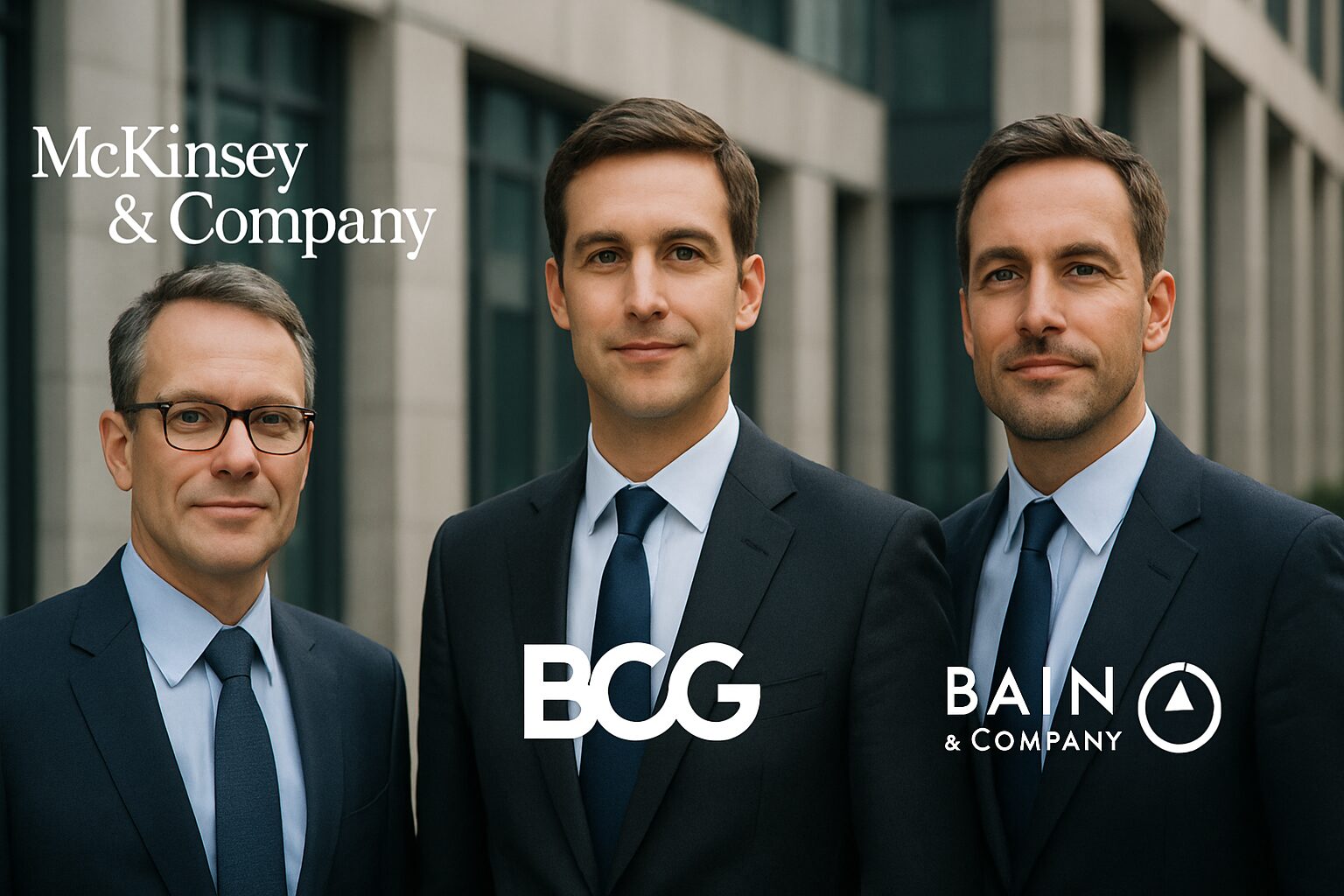
McKinsey and Company: The Gold Standard
McKinsey is widely regarded as the most prestigious of all the strategy consulting firms. Founded in Chicago in 1926 and now headquartered in New York, it reported $16 billion in revenue in 2023 and employs over 40,000 personnel across 120+ offices worldwide. McKinsey’s academic culture prizes intellectual rigor and continuous improvement, and the firm consistently ranks first in consulting brand value. The tradeoffs are real: intense travel schedules, long hours, and a highly competitive internal environment contribute to notable turnover among junior consultants. If you’re hiring them, make sure you know exactly who will be in the room on day 90, not just day one.
Boston Consulting Group: The Thought Leader
BCG pioneered the concept of thought leadership in consulting after its founding in 1963. With more than $13 billion in revenue and 30,000 employees across 90 offices in 50 countries, BCG is one of the largest strategy consultancies globally. Its bottom-up, collaborative culture contrasts with McKinsey’s more hierarchical style. BCG ranked fourth on Fortune’s “100 Best Companies to Work For” in 2018 and third on Glassdoor’s Best Places to Work in both 2017 and 2018, reflecting strong employee satisfaction despite demanding hours. For clients, that culture translates into teams that are genuinely invested in the problem.
Bain and Company: The Practical Partner
Bill Bain left BCG in 1973 to build a firm around a concierge model: one client per industry, maximizing value per engagement. Bain now counts 19,000 employees across 56 offices and is particularly renowned for its private equity practice. The firm topped Glassdoor’s Best Places to Work list, ranking first in 2019 and first in North America in 2017. Former CEO Bob Bechek held a near-100% approval rating on Glassdoor, which tells you something real about internal culture. Bain’s emphasis on ownership and results is palpable in how their teams operate, though some former employees describe an intense, insular internal atmosphere.
Beyond MBB: Other Leading Business Strategy Consulting Firms

The Big 4 Advisory Giants
The Big 4 accounting firms have built formidable strategy arms that compete directly with MBB on large transformation mandates. Monitor Deloitte, Strategy& (PwC), EY-Parthenon, and KPMG Strategy are all credible firms with global reach and deep implementation muscle. Strategy& offers a proprietary Strategy Profiler tool that benchmarks clients against high-performing competitors in their sector. While their prestige may not match MBB in pure strategy, they often provide more cost-effective, end-to-end solutions, especially for transformation projects that require technology integration alongside strategic planning.
Elite Boutique Strategy Firms
Several boutiques consistently appear at the top of independent rankings. Oliver Wyman, with 7,000+ professionals across more than 70 cities in 30 countries, holds Diamond-level status in the Consulting.us strategy rankings for both the U.S. and Europe. L.E.K. Consulting is a Platinum-level global strategy consultancy specializing in growth and competitive advantage. OC&C Strategy Consultants and Roland Berger offer deep sector expertise in consumer goods, retail, and industrial markets, often at fee structures 30-40% below MBB rates. Other notable names include Kearney, Arthur D. Little, and Simon-Kucher, a 2,200-person firm in 30+ countries focused exclusively on commercial strategy and pricing.
Tech-Forward Powerhouses
Accenture Strategy, the C-suite consulting wing of Accenture, draws on the parent company’s $69 billion in annual revenue and 779,000 employees to deliver strategy with technology at its core. Roughly 95 of the Fortune Global 100 use Accenture services in some capacity. Firms like Analysys Mason and Avasant are also emerging as go-to advisors for digital and AI-driven strategy. These business strategy are often the right call when transformation hinges on digital infrastructure rather than pure market positioning.
Booz Allen Hamilton: The Government and Defense Specialist
Booz Allen Hamilton occupies a unique position among consulting firms. With more than 33,000 employees and annual revenues exceeding $9 billion, it dominates the government, defense, and intelligence strategy space. For private-sector companies operating at the intersection of regulated industries and national security, Booz Allen’s clearance-holding consultants and deep federal relationships are genuinely irreplaceable. It’s a different kind of strategy firm, but an important one to know.
Boutique vs. Generalist: Choosing the Right Type of Firm

When a Boutique Firm Wins
I’ve repeatedly seen mid-market companies achieve faster, better results with a focused boutique. A specialist firm that lives and breathes your sector arrives with pre-built frameworks and a network of relevant contacts. Engagement teams are typically leaner, more senior, and more invested in the outcome. Boutiques often charge 20-40% less than MBB and provide direct access to partners who still practice, not just manage. For a $30M healthcare company trying to expand into a new service line, a boutique with 15 years of healthcare strategy experience will almost always outperform a generalist firm staffed with first-year MBAs.
When a Global Firm Is Necessary
If you need simultaneous market entry in Berlin, São Paulo, and Jakarta, or a complete culture overhaul affecting 50,000 employees, the global reach of MBB or the Big 4 becomes genuinely necessary. Large this type of firms offer bench depth, institutionalized knowledge management, and the ability to absorb cost overruns on fixed-price engagements. Their brand name also carries weight with investors and boards, which can be decisive for companies preparing for an IPO or major acquisition. Sometimes the logo on the cover page matters as much as what’s inside it.
| Firm Type | Examples | Strengths | Limitations | Ideal For |
|---|---|---|---|---|
| MBB Pure-Strategy | McKinsey, BCG, Bain | Unmatched prestige, top 1% talent, rigorous frameworks, global scale | Extremely high cost, potential overkill for mid-market, high consultant turnover | Fortune 500 C-suite strategy, complex transformation, pre-IPO advisory |
| Big 4 Advisory | Monitor Deloitte, Strategy&, EY-Parthenon, KPMG | Broadest service range, large implementation teams, more aggressive pricing | Strategy depth may not match MBB, brand less iconic in pure strategy | Large-scale transformation, integrated tech + strategy, regulated industries |
| Boutique Strategy | OC&C, Roland Berger, Simon-Kucher, L.E.K. | Deep sector knowledge, senior-heavy teams, cost-effectiveness, partner access | Limited geographic footprint, narrower service lines | Mid-market growth, specific industries (retail, pricing, healthcare) |
| Tech-Forward | Accenture Strategy, Analysys Mason, Avasant | AI and digital native, can move from strategy to build, large talent pools | Strategy may be subordinate to technology implementation | Digital transformation, AI roadmaps, cloud-driven business model shifts |
| Government/Defense | Booz Allen Hamilton | Federal relationships, clearance-holding staff, regulated industry depth | Limited private-sector applicability | Defense, intelligence, regulated government-adjacent industries |
Pros and Cons of Hiring Business Strategy Consulting Firms
Pros
- External objectivity: Consultants surface uncomfortable truths that internal politics often bury.
- Accelerated analysis: A seasoned team compresses months of research into weeks, especially with AI-assisted tools.
- Access to benchmarks: Top business strategy consulting firms carry proprietary industry data you simply can’t buy elsewhere.
- Credibility with stakeholders: An MBB or Big 4 endorsement carries real weight with boards, investors, and lenders.
- Knowledge transfer: The best engagements leave your team materially smarter about strategy than before.
Cons
- High cost: A six-month MBB engagement can exceed $2 million. Even boutique sprints run $50,000-$100,000 for two weeks.
- Implementation gap: Many firms excel at diagnosis but underdeliver on execution support.
- Bait-and-switch staffing: Senior partners sell the work; junior analysts often do it. Always meet the day-to-day team before signing.
- Dependency risk: Without deliberate knowledge transfer, companies can become reliant on external advisors for decisions they should own internally.
- Cultural friction: Outside consultants can create resentment among internal teams if the engagement isn’t managed carefully.
How AI Is Reshaping Business Strategy Consulting Firms
From Analysis to Execution with Machine Learning
As of 2026, business strategy consulting firms that treat AI as an afterthought are losing relevance fast. Machine learning models now parse millions of transactions, customer reviews, and competitor moves in hours, work that used to take months of spreadsheet-driven analysis. This shift isn’t just about efficiency. It enables real-time strategy adaptation. A consulting team can now test market entry scenarios live against a synthetic consumer panel before recommending a go-to-market plan, something that was genuinely impossible three years ago.
The Rise of Agentic AI in Strategy Formulation
We’re moving beyond dashboards to agentic AI: autonomous systems that not only analyze but also recommend strategic actions, simulate competitive responses, and trigger pilot executions. The best business strategy consulting firms now embed these tools into their proprietary methodologies. During a recent engagement I advised on, an AI agent simulated 10,000 pricing scenarios in under two minutes, identifying a sweet spot that increased projected margins by 3.2 percentage points. That insight would have been impossible to uncover manually at that speed. The Vault 2026 ranking methodology, which weights prestige at 30%, culture at 15%, and satisfaction at 15%, is also beginning to incorporate AI capability assessments as a formal evaluation criterion.
Competitive Intelligence in Minutes, Not Weeks
Old-school competitive landscaping required junior consultants to scour public filings and press releases for weeks. Today, large language models ingest entire patent databases, social media sentiment, and even shipping manifests to build a real-time competitive picture. Firms deploying this technology can give clients a 72-hour head start on market reactions, a timeframe that frequently decides winners and losers in fast-moving sectors. This is one area where the gap between AI-native firms and traditional ones is widening quickly.
Strategic Pricing Models: Moving Beyond Billable Hours
Traditional Retainer vs. Outcome-Based Fees
The billable-hour model is dying. Leading business strategy consulting firms now offer hybrid pricing: a reduced retainer coupled with performance bonuses tied to EBITDA growth, revenue lift, or customer acquisition targets. This aligns incentives in a way that traditional T&M contracts never could. I’ve personally seen deals where 40% of the consulting fee was contingent on hitting a specific enterprise value milestone after 24 months. The resulting intensity of effort from the consulting team was palpable. Clients get consultants with real skin in the game. Consultancies earn multiples when they overdeliver.
The Fractional CSO Model as a Cost-Effective Alternative
Not every company needs a $500,000 strategy project. A growing number of senior strategists now work on a fractional basis, embedding themselves 2-3 days per month as a virtual Chief Strategy Officer for a flat monthly fee. This model, increasingly adopted by business strategy consulting firms targeting the mid-market, provides continuous strategic guidance without the overhead of a full engagement. For companies with $10M-$100M in revenue, it often yields higher ROI because strategy is iterated in real time with the management team, not delivered in a slide deck every six months and then forgotten.
A Practical 5-Step Framework to Select the Right Firm
Step 1: Define Clear, Measurable Objectives
Start with a one-page brief that states exactly what success looks like. “Enter the Brazilian market with 5% share within 18 months” is a real objective. “Explore growth opportunities” is not. Vagueness invites scope creep and disappointing results, and it gives consultants cover to deliver generic work.
Step 2: Shortlist Firms with Deep Sector Knowledge
Use rankings like Forbes Best Management Consulting Firms and Consulting.us Strategy Rankings to build a longlist, then filter for firms that have completed similar projects in your industry within the last 24 months. Ask for anonymized case summaries. If they can’t produce them, move on.
Step 3: Evaluate Methodologies and Technology Stack
During proposal meetings, ask: “How exactly will you approach this?” A strong firm will describe a specific framework, such as BCG’s Growth-Share Matrix or Bain’s Elements of Value, and show how it adapts to your context. Also probe their AI capabilities directly. Are they using proprietary tools built for strategy work, or just wrapping a general-purpose chatbot in a nice interface?
Step 4: Conduct a Cultural Fit and Reference Check
Speak to at least two recent clients, including one whose engagement ended more than a year ago to assess the sustainability of results. Insist on meeting the day-to-day team, not just the partners who sell the work. A business strategy consulting firm can have a stellar brand but assign a junior team that sours the relationship within 60 days.
Step 5: Negotiate a Transparent, Outcome-Focused Contract
Insist on clear deliverables, a fixed scope or staged releases, and at least one performance-contingent payment. Avoid open-ended time-and-materials contracts. The best business strategy consulting firms will welcome this structure because it proves their confidence in delivering real value, not just billable hours.
Maximizing ROI from Your Consulting Engagement
Pre-Engagement Alignment
Before the first workshop, build an internal coalition of people who will own the strategy after the consultants leave. Without this, I’ve seen brilliant recommendations gather dust because no internal champion had the authority or motivation to act. The consulting firm can’t care more about your strategy than your own team does.
Building Internal Capability for Lasting Impact
Request that the business strategy consulting firm trains your team in the frameworks it uses. This knowledge transfer multiplies ROI: your leaders become better strategists, and future initiatives cost less. A good engagement leaves behind not just a plan, but an upgraded organization. That’s the standard I hold every advisory relationship to.
Measuring Success with Hard Metrics
Track three to five KPIs tied directly to the original objectives, such as revenue growth, margin expansion, or customer acquisition cost reduction, and schedule a 12-month post-engagement review. Share these results with the consulting firm. It reinforces accountability and helps them refine their approach for future work with you.
The right business strategy consulting firm functions as an accelerant, not a crutch. In 2026, with AI compressing analysis timelines and outcome-based pricing shifting risk back to advisors, there has never been a better time to hire a partner that is genuinely aligned with your success rather than your billable hours.
If you’re evaluating which type of advisory relationship fits your stage, I’d also recommend reading about AI infrastructure strategy and how it intersects with corporate planning. The firms that win the next decade will be the ones that treat technology strategy and business strategy as the same conversation.
Frequently Asked Questions
What exactly does a business strategy consulting firm do?
A business strategy consulting firm advises senior leaders on long-term direction, market entry, growth, and competitive positioning. They bring analytical rigor, external benchmarks, and implementation roadmaps to help companies make better decisions faster. The best ones also transfer frameworks and capabilities to internal teams so the value outlasts the engagement.
How much do business strategy consulting firms charge?
Pricing varies significantly. A two-week strategy sprint from a boutique may cost $50,000-$100,000, while a six-month MBB engagement can exceed $2 million. Increasingly, leading business strategy consulting firms offer hybrid models with a base fee plus performance bonuses tied to specific KPIs like revenue growth or margin expansion.
Which are the top business strategy consulting firms in 2026?
McKinsey, BCG, and Bain remain the most prestigious. The Big 4, including Deloitte, PwC, EY, and KPMG, have strong strategy practices through Monitor Deloitte, Strategy&, EY-Parthenon, and KPMG Strategy. Elite boutiques like Oliver Wyman, L.E.K., and Simon-Kucher are highly regarded in their niche areas. See the comparison table above for a full breakdown.
How do I choose between an MBB firm and a boutique?
If you need global scale, board-level credibility, or a complex multi-country transformation, MBB or the Big 4 are often the right choice. For deep sector expertise, senior-heavy teams, and cost-effectiveness, a specialist boutique typically delivers higher ROI. The decision usually comes down to scope, budget, and how much brand-name credibility matters to your stakeholders.
What role does AI play in modern strategy consulting?
AI is now integral to how top business strategy consulting firms operate. Leading firms use machine learning for rapid market analysis, agentic AI for scenario simulation, and natural language processing for competitive intelligence. This allows real-time strategy iteration and often surfaces insights that traditional methods would take months to uncover.
Can I hire a fractional strategy consultant instead of a full firm?
Yes, and for many mid-market companies it’s the smarter move. Fractional Chief Strategy Officers embed part-time at a monthly retainer, providing continuous strategic guidance without the large project fee. This model suits companies with $10M-$100M in revenue that need ongoing, hands-on support rather than a one-time strategy document.
Enjoyed this article?
Connect with me for collaboration, ventures, or just a good conversation about building things.
Get in Touch