Business Consultation: What It Is and How It Works

Business consultation is the professional practice of delivering expert advice to organizations to improve performance, solve problems, or achieve growth. I’ve seen firsthand how the right outside perspective can shift a stalled company into motion faster than any internal initiative.
Key Takeaways
- Advisory services range from strategy and operations to financial planning and digital transformation.
- Free resources like the SBA, SCORE, and SBDCs make expert guidance accessible to small businesses at no cost.
- Consultant fees vary widely: hourly rates typically run $100–$300, while project engagements often range from $5,000 to $50,000 or more.
- Measuring ROI starts before the engagement begins, not after it ends.
- AI tools are reshaping how advisory work gets delivered, making it faster and more accessible for smaller teams.
- Starting your own consulting practice requires a clear value proposition, a defined target market, and the right legal structure from day one.
What Is Business Consultation?
Business consultation is the professional practice of providing expert advice to organizations to improve performance, solve problems, or achieve growth. Consultants bring specialized knowledge across strategy, operations, finance, and more, helping companies overcome challenges and act on opportunities they might otherwise miss.
A typical engagement starts with a deep assessment of where the company actually stands. Consultants analyze internal processes, market position, and the competitive environment to find gaps and opportunities. The output is a tailored plan, often backed by implementation support, that drives measurable results. Whether you need a single strategy session or ongoing advisory support, outside perspective accelerates progress in ways that internal teams rarely can.
Definition and Core Purpose
At its core, this kind of advisory work delivers specialized knowledge to solve organizational problems. According to Wikipedia, a business consultant is “a professional who provides professional or expert advice in a particular area such as management, accountancy, law, human resources, marketing, or any of many other specialized fields.” The purpose is to save time, increase revenue, and preserve resources by applying expertise the client doesn’t have in-house.
The Evolution of Business Consultation
Advisory services have evolved from simple management advice to encompass digital transformation, data analytics, and change management. Historically, governments have supported small business access to consultancy. The UK’s Business Link program, for example, funded small business advisory services from 1992 to 2011. Today, remote delivery is standard, and AI tools are augmenting traditional advisory work, making it more scalable and data-driven than ever before.
Why Businesses Seek Outside Advice
Companies pursue outside expertise for a range of reasons: stagnant growth, operational inefficiencies, market disruption, or a lack of internal capability. Research has consistently shown that repeat business and referrals are key drivers of consultant appointments, which highlights the trust-based nature of these relationships. Effective advisory work uncovers blind spots and aligns teams around a shared direction.
Types of Business Consultation Services
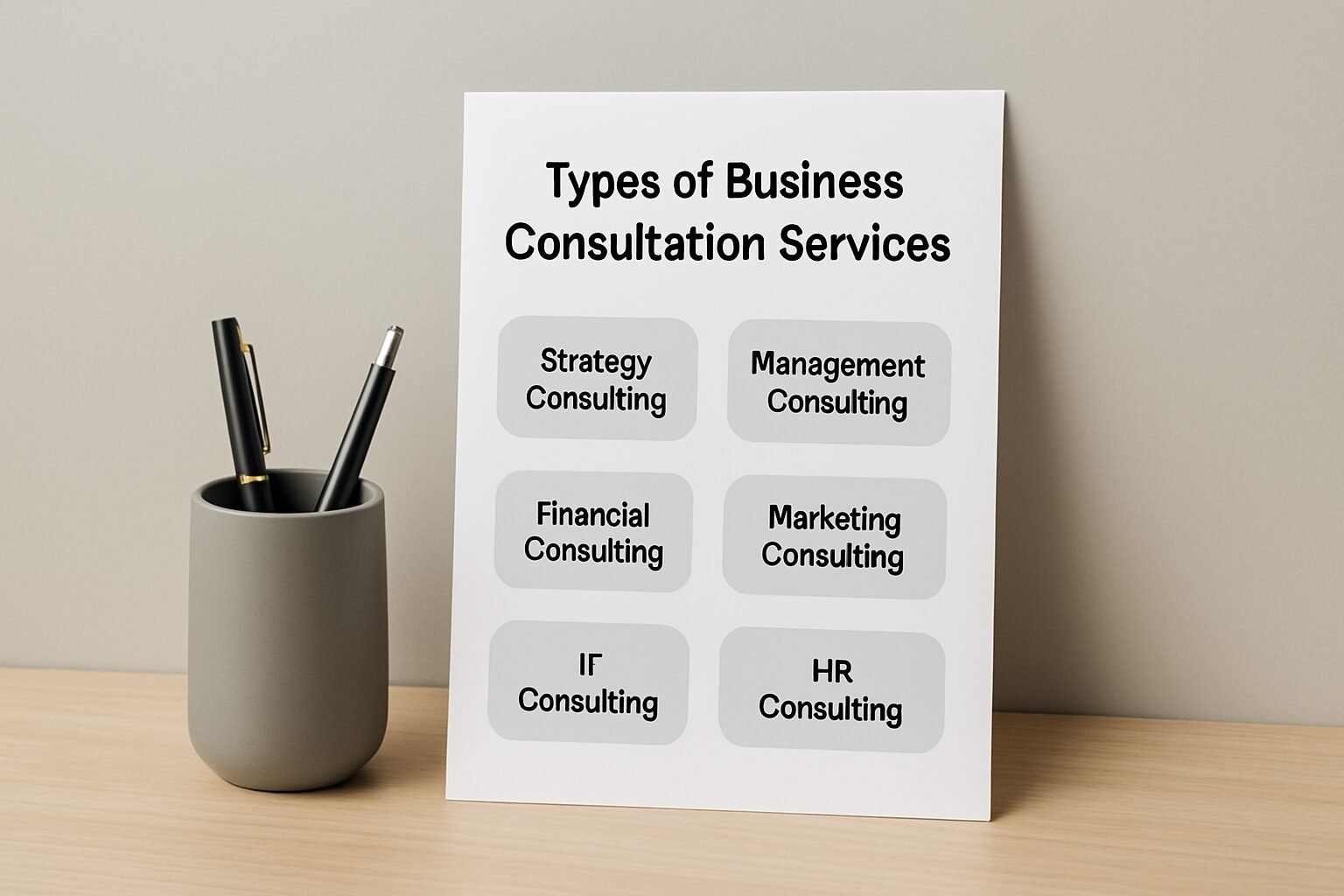
Advisory services span a broad spectrum of specialties. The right type depends on your organization’s immediate needs, industry, and long-term goals. Below are the most common categories, each of which can be delivered by an internal or external advisor.
Strategy and Management Consultation
Strategic advisory focuses on high-level direction. Consultants help define vision, set objectives, and build roadmaps to achieve competitive advantage. Activities often include market analysis, business model innovation, and merger integration. Firms like Centric Consulting emphasize “strategy alignment and architecture” to ensure every initiative ties back to the company vision. Most strategy engagements run 3–6 months and include both diagnostic and planning phases.
Financial and Accounting Consultation
Financial advisory covers cash flow analysis, budgeting, forecasting, and tax strategy. These services are especially valuable for small businesses that lack a full-time CFO. A good financial advisor doesn’t just report numbers. They identify where money is leaking and build a plan to stop it. For early-stage companies, this kind of clarity can be the difference between surviving year two and not.
Operations and Process Improvement
Operational advisory aims to streamline workflows, reduce waste, and improve quality. Consultants apply methodologies like Lean or Six Sigma to redesign processes. The goal is a measurable efficiency gain, though results vary significantly by project scope and organizational readiness. I’ve seen process improvement projects deliver results in 60–90 days when leadership is aligned and execution is disciplined.
Digital Transformation and AI Strategy
As of 2026, digital transformation advisory has become one of the fastest-growing segments in the consulting market. Companies need help deciding which technologies to adopt, how to sequence implementation, and how to manage the organizational change that follows. AI strategy, in particular, is now a standalone service category. If you’re building with AI and want a framework for how I think about it, the work I’ve documented on aminferdowsi.com covers the practical side of these decisions.
Pros and Cons of Hiring a Business Consultant

Outside advisory is a real investment. Before you commit, it’s worth being honest about what you’re getting and what you’re giving up.
Pros
- Outside perspective: Consultants see patterns across many companies that insiders miss because they’re too close to the problem.
- Specialized expertise on demand: You get senior-level knowledge without the cost of a full-time hire.
- Faster execution: A focused engagement with clear deliverables moves faster than internal projects competing for attention.
- Accountability: A good consultant holds leadership to commitments in ways that internal teams often can’t.
- Access to free resources: SBA partners like SCORE and SBDCs offer no-cost counseling across the U.S., lowering the barrier to entry.
Cons
- Cost: Quality advisory isn’t cheap. Project fees from $5,000 to $50,000 or more are common for meaningful engagements.
- Knowledge transfer risk: If the consultant leaves without embedding their knowledge, you’re back to square one.
- Misaligned incentives: Some consultants optimize for billable hours, not client outcomes. Vet carefully.
- Dependency: Over-relying on outside advice can stunt internal capability development.
When Should You Hire a Business Consultant?

The right moment to bring in outside help is usually earlier than most founders think. Waiting for a crisis means you’re paying a premium to fix something that proper advisory could have prevented.
Signs Your Business Needs Outside Help
- Persistent performance gaps: Missed targets, declining market share, or rising customer complaints.
- Strategic uncertainty: Leadership lacks clarity on a new direction or market entry.
- Initiative overload: Too many priorities without clear ownership or resources.
- Change fatigue: Staff resistance to necessary transformation.
Common Trigger Events for Consultation
Specific scenarios often prompt companies to seek outside expertise: a merger or acquisition, launching a new product line, regulatory changes, or the need to digitize operations. For small businesses, the U.S. Small Business Administration (SBA) recommends consulting before applying for loans or entering federal contracting, as their district offices provide free counseling. That’s a resource most founders underuse.
How Much Does Business Consultation Cost?
Costs vary widely based on expertise, project complexity, and engagement model. Understanding these structures helps you budget effectively and choose the right advisor for your needs.
Comparing Engagement Models
| Engagement Model | Pros | Cons | Best For |
|---|---|---|---|
| Hourly Consultation | Flexible, pay for exact time used | Costs can escalate if scope is unclear | Short-term advice, troubleshooting |
| Project-Based | Clear deliverables and budget | Less flexibility for scope changes | Defined initiatives like strategy development |
| Retainer | Ongoing support, priority access | Commitment to regular fees | Long-term advisory, fractional executive |
Factors That Influence Fees
Consultant fees are shaped by experience, industry specialization, geographic location, and reputation. For in-house roles, the South Carolina Department of Administration lists a business consultant salary range of $39,300 to $66,800 annually. Independent consultants typically earn significantly more. One LinkedIn service provider reported generating over $900,000 in direct client sales, which shows what specialized advisory can produce at scale. Hourly rates for independent consultants commonly run $100–$300, with senior specialists charging more in competitive markets.
How to Choose the Right Business Consultant
Selecting the right advisory partner is one of the highest-leverage decisions you’ll make. A mismatched consultant wastes time and money. The right one becomes a catalyst you’ll wish you’d found sooner.
Defining Your Needs and Goals
Start by writing a clear problem statement. Something like “increase online sales by 20% within 12 months” or “reduce employee turnover by 10% this year.” That clarity is what lets you evaluate whether a consultant’s track record actually matches your situation. Vague goals produce vague engagements.
Evaluating Credentials and Experience
Look for relevant track records, client testimonials, and industry certifications. While not mandatory, credentials like Certified Management Consultant (CMC) or technical certifications such as AWS or Microsoft add credibility. Ask for case studies from similar projects. The best advisory comes from practitioners who have both deep knowledge and proven execution skills. Theory without implementation experience is expensive guesswork.
“Placing a heavy focus on enabling and sustaining change, as well as establishing platforms for continuous improvement, is key to successful business consultation.” – Centric Consulting Business Consulting Services
Starting Your Own Business Consultation Practice
If you have deep expertise in a domain, launching your own advisory practice can be one of the most rewarding moves you make. I’ve watched people with genuine operator experience build six-figure consulting businesses in under 18 months by following a disciplined launch process. The following steps, adapted from Wolters Kluwer, provide a practical roadmap.
- Know your unique value proposition. Identify what sets you apart. Why should clients choose you over an established firm?
- Research your target market. Build a profile of ideal clients using demographics, industry trends, and competitor analysis.
- Enhance credibility with certifications. Pursue relevant credentials to boost your authority and attract clients faster.
- Create a business plan. Outline your services, marketing strategy, and financial projections. Keep it lean but specific.
- Choose a business structure. Decide between sole proprietorship, LLC, partnership, or corporation based on liability and tax considerations.
- Determine legal compliance. Obtain required licenses and permits for your location and service type. Requirements vary by state, so check your local Secretary of State website and the SBA’s licensing guide before you launch.
- Set your pricing and packages. Define whether you’ll charge hourly, by project, or via retainer, and structure your offerings accordingly.
- Develop a marketing and sales strategy. Use content, networking, and platforms like LinkedIn to build visibility. Most early clients come from your existing network, not cold outreach.
- Invest in tools and infrastructure. Use project management, CRM, and video conferencing tools to deliver professional, organized engagements from day one.
- Launch, learn, and iterate. Start with a pilot client, gather honest feedback, and refine your process as you grow.
“The consulting industry rewards specialists far more than generalists. The more precisely you can define the problem you solve and the client you solve it for, the faster you’ll build a sustainable practice.” – Based on patterns observed across Y Combinator alumni who transitioned from operators to advisors
Marketing Your Consulting Practice
Most new consultants underinvest in marketing because they assume referrals will carry them. Referrals are essential, but they’re not a strategy. A content-driven approach, publishing case studies, frameworks, and honest takes on industry problems, builds inbound pipeline that compounds over time. LinkedIn remains the highest-ROI platform for B2B advisory services. Pair that with a focused email list and you have a sustainable acquisition engine that doesn’t depend on any single referral source.
Measuring the ROI of Business Consultation
One of the most overlooked aspects of any advisory engagement is measuring its return. Without clear metrics, it’s difficult to justify the investment or replicate success. Defining ROI before the work begins is non-negotiable.
Defining Key Performance Indicators
KPIs should tie directly to your original goals. For a cost-reduction project, track savings as a percentage of revenue. For a growth initiative, monitor revenue lift, customer acquisition cost, or market share movement. Effective advisory always starts with a baseline measurement so you can compare pre- and post-engagement results with confidence.
Quantifying Tangible and Intangible Benefits
Tangible benefits include cost savings, revenue growth, and time saved. Intangible benefits, like improved team morale, better decision-making, or faster innovation, are harder to measure but equally real. A well-structured engagement captures both through periodic reviews and stakeholder interviews. I’ve found that the intangible benefits often outlast the tangible ones by years.
The Future of Business Consultation: AI and Digital Disruption
The advisory industry is being reshaped by artificial intelligence and digital tools. From automated data analysis to virtual advisory platforms, technology is augmenting human expertise and creating entirely new delivery models. This year, the shift has accelerated faster than most traditional firms anticipated.
How Technology Is Reshaping Advisory Services
AI-powered tools can now perform market analysis, generate financial models, and draft strategy documents in a fraction of the time it used to take. This lets consultants focus on high-level judgment and client relationships, which is where the real value has always been. According to reporting from TechCrunch and analysis from the a16z blog, AI-native professional services firms are growing faster than their traditional counterparts, particularly in strategy and data advisory segments.
Hybrid Human-AI Consultation Models
The most effective advisory in the coming years will combine human intuition with machine intelligence. A consultant might use AI to identify patterns in customer data, then interpret those insights in the context of the client’s unique culture and constraints. This hybrid model makes expert guidance more accessible and affordable for small businesses that previously couldn’t justify the cost of senior advisory talent. I’m actively building in this space, and the productivity gains are real. If you want to explore what this looks like in practice, the AI strategy work I’ve published at aminferdowsi.com goes deeper on the frameworks I use.
Frequently Asked Questions
How do I find free business consultation near me?
The SBA and its resource partners, including SCORE, Small Business Development Centers (SBDCs), Women’s Business Centers (WBCs), and Veterans Business Outreach Centers (VBOCs), offer no-cost counseling and training across the United States. Enter your ZIP code on SBA.gov to find local help. These resources are genuinely underused by most founders.
How much do business consultants charge?
Hourly rates vary by expertise and location, but many small business consultants charge $100–$300 per hour. Project-based fees often range from $5,000 to $50,000 or more depending on scope. Always clarify pricing and deliverables during the initial conversation before any work begins.
What is the typical business consultation salary?
According to the South Carolina Department of Administration, a state-level business consultant earns between $39,300 and $66,800 annually. Independent consultants typically earn significantly more, and specialized advisory practices can generate well over $500,000 in annual revenue once established.
What certifications help a business consultation career?
While not required, certifications like Certified Management Consultant (CMC), Project Management Professional (PMP), or industry-specific credentials such as AWS or Google certifications can enhance credibility and attract clients. Practical track record matters more than credentials at the senior level, but certifications help early in your career.
How long does a typical business consultation engagement last?
Engagements range from a single one-hour strategy session to a multi-year transformation program. A typical small business advisory project runs 3–6 months, with defined milestones and regular check-ins to keep both sides accountable.
Enjoyed this article?
Connect with me for collaboration, ventures, or just a good conversation about building things.
Get in Touch