Building a Creative Agency That Actually Ships
Key Takeaways
- Most creative agencies fail because they chase vanity metrics instead of client outcomes
- AI tools are commoditizing design work , agencies must move up the value chain to strategy and execution
- The future belongs to hybrid agencies that blend creative with technical implementation
- Recurring revenue models beat project-based work every time
- Small teams with specialized skills outperform large generalist shops
I’ve started three creative agencies over the past decade. Two failed spectacularly. The third one I sold for mid-seven figures in 2024.
The difference wasn’t talent, connections, or luck. It was understanding what clients actually buy versus what we thought we were selling. Most agencies get this backwards, which is why 60% of them shut down within five years.
Here’s what I learned building agencies that actually work , and why the entire industry is about to get flipped upside down.
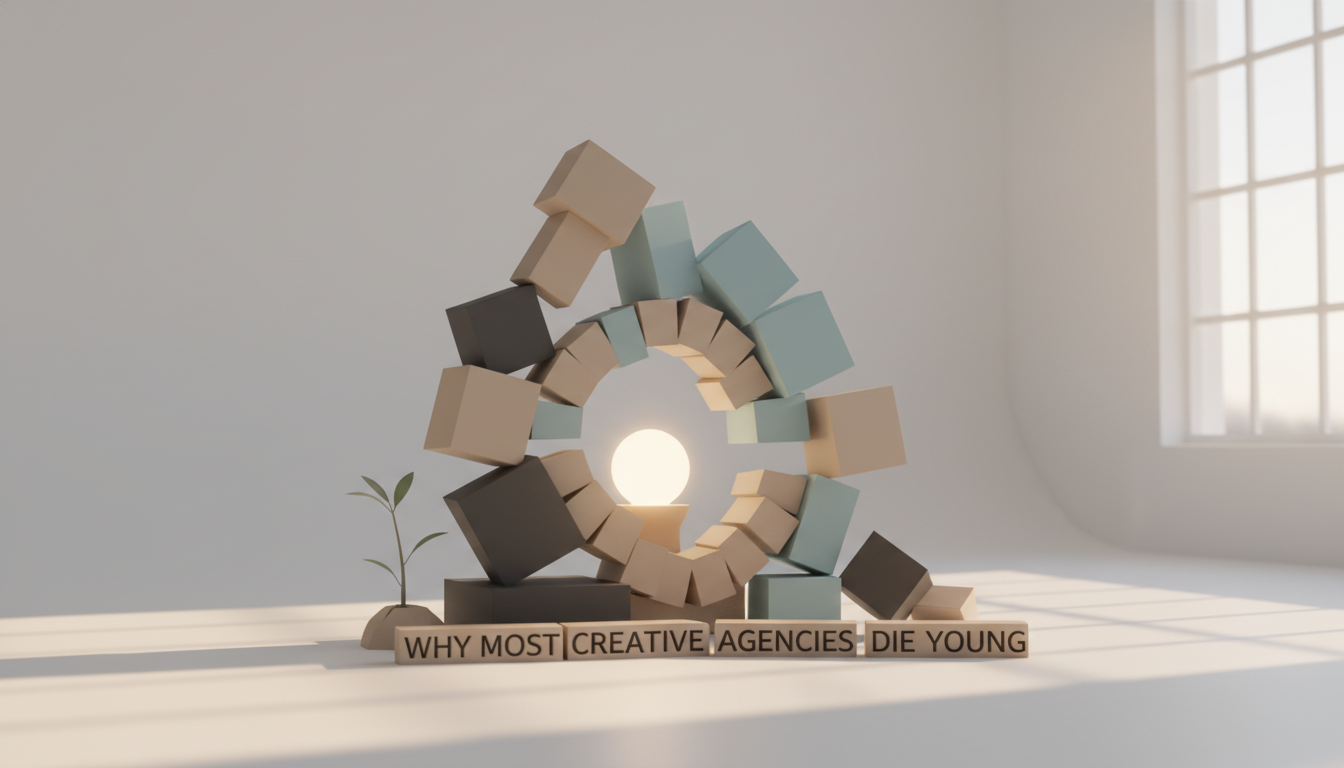
Why Most Creative Agencies Die Young
My first agency lasted eight months. We had killer portfolios, a trendy office in SOMA, and absolutely no idea how businesses actually make money.
The Fatal Flaw: Confusing Output with Outcomes
We measured success by deliverables shipped. Logo designs completed. Websites launched. Social campaigns posted. All vanity metrics that made us feel productive while clients quietly questioned our value.
The wake-up call came when our biggest client , a Series B startup , fired us after six months of “beautiful work.” Their CMO was brutally honest: “Your designs are gorgeous, but our conversion rates haven’t moved. We need results, not awards.”
That’s when I realized we were selling the wrong thing entirely.
The Revenue Trap That Kills Agencies
Most creative shops operate on a feast-or-famine cycle. Land a big project, work like crazy for three months, deliver everything, then scramble to find the next client. It’s exhausting and unsustainable.
I tracked our cash flow patterns across 18 months. We’d spike to $40K monthly revenue, then crash to $8K the next month. No business can survive that volatility, especially when you’re carrying fixed costs like office rent and full-time salaries.
The agencies that survive figure out recurring revenue early. Retainers, ongoing campaigns, maintenance contracts , anything that creates predictable monthly income.
The Generalist Mistake
We tried to be everything to everyone. Brand identity, web design, social media, content marketing, paid ads, video production. Jack of all trades, master of none.
Specialized agencies command higher rates and attract better clients. When you’re known for one thing and you’re exceptional at it, clients will pay premium prices. When you do everything adequately, you compete on price.
The AI Revolution Nobody Talks About

By 2026, AI has fundamentally changed what creative agencies can and should do. Most are still pretending it’s 2019.
Design Work Is Being Commoditized
Midjourney can generate logo concepts in seconds. ChatGPT writes decent copy. Figma’s AI features handle routine design tasks. The barrier to creating “good enough” creative has collapsed.
This terrifies traditional agencies, but it shouldn’t. It’s actually the biggest opportunity in decades , if you position correctly.
Instead of competing with AI on basic design tasks, we started using it to amplify our strategic thinking. AI handles the grunt work, we focus on the high-value stuff: understanding business problems, crafting positioning, building systems that scale.
The New Value Stack
Here’s how the value hierarchy has shifted:
Low value (AI-replaceable): Logo design, basic web layouts, social media graphics, stock photo selection
Medium value (AI-assisted): Brand guidelines, content calendars, email templates, presentation design
High value (human-driven): Strategic positioning, customer research, conversion optimization, technical implementation
The agencies winning in 2026 have moved almost entirely to the high-value tier.
Technical Skills Become Table Stakes
Creative agencies that can’t implement their ideas are becoming irrelevant. Clients don’t want pretty mockups , they want working solutions.
My current team includes developers, growth marketers, and data analysts alongside traditional creatives. We don’t just design landing pages; we build them, optimize them, and measure their performance. That’s what clients actually pay for.
Building an Agency That Actually Works

After two failures, I approached the third agency completely differently. Less ego, more business fundamentals.
Start with a Niche, Then Expand
We focused exclusively on B2B SaaS companies raising Series A funding. Specific enough to become known for something, large enough to build a real business.
This constraint forced us to deeply understand one type of client. We knew their challenges, spoke their language, and could predict their needs. Sales conversations became consultations instead of pitches.
Once we dominated that niche, expanding to adjacent markets was straightforward. But starting narrow gave us the credibility and cash flow to grow strategically.
Recurring Revenue from Day One
Instead of project-based work, we structured everything as ongoing partnerships. Monthly retainers for brand management, quarterly strategy reviews, annual brand audits.
Our minimum engagement was six months. This filtered out bargain hunters and attracted clients serious about long-term results. It also made our revenue predictable and our team’s workload manageable.
Outcome-Based Pricing
We stopped charging by the hour and started charging for results. Website redesigns were priced based on conversion lift. Brand campaigns were tied to awareness metrics. Content strategies included performance bonuses.
This aligned our incentives with client success and justified premium pricing. When clients see direct ROI from your work, price becomes less relevant.
| Traditional Agency Model | Outcome-Based Model |
|---|---|
| Hourly billing | Value-based pricing |
| Project deliverables | Business outcomes |
| One-time engagements | Ongoing partnerships |
| Creative awards | Client growth metrics |
| Large generalist team | Small specialist team |
The Technical-Creative Hybrid Model

The most successful agencies I know today aren’t traditional creative shops. They’re hybrid organizations that blend creative thinking with technical execution.
Beyond Pretty Pictures
Clients don’t just want beautiful designs anymore. They want systems that work, campaigns that convert, and brands that drive business results.
This means creative agencies need technical chops. Understanding conversion optimization, growth marketing, data analysis, and technical implementation. The days of “throwing designs over the wall” to developers are over.
The Full-Stack Creative Team
Our core team includes:
- Brand strategist (understands positioning and messaging)
- UX designer (focuses on user behavior and conversion)
- Developer (builds and optimizes everything we design)
- Growth marketer (measures and improves performance)
- Project manager (keeps everything on track)
Five people who can take a brand from strategy to implementation to optimization. No handoffs, no miscommunication, no excuses.
Measuring What Matters
We track client metrics as closely as our own. Website conversion rates, email open rates, social engagement, lead quality, customer acquisition costs. If we can’t measure the impact of our work, we’re not doing our job.
This data-driven approach has transformed how we think about creative work. Every design decision is informed by user behavior. Every campaign is optimized based on performance data.
Scaling Without Losing Your Soul
Growing a creative agency is tricky. Scale too fast and quality suffers. Stay too small and you limit your impact.
The Talent Acquisition Challenge
Finding people who combine creative skills with business acumen is incredibly difficult. Most designers think in aesthetics, not outcomes. Most marketers lack creative vision.
We solved this by hiring for attitude and training for skills. Look for people who are naturally curious, data-driven, and client-focused. You can teach design tools and marketing tactics. You can’t teach someone to care about results.
Systems Over Heroics
Early-stage agencies rely on founder heroics. The owner does everything, works 80-hour weeks, and personally manages every client relationship. This doesn’t scale.
Building systems and processes is boring but essential. Client onboarding checklists, project management workflows, quality control standards, performance review templates. The unglamorous stuff that lets you grow without chaos.
Saying No to Bad Clients
Not every client is worth having. Price shoppers, micromanagers, and companies with unrealistic expectations will drain your team’s energy and hurt your reputation.
We developed strict client qualification criteria. Minimum budget thresholds, decision-maker access requirements, timeline expectations. Saying no to bad fits lets you say yes to great partnerships.
The Future of Creative Agencies
The industry is changing faster than most agencies realize. The winners will be those who adapt quickly to new realities.
AI as Creative Partner, Not Threat
Instead of fighting AI, smart agencies are embracing it. We use AI for initial concept generation, copy variations, image editing, and data analysis. This frees up human creativity for higher-level strategic thinking.
The key is positioning AI as a tool that amplifies human creativity rather than replacing it. Clients still want human insight, empathy, and strategic thinking. They just don’t want to pay premium rates for tasks a machine can do.
Remote-First Operations
The best creative talent isn’t concentrated in expensive coastal cities anymore. Remote work has democratized access to top-tier designers, developers, and strategists worldwide.
Our team spans four time zones. This gives us 16-hour coverage for client needs and access to specialized skills we couldn’t afford locally. The overhead savings let us invest more in talent and tools.
Vertical Specialization
Generalist agencies are becoming extinct. The future belongs to specialists who deeply understand specific industries, business models, or customer types.
Whether it’s fintech startups, healthcare companies, or e-commerce brands, clients want agencies that speak their language and understand their unique challenges. This specialization commands premium pricing and creates defensible competitive advantages.
Common Mistakes That Kill Agency Growth
I’ve made most of these mistakes myself. Learning from failure is expensive , learning from someone else’s failure is free.
Chasing Vanity Metrics
Awards, social media followers, press mentions , none of this matters if your clients aren’t growing their businesses. I spent way too much time in my early agencies optimizing for industry recognition instead of client results.
The agencies that last focus obsessively on client outcomes. Revenue growth, conversion improvements, brand awareness lifts. Metrics that actually matter to the people writing your checks.
Underpricing Your Services
Most agency founders are terrible at pricing. We undervalue our work, compete on price instead of value, and accept projects with razor-thin margins.
Premium pricing isn’t about being expensive , it’s about positioning your work as an investment that generates returns. When clients see clear ROI from your services, price becomes less relevant than results.
Scaling Too Fast
Growth can kill you as quickly as stagnation. Hiring too many people too quickly, taking on more work than you can handle well, expanding into markets you don’t understand.
Sustainable growth means maintaining quality while increasing capacity. Better to turn down work than deliver subpar results that damage your reputation.
What I Learned
Building a successful creative agency isn’t about having the best designers or the coolest office. It’s about understanding what clients actually need and delivering measurable value consistently.
The agencies winning in 2026 combine creative vision with business acumen, use AI to amplify human capabilities, and focus obsessively on client outcomes. They’re not just making things look pretty , they’re driving real business results.
Most importantly, they’ve learned that creativity without strategy is just art. And art doesn’t pay the bills.
FAQ
What makes a creative agency successful in 2026?
Successful agencies combine creative expertise with technical implementation and business strategy. They focus on measurable client outcomes rather than just deliverables, use AI to amplify human creativity, and operate on recurring revenue models instead of project-based work.
How is AI changing the creative agency space?
AI is commoditizing basic design tasks like logo creation and simple graphics, forcing agencies to move up the value chain to strategic thinking and technical implementation. Smart agencies use AI as a tool to handle routine work while humans focus on strategy, client relationships, and complex problem-solving.
Should I start a generalist or specialist creative agency?
Start with a specific niche , whether that’s an industry vertical like SaaS companies or a service specialty like conversion optimization. Specialization allows you to charge premium rates, develop deep expertise, and become known for something specific. You can always expand later once you’ve established credibility.
What’s the biggest mistake new agency owners make?
Underpricing services and competing on cost rather than value. Most new agencies focus on winning projects at any price instead of demonstrating clear ROI to clients. This creates unsustainable business models and attracts price-sensitive clients who don’t value quality work.
How important is recurring revenue for creative agencies?
Absolutely critical. Project-based work creates feast-or-famine cash flow cycles that make it impossible to build a stable business. Successful agencies structure engagements as ongoing partnerships with monthly retainers, quarterly reviews, and annual contracts that create predictable revenue streams.
What skills do creative agencies need beyond traditional design?
Modern agencies need technical implementation skills (web development, marketing automation), data analysis capabilities (conversion tracking, performance measurement), and business strategy expertise (positioning, growth marketing). The most successful agencies can take projects from concept to implementation to optimization.
Enjoyed this article?
Connect with me for collaboration, ventures, or just a good conversation about building things.
Get in Touch