Business Management Consulting Guide: Top Firms & Costs 2026
- Business management consulting helps organizations improve performance, solve problems, and achieve strategic goals.
- Top firms include McKinsey, BCG, Bain (MBB), and the Big Four (Deloitte, PwC, EY, KPMG).
- Costs range from $200–$800 per hour for independent consultants to $1,000–$5,000+ per hour for top-tier firms.
- Look for industry experience, proven methodologies, and cultural fit when selecting a consultant.
- Certifications like CMC (Certified Management Consultant) indicate professional standards.
What Is Business Management Consulting?
Business management consulting is exactly what it sounds like , bringing in outside experts to fix what’s broken inside your company. I’ve hired consultants three times across my ventures, and each time the value came down to one thing: they see problems you’re too close to notice.
The global management consulting market hit $330 billion in 2025, according to Statista. That’s not just corporate bloat , it’s proof that even the smartest founders and CEOs need external perspective. When I was scaling my second startup, we brought in a consultant who spotted inefficiencies in our customer acquisition funnel that were costing us $50K monthly. Sometimes you need fresh eyes.
Key Services Offered by Business Management Consultants

Most **business management consulting** engagements fall into five buckets. I’ve used consultants for three of these, and the results varied wildly based on how well we defined the problem upfront:
- Strategy development: Defining long-term goals, market positioning, and growth plans.
- Operational improvement: Streamlining processes to reduce costs by 15–25% and increase efficiency.
- Organizational change management: Guiding companies through restructuring, mergers, or cultural shifts.
- Technology implementation: Advising on digital tools, AI adoption, and IT strategy.
- Financial advisory: Improving profitability, cash flow, and financial planning.
The operational improvement work tends to pay for itself fastest. When we hired a process consultant for our fulfillment operations, they identified bottlenecks that were adding 2-3 days to every order. The fix cost $15K to implement but saved us roughly $200K annually in customer service costs and refunds.
Top Business Management Consulting Firms: Comparison Table
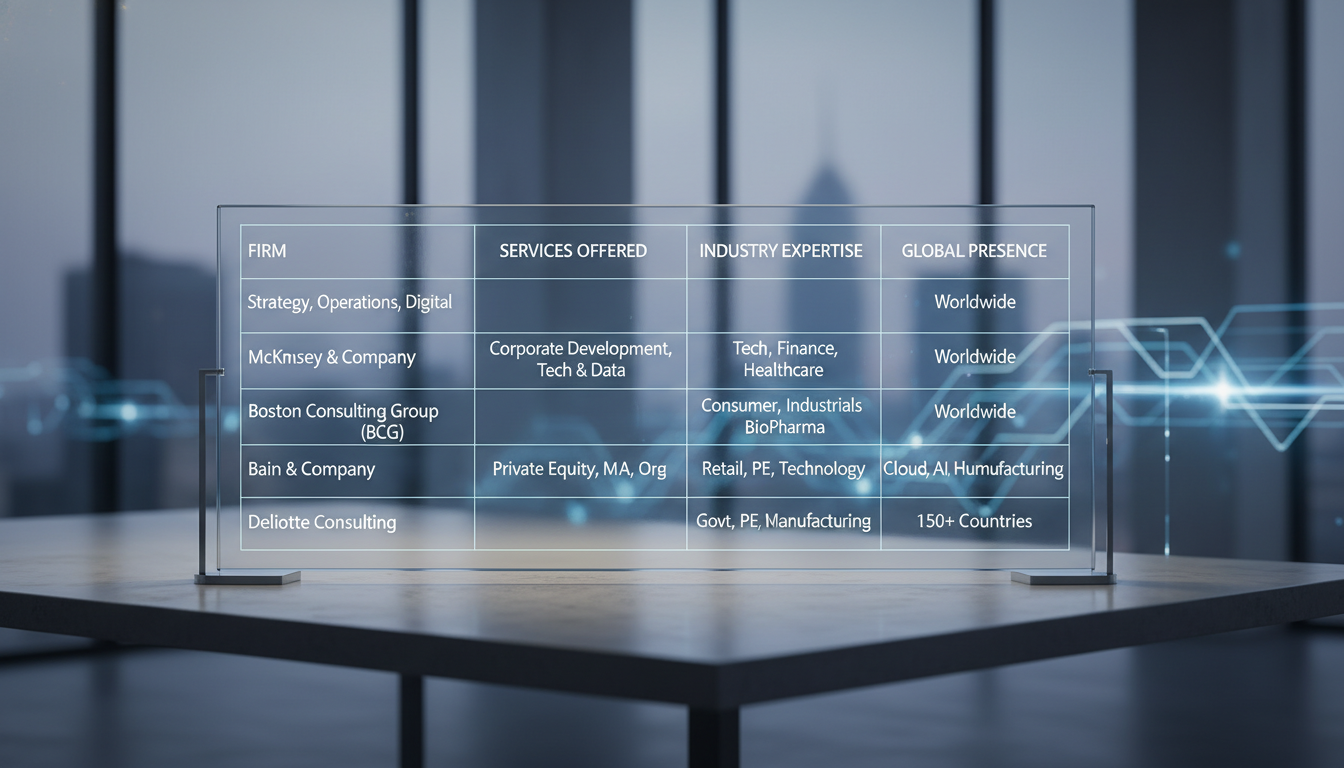
| Firm | Focus Areas | Typical Project Cost | Best For |
|---|---|---|---|
| McKinsey & Company | Strategy, operations, digital, sustainability | $1,000–$3,000/hour | Large enterprises, complex strategic challenges |
| Boston Consulting Group (BCG) | Strategy, innovation, AI, climate | $1,000–$3,000/hour | Growth strategy, technology transformation |
| Bain & Company | Strategy, private equity, customer strategy | $1,000–$3,000/hour | Results-driven projects, PE due diligence |
| Deloitte Consulting | Strategy, operations, technology, human capital | $500–$2,000/hour | End-to-end transformation, Big Four expertise |
| Independent Consultants | Niche expertise, flexible engagements | $200–$800/hour | SMEs, specific projects, budget constraints |
What to Look For When Buying Business Management Consulting Services
 Consulting Services – business management consulting | Amin Ferdowsi” class=”wp-image-2217″ loading=”lazy” width=”1792″ height=”1024″ />
Choosing the right consultant is like hiring a senior executive , except they’re temporary and cost more per hour. I’ve made this decision multiple times, and here’s what actually matters:
Industry Experience
Generic business advice is worthless. Choose a consultant with a proven track record in your sector. Healthcare consulting requires knowledge of HIPAA regulations, while manufacturing consulting benefits from lean Six Sigma expertise. When I needed help with marketplace dynamics, I specifically sought consultants who’d worked with two-sided platforms. The domain knowledge saved months of education.
Methodology and Tools
Top firms use proprietary frameworks like McKinsey’s 7S or BCG’s Growth-Share Matrix. But don’t get seduced by fancy names. Ensure the consultant’s approach aligns with your company’s culture and needs. I once worked with a consultant who insisted on a rigid framework that didn’t fit our startup’s reality. We spent more time explaining why their process didn’t work than solving problems.
Cultural Fit
A consultant must work well with your team. Request references and conduct interviews to assess communication style and collaboration. The best consultant I ever hired spent the first week just listening. The worst one started recommending changes before understanding our business model.
Cost and ROI
Budget for consulting fees, but focus on expected return. A $500,000 project that saves $2 million annually is a strong investment. Always negotiate success metrics upfront. Vague deliverables lead to disappointing results.
Pricing Tiers: Budget vs Premium Business Management Consulting
**Business management consulting** pricing follows three distinct tiers, and I’ve hired from each category depending on the project scope:
Budget Tier ($200-$500/hour)
Independent consultants and boutique firms. Perfect for specific, well-defined problems. I hired a $300/hour operations consultant who redesigned our inventory system. The project took six weeks and delivered measurable results. Best for startups and SMEs with clear objectives.
Mid-Range Tier ($500-$1,500/hour)
Regional firms and Big Four junior teams. Good balance of expertise and cost. Deloitte’s mid-level team helped us with a technology integration project. More resources than independents, less overhead than MBB firms. Ideal for growth-stage companies.
Premium Tier ($1,500-$5,000/hour)
McKinsey, BCG, Bain , the MBB firms. You’re paying for brand, methodology, and access to Fortune 500 case studies. Worth it for complex strategic challenges or when you need credibility with investors or boards. I’ve seen $2M engagements deliver $20M+ in value, but only when the problem matched their capabilities.
How to Style Your Consulting Engagement: Engagement Models That Work
The structure of your **business management consulting** engagement matters as much as who you hire. Based on my experience across multiple projects, here are the models that actually deliver results:
Sprint Model (4-8 weeks)
Perfect for specific problems with clear outcomes. We used this for a pricing strategy project , consultant analyzed our data, interviewed customers, and delivered new pricing within six weeks. Cost: $75K. Result: 23% revenue increase in Q1.
Embedded Model (3-6 months)
Consultant works alongside your team on implementation. More expensive but higher success rate. When we rebuilt our customer success process, the consultant stayed through rollout and training. The hands-on approach prevented the typical “great recommendations that never get implemented” problem.
Advisory Model (ongoing)
Monthly or quarterly check-ins for strategic guidance. Works well with experienced independent consultants. I maintain relationships with two consultants who provide ongoing advice for $5K-$10K monthly. Much cheaper than hiring full-time executives for specialized expertise.
Project-Based Model (fixed scope)
Traditional approach with defined deliverables and timeline. Good for operational improvements or process redesign. Clear boundaries prevent scope creep, but less flexibility if priorities change mid-project.
How to Choose the Right Consultant: A Step-by-Step Process
I’ve refined this process through multiple consulting hires. Skip steps at your own risk:
- Define your objectives: Write a one-page problem statement. If you can’t articulate the problem clearly, consultants can’t solve it effectively.
- Research firms: Look at rankings, case studies, and client reviews. Check their recent work, not just prestigious client names from years ago.
- Request proposals: Ask for detailed scope, timeline, and pricing. Good consultants will push back on vague requirements , that’s a positive sign.
- Check references: Speak with past clients about results and working style. Ask specifically about what didn’t work, not just successes.
- Evaluate fit: Assess expertise, methodology, and cultural alignment. Schedule working sessions, not just presentations.
- Negotiate terms: Agree on deliverables, milestones, and payment structure. Include success metrics and exit clauses.
Cost of Business Management Consulting in 2026
Consulting fees have increased roughly 15-20% since 2024, driven by AI expertise demand and talent shortages. Independent consultants now charge $200–$800 per hour, while top-tier firms like McKinsey, BCG, and Bain bill $1,000–$5,000 per hour.
Fixed-price projects for SMEs range from $10,000 to $100,000. According to Consultancy.org’s 2024 survey, the average daily rate for a senior consultant hit $2,500. But here’s what matters more than hourly rates: total project cost and expected ROI.
I budget 2-5% of annual revenue for external consulting across my ventures. For a $10M revenue company, that’s $200K-$500K annually. Sounds expensive until you calculate the opportunity cost of making wrong strategic decisions internally.
2026 Trends in Business Management Consulting
The **business management consulting** landscape is shifting rapidly. Based on conversations with consultants and fellow entrepreneurs, here’s what’s driving change this year:
AI Integration Consulting
Every consultant now claims AI expertise, but few understand implementation realities. Look for consultants who’ve actually deployed AI systems, not just studied them. The best AI consultants I’ve worked with focus on workflow integration, not just technology selection.
Sustainability and ESG
Environmental and governance consulting has moved from nice-to-have to regulatory requirement. Particularly important for companies planning IPOs or seeking institutional investment. Budget 20-30% more for consultants with proven ESG track records.
Remote Work Optimization
Post-pandemic organizational design remains a hot consulting area. The best engagements focus on productivity metrics, not just employee satisfaction surveys. Look for consultants who measure output, not just input.
Care & Maintenance of Consulting Engagements
Getting value from **business management consulting** requires active management. I learned this the hard way during my first consulting engagement, where great recommendations sat in a PowerPoint deck for months.
Assign an internal project manager with decision-making authority. Schedule weekly check-ins, not monthly updates. Track KPIs in real-time using shared dashboards. Most importantly, start implementation during the engagement, not after.
After the engagement ends, maintain momentum with a dedicated implementation team. Measure results quarterly and adjust based on data. The best consulting projects continue delivering value years later through embedded process improvements.
What to Expect: Timeline and Deliverables
Realistic expectations prevent disappointment. Here’s what typical **business management consulting** projects actually deliver:
Week 1-2: Discovery and Analysis
Consultants interview stakeholders, analyze data, and understand current state. Good consultants will challenge your assumptions early. If they’re just agreeing with everything, you hired the wrong firm.
Week 3-6: Solution Development
Framework development and recommendation creation. Expect multiple iterations and feedback sessions. The best consultants present options, not just single solutions.
Week 7-12: Implementation Planning
Detailed roadmaps, change management plans, and success metrics. This phase determines whether recommendations actually get executed. Don’t rush it.
Ongoing: Monitoring and Adjustment
Quarterly reviews and course corrections. The relationship shouldn’t end with final presentation. Budget for 3-6 months of follow-up support.
Red Flags: When to Walk Away
I’ve encountered several consulting disasters. Here are the warning signs I now watch for:
**Generic proposals:** If the consultant’s proposal could apply to any company in your industry, they don’t understand your specific challenges. Good consultants ask hard questions and customize their approach.
**Unrealistic timelines:** Complex problems require time to solve properly. Consultants promising quick fixes are usually selling snake oil. Strategic projects typically need 8-16 weeks minimum.
**Vague success metrics:** “Improve efficiency” isn’t a measurable outcome. Demand specific KPIs and measurement methodologies upfront. If they can’t define success, they can’t deliver it.
Frequently Asked Questions
What is the difference between management consulting and business consulting?
Management consulting focuses on improving organizational performance and strategy, while business consulting covers broader areas like marketing, HR, and operations. The terms are often used interchangeably, but management consulting typically involves more strategic, C-level work.
How much does a business management consultant cost in 2026?
Costs range from $200–$800 per hour for independent consultants to $1,000–$5,000 per hour for top-tier firms like McKinsey or BCG. Fixed projects for small businesses start at $10,000, while enterprise engagements can exceed $1 million.
How do I become a business management consultant?
You typically need a bachelor’s degree, 3-5 years of industry experience, and strong analytical skills. An MBA from a top school helps but isn’t required. Certifications like CMC (Certified Management Consultant) enhance credibility, especially for independent practitioners.
What certifications should a management consultant have?
The Certified Management Consultant (CMC) credential from the Institute of Management Consultants is the global standard. Other valuable certifications include PMP (project management), Six Sigma (process improvement), and industry-specific credentials like CFA for financial consulting.
Can a small business benefit from management consulting?
Absolutely. Small businesses can hire independent consultants for targeted projects like marketing strategy, process improvement, or technology selection. Budget $10,000-$50,000 for meaningful engagements that deliver measurable ROI.
How long does a typical consulting engagement last?
Engagements vary from 4 weeks to 18 months depending on scope. Strategy projects typically take 8-12 weeks, operational improvements run 6-16 weeks, and full transformations can last 12-18 months. Shorter isn’t always better , complex problems need adequate time.
Enjoyed this article?
Connect with me for collaboration, ventures, or just a good conversation about building things.
Get in Touch