


I’ve built analytics systems for three different companies, and I can tell you this: most businesses are drowning in data while starving for insights. The problem isn’t collecting information — it’s turning that information into decisions that actually move the needle.
After watching teams spend months building dashboards nobody uses and implementing tracking that measures everything except what matters, I’ve learned that successful analytics isn’t about the tools. It’s about asking the right questions and building systems that answer them reliably.
Why Most Analytics Implementations Fail

The first analytics system I built tracked 47 different metrics across our SaaS platform. We had beautiful charts, real-time updates, and enough data points to make any data scientist happy. The system was technically perfect and completely useless.
The Vanity Metrics Trap
We measured page views, session duration, and user engagement scores — all impressive numbers that told us nothing about whether our business was healthy. Meanwhile, we missed the one metric that mattered: how many users completed their first successful workflow within 48 hours of signup.
This completion rate predicted retention better than any other signal we tracked. Users who hit this milestone had an 80% chance of becoming paying customers. Those who didn’t had a 12% chance. But we didn’t discover this until six months later when we finally started asking better questions.
Tool-First Thinking
Most teams start with the question “What analytics platform should we use?” instead of “What decisions do we need to make?” This backwards approach leads to impressive-looking dashboards that don’t drive action.
I’ve seen companies spend $50,000 annually on enterprise analytics platforms while their most important business decisions still get made based on gut feeling. The tool becomes the goal instead of the means.
Data Without Context
Raw numbers without business context are just expensive noise. A 15% increase in website traffic sounds great until you realize it’s all bot traffic. A spike in user signups looks promising until you discover they’re all churning within a week.
The most valuable analytics work I’ve done involved sitting with sales teams, customer success managers, and product users to understand what questions they actually needed answered. The data told us what happened, but only business context told us what it meant.
Building it That Drive Decisions

After those early failures, I developed a framework that starts with decisions and works backward to data. This approach has helped multiple companies build analytics systems that actually get used.
Start With Decision Points
Before touching any it tools, map out the key decisions your business makes weekly and monthly. Should we increase ad spend on this channel? Is this feature worth continuing to develop? Which customer segments should we prioritize?
For each decision, identify what information would make that choice obvious. If you’re deciding on ad spend, you need cost per acquisition by channel, lifetime value by source, and payback periods. If you’re evaluating features, you need usage rates, user feedback scores, and impact on retention.
Design for Action, Not Analysis
The best analytics systems I’ve built had one thing in common: they made the next action obvious. Instead of showing raw conversion rates, we showed conversion rates compared to our target with clear indicators of whether we were on track.
We replaced complex multi-tab dashboards with simple alerts: “Customer acquisition cost increased 23% this week — investigate Facebook campaign performance.” These actionable insights drove more business value than any beautiful visualization.
Automate the Obvious
Once you know what decisions need to be made and what data drives them, automate everything possible. Set up alerts for when key metrics move outside expected ranges. Create automated reports that highlight anomalies and trends.
I built a system that automatically flagged when any marketing channel’s performance dropped below our target efficiency. Instead of someone manually checking 12 different campaigns daily, we got pinged only when action was needed. This freed up hours of analyst time for deeper investigation.
The Four Types of it That Actually Matter
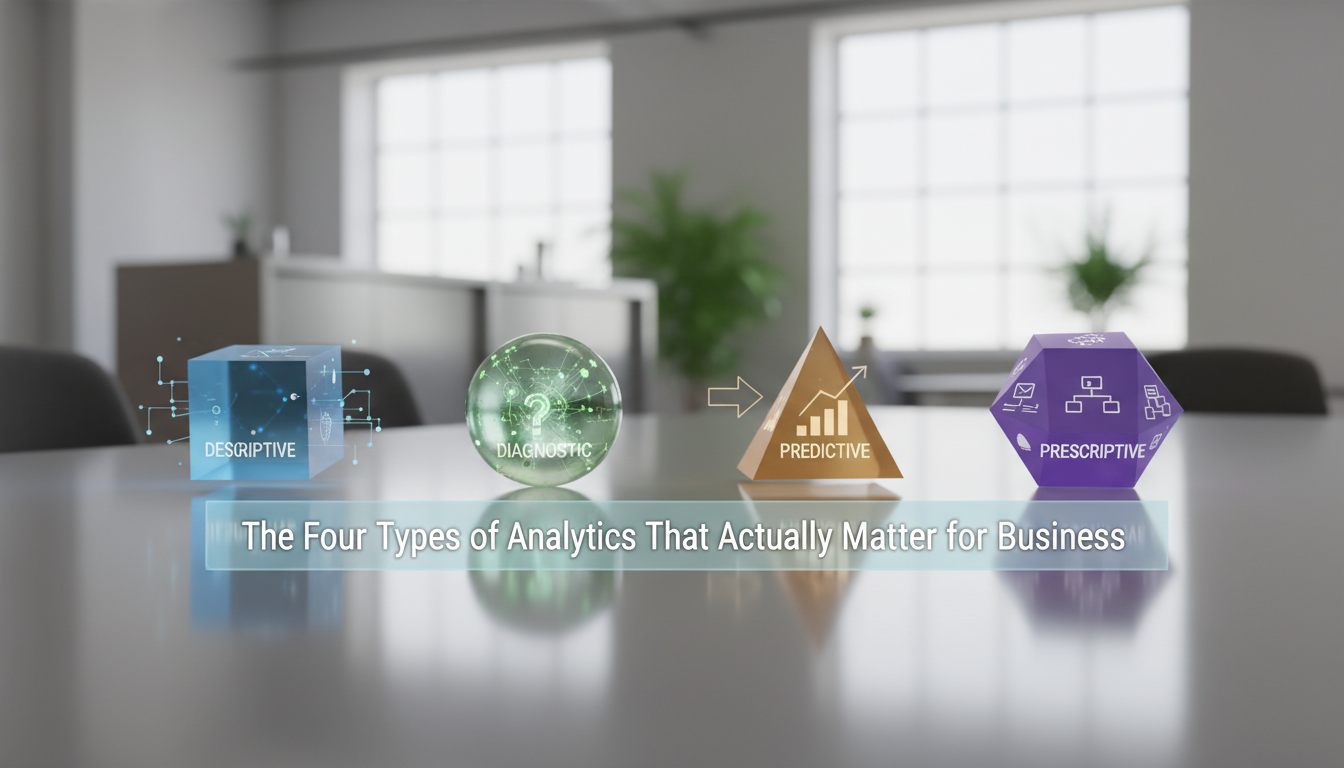
Academic frameworks talk about descriptive, diagnostic, predictive, and prescriptive analytics. In practice, I’ve found four different categories that map better to real business needs.
Health Check it
These are your vital signs — the metrics that tell you if your business is fundamentally healthy. For a SaaS company, this might be monthly recurring revenue growth, churn rate, and customer acquisition cost. For an e-commerce business, it could be conversion rate, average order value, and return customer percentage.
Health check analytics should be simple, automated, and visible to everyone who needs them. We used a traffic light system: green meant we were hitting targets, yellow meant we needed attention, red meant we had a problem requiring immediate action.
Investigation it
When health check metrics show problems, you need tools to dig deeper. Why did conversion rates drop? Which customer segments are churning? What’s causing the spike in support tickets?
These systems need to be flexible and powerful enough for deep analysis, but simple enough that non-technical team members can use them. We built custom dashboards that let anyone filter by date range, customer segment, traffic source, and product feature to isolate issues quickly.
Opportunity Analytics
This is where you identify growth opportunities and optimization potential. Which marketing channels have room to scale? What product features correlate with higher retention? Which customer segments have the highest lifetime value?
Opportunity it often requires combining data from multiple sources — marketing platforms, product usage, customer support, and financial systems. The insights here drive strategic decisions about where to invest time and resources.
Prediction Analytics
The goal isn’t to predict the future perfectly, but to make better bets. Will this customer churn next month? Is this marketing campaign likely to hit our target ROI? Which product features should we prioritize based on expected impact?
I’ve found simple predictive models often outperform complex ones. A basic logistic regression predicting customer churn based on usage patterns and support ticket volume worked better than sophisticated machine learning models that considered dozens of variables.
Common it Mistakes I’ve Made (And How to Avoid Them)

Building effective analytics systems requires avoiding several common traps that can derail even well-intentioned efforts.
Measuring Everything Instead of What Matters
My first it implementation tracked every possible user action. We measured clicks, scrolls, time on page, and dozens of other behaviors. The result was analysis paralysis — so much data that finding meaningful insights became nearly impossible.
Now I start with a maximum of five key metrics per business area. Once those are working well and driving decisions, we gradually add more specific measurements. This constraint forces focus on what actually impacts business outcomes.
Building for Analysts Instead of Decision Makers
I spent months building sophisticated analytics dashboards that impressed data scientists but confused everyone else. The interfaces were powerful but required training to use effectively. Most team members gave up and went back to making decisions based on intuition.
The solution was designing different interfaces for different users. Executives got simple, high-level dashboards with clear trend indicators. Marketing managers got campaign-specific views with actionable insights. Customer success teams got customer health scores with recommended actions.
Ignoring Data Quality Until It’s Too Late
Bad data is worse than no data because it leads to confident wrong decisions. I learned this lesson when our customer acquisition cost calculations were off by 40% due to attribution errors. We scaled marketing campaigns based on false efficiency metrics and burned through budget quickly.
Now I build data validation into every it system from day one. Automated checks flag unusual patterns, cross-reference metrics across systems, and alert us to potential data quality issues before they impact decisions.
Choosing the Right Analytics Stack
The tools matter less than the strategy, but choosing the right technology can make implementation much easier or much harder.
Start Simple, Scale Smart
For most businesses under $10M in revenue, Google it plus a simple business intelligence tool like Metabase or Grafana covers most of analytics needs. The remaining about one in five can be handled with spreadsheets and manual analysis until the business grows large enough to justify more sophisticated tools.
I’ve seen startups spend $100,000 annually on enterprise it platforms when they could have gotten better results with $500/month in tools and more focus on asking the right questions.
Integration Over Features
The best analytics tool is the one that connects easily with your existing systems. A mediocre platform that pulls data automatically from your CRM, marketing tools, and product database will deliver more value than a sophisticated system that requires manual data entry.
When evaluating tools, spend more time testing integrations than exploring features. Can it connect to your payment processor? Does it sync with your email marketing platform? How easy is it to get product usage data in and out?
Custom vs. Off-the-Shelf
I’ve built custom it systems and implemented dozens of third-party platforms. Custom solutions give you exactly what you need but require ongoing development resources. Off-the-shelf tools get you started faster but may not fit your specific business model.
My current approach: start with existing tools to validate what analytics you actually need, then build custom solutions for the 10-about one in five of use cases that drive the most business value. This hybrid approach balances speed with specificity.
Making it a Competitive Advantage
The companies that win with analytics don’t just collect data — they build decision-making systems that get smarter over time.
Create Feedback Loops
Every it insight should lead to an action, and every action should generate new data to analyze. When we identified that users who completed our onboarding checklist had 3x higher retention, we redesigned the signup flow to emphasize checklist completion.
The new signup flow generated data about which checklist items were most effective, which led to further optimizations. This feedback loop turned analytics from a reporting function into a continuous improvement engine.
Democratize Data Access
The most successful it implementations I’ve seen made data accessible to everyone who needed it, not just analysts. Customer success managers could see account health scores. Sales reps could track their pipeline conversion rates. Product managers could monitor feature adoption in real-time.
This democratization required building different interfaces for different skill levels, but the payoff was huge. When everyone has access to relevant data, the entire organization makes better decisions.
Invest in Analytics Culture
Technology alone doesn’t create an it-driven culture. You need processes that encourage data-driven decision making and discourage decisions based purely on opinion or hierarchy.
We instituted “data first” meetings where any significant business decision required supporting analytics. This wasn’t about bureaucracy — it was about building better decision-making habits. Over time, teams naturally started gathering data before proposing changes.
The Future of Business it
Analytics is evolving rapidly, driven by advances in AI, real-time processing, and automated insight generation.
AI-Powered Insights
The next generation of it tools won’t just show you what happened — they’ll automatically identify patterns, suggest explanations, and recommend actions. I’m already testing systems that can spot anomalies in customer behavior and suggest potential causes without human intervention.
These AI-powered insights won’t replace human analysis, but they’ll make analysts more productive by handling routine pattern recognition and flagging unusual events that deserve deeper investigation.
Real-Time Decision Making
Batch processing and daily reports are giving way to real-time analytics that enable immediate responses to changing conditions. Marketing campaigns can automatically adjust spend based on performance. Product features can be modified based on user behavior patterns.
This shift requires rethinking it architecture to handle streaming data and automated decision making, but the competitive advantages are significant for companies that get it right.
Privacy-First Analytics
Increasing privacy regulations and consumer awareness are changing how we collect and use data. The future belongs to companies that can generate valuable insights while respecting user privacy and complying with evolving regulations.
This means building it systems that work with aggregated, anonymized data and finding ways to understand customer behavior without invasive tracking. It’s a constraint that’s forcing innovation in analytics methodology.
it done right transforms how businesses operate. It turns gut-feeling decisions into data-driven strategies and gives teams the confidence to move quickly because they know what’s working. The key is starting with the decisions you need to make and building backward to the data that supports them.
Want to discuss how analytics can drive growth in your business? I’d love to hear about the decisions you’re trying to make and help you think through what data would make those choices obvious. Connect with me to explore how we can turn your data into competitive advantage.