Vance GOP Campaign Finance Case: What’s at Stake

The vance gop campaign finance case is a constitutional challenge before the U.S. Supreme Court seeking to remove federal limits on coordinated spending between political parties and their candidates. Oral arguments were held December 9, 2025, with a ruling expected by June 2026.
Key Takeaways
- The Vance GOP campaign finance case challenges federal caps on coordinated party spending, rooted in JD Vance’s 2022 Ohio Senate run.
- Oral arguments were held on December 9, 2025; a decision is expected by mid-2026.
- The outcome could fundamentally alter the balance of power between parties, candidates, and outside groups like super PACs.
- Conservative justices signaled openness to striking down the caps during arguments.
- Critics warn that eliminating these limits would allow wealthy donors to funnel unlimited funds directly to candidates through party committees.
- The Trump DOJ refused to defend the law, forcing the Court to appoint outside counsel, a rare procedural move.
What Is the Vance GOP Campaign Finance Case?
Origins in JD Vance’s 2022 Senate Run
In 2022, JD Vance, then a candidate for the U.S. Senate from Ohio, joined with two Republican campaign committees wait, let me restate that without the dash. In 2022, JD Vance joined the National Republican Senatorial Committee (NRSC), the National Republican Congressional Committee (NRCC), and former Representative Steve Chabot to file a lawsuit against the Federal Election Commission (FEC). They challenged the FECA provisions limiting how much political parties can spend in coordination with their candidates on advertising and other campaign activities. Vance, now Vice President, continued the fight even after taking office, turning a campaign-era grievance into a high-stakes constitutional question that the entire country is now watching.
The Legal Parties and Stakes
Plaintiffs in the vance gop campaign finance case are the NRSC, NRCC, Vance, and Chabot. Respondent is the FEC. The Democratic Party intervened on the other side. The Trump administration, through Solicitor General John Sauer, declared it would not defend the law, leading the Court to appoint Roman Martinez as amicus curiae to argue in favor of the limits. This rare move signals the administration’s full alignment with the petitioners. The case’s caption is National Republican Senatorial Committee v. Federal Election Commission, docket 24-621. According to Courthouse News, the current limits can reach $4 million for Senate races and $127,000 for House elections, though the exact formula varies by state voting-age population.
Historical Context of Campaign Finance Law

The Federal Election Campaign Act of 1971
Congress passed the Federal Election Campaign Act (FECA) in 1971 to create a national framework for congressional and presidential elections. A pivotal 1974 amendment introduced the coordinated expenditure limits now at the center of this dispute. The law gives the FEC broad power to regulate elections and restricts both the amounts individual donors can give to political parties or candidates and the amounts parties can spend in coordination with candidates.
Buckley v. Valeo and Citizens United
In its landmark 1976 ruling in Buckley v. Valeo, the Supreme Court struck down limits on independent expenditures but generally upheld contribution limits, ruling that money spent directly on elections is core political speech protected by the First Amendment. A quarter-century later, in 2001, the Court in FEC v. Colorado Republican Federal Campaign Committee (Colorado II) upheld the FECA’s limits on coordinated party expenditures by a 5-4 vote. The most significant shift came in 2010 with Citizens United v. FEC, which opened the door for unlimited independent expenditures by outside groups and fundamentally reshaped political spending. The vance gop campaign finance case is the next major test of that trajectory.
Understanding Coordinated Party Expenditure Limits

How the Caps Function in Practice
Coordinated expenditures are payments made by a party committee for activities such as advertising that are arranged with a candidate. Federal law sets a cap on how much each party committee can spend in coordination per candidate per election cycle. These limits are adjusted for inflation and vary by state. According to CNN, in 2024 the limits ranged from $123,600 to $3,772,100 for Senate candidates and $61,800 to $123,600 for House candidates. The caps are designed to prevent donors from circumventing individual contribution limits by routing money through party committees.
The Numbers: Limits for Senate and House Races
| Office | Minimum Coordinated Limit (2024) | Maximum Coordinated Limit (2024) |
|---|---|---|
| U.S. Senate | $123,600 | $3,772,100 |
| U.S. House | $61,800 | $123,600 |
In the 2021-2022 election cycle, the NRSC spent approximately $15.5 million on coordinated expenditures, while the NRCC spent about $8.3 million, primarily on political advertising, as reported by the Oyez case page. Those figures put real dollars behind what can otherwise feel like an abstract legal fight. The vance gop campaign finance case is, at its core, a fight over who controls those dollars.
Pros and Cons of Striking Down Coordinated Spending Limits
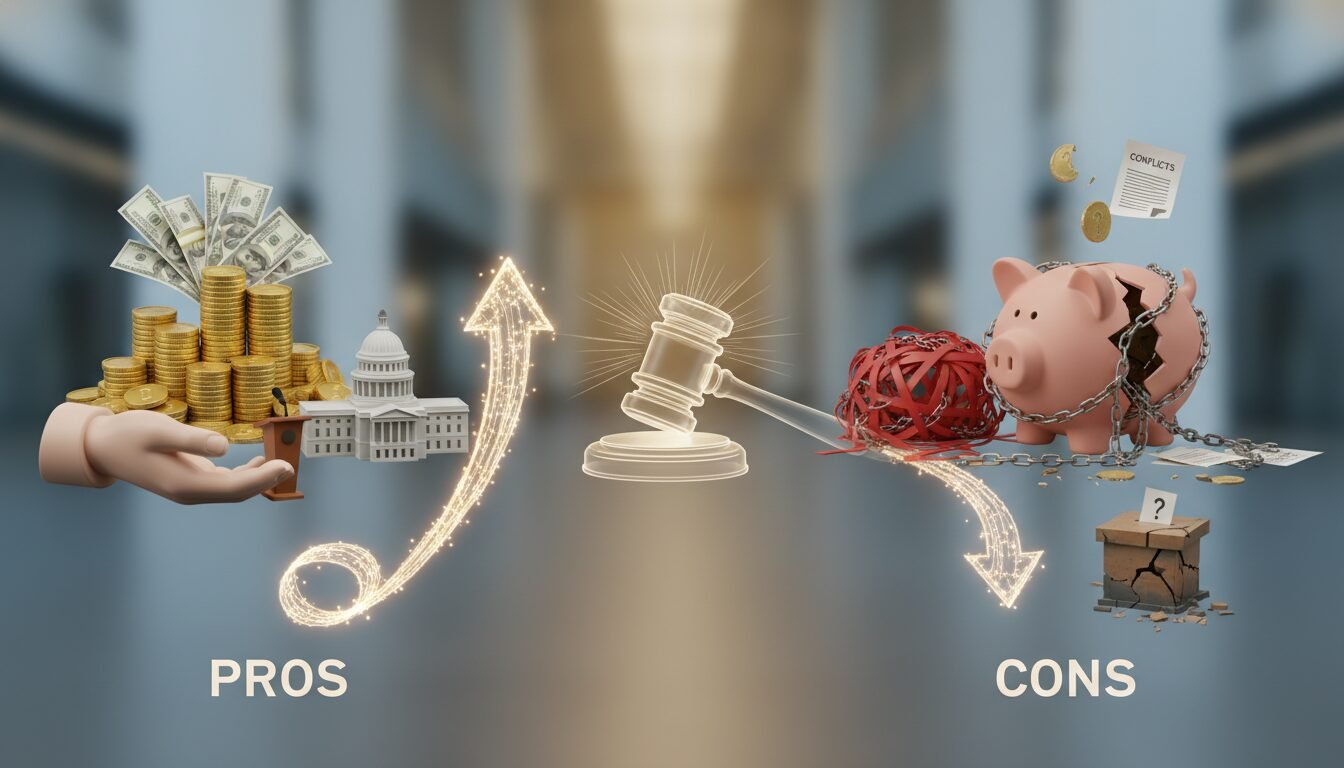
Pros
- Strengthens political parties: Redirecting money from unaccountable super PACs back to formal party structures could increase coordination and reduce fringe influence.
- First Amendment alignment: The Roberts Court has consistently held that political spending is protected speech; removing these caps would be consistent with that doctrine.
- Potential moderation effect: Parties have incentives to build broad coalitions, unlike single-issue outside groups, so party-led spending could reduce polarization.
- Removes inconsistency: The 2014 amendment already allows unlimited coordinated spending for election recounts, making the broader cap legally incoherent.
Cons
- Corruption risk: Without caps, wealthy donors could give unlimited sums to party committees with the clear expectation that funds flow to a specific candidate.
- Overturns 50 years of precedent: Striking down limits set in 1974 and upheld in Colorado II (2001) would be a significant departure from established law.
- Increases total election costs: Removing caps could dramatically inflate the cost of congressional races, raising the barrier for non-wealthy candidates.
- Concentrates donor power: Critics argue the change would benefit the same mega-donors who already fund super PACs, just through a different channel.
The First Amendment Debate at the Heart of the Case
The Petitioners’ Case for Overturning Precedent
Vance and the GOP committees argue that the coordinated spending limits violate the First Amendment. They contend the 2001 Colorado II precedent is obsolete because of changes in campaign finance law, the rise of super PACs, and shifts in the Court’s First Amendment jurisprudence. They also point to the 2014 amendment allowing unlimited coordinated spending for election recounts as proof the regime is internally inconsistent. Their brief states: “The limits run afoul of modern campaign-finance doctrine and burden parties’ and candidates’ core political rights.”
The Defense of Limits as Anti-Corruption Measures
Defenders of the law, including court-appointed amicus Roman Martinez and intervenor Democrats, argue that without these caps, wealthy donors could funnel tens of thousands of dollars to party committees with the understanding that the money be spent on a specific candidate, effectively evading individual contribution limits. The Democratic Party told the Court that eliminating the caps would “blow open the cap on the amount of money that donors can funnel to candidates.” Justice Sonia Sotomayor echoed this concern during oral arguments, stating: “Every time we interfere with the congressional design, we make matters worse.”
“We have come to a point at which campaign finance regulations reviewed by the Supreme Court are almost presumptively unconstitutional. It’s very difficult to imagine that the justices agreed to take up this case to buck that trend, rather than continue it.” Steve Vladeck, CNN Supreme Court analyst and professor at Georgetown University Law Center
Key Developments in the Supreme Court Proceedings
The Sixth Circuit’s Reluctant Decision
The case was first filed in the U.S. District Court for the Southern District of Ohio. As required for constitutional challenges under FECA, the question was certified to the U.S. Court of Appeals for the Sixth Circuit sitting en banc. The Sixth Circuit ruled the limits do not violate the First Amendment but signaled clear unease, with Chief Judge Jeffrey Sutton writing that in “a hierarchical legal system, we must follow” the Supreme Court’s Colorado II precedent unless the high court overrules it. That ruling set the stage for the Supreme Court appeal.
The Unusual Stance of the Justice Department
In a highly unusual move, the Department of Justice under the Trump administration informed the Court in May 2025 that it would not defend the law. Solicitor General John Sauer argued the case “involves a campaign-finance restriction that violates core First Amendment rights” and urged the Court to appoint outside counsel. The Court granted certiorari on June 30, 2025, and heard two hours of oral arguments on December 9, 2025. A decision is expected by the end of the 2025-2026 term.
The progression of the vance gop campaign finance case breaks down into six clear steps:
- Step 1: 2022 Lawsuit filed in Ohio district court by Vance, NRSC, NRCC, and Chabot.
- Step 2: 2023 District court certifies constitutional question to the Sixth Circuit en banc.
- Step 3: Early 2025 Sixth Circuit upholds limits, relying on Colorado II.
- Step 4: June 30, 2025 Supreme Court grants certiorari.
- Step 5: December 9, 2025 Oral arguments held, with debate over mootness and First Amendment principles.
- Step 6: 2026 Anticipated ruling that could upend decades of campaign finance law.
Facial vs. As-Applied Challenges: Why the Distinction Matters
One underreported angle in the vance gop campaign finance case is whether the petitioners are bringing a facial challenge or an as-applied challenge to the coordinated spending limits. A facial challenge argues the law is unconstitutional in all its applications. An as-applied challenge argues it is unconstitutional only as applied to a specific party or set of facts. The petitioners have primarily pressed a facial challenge, which, if successful, would wipe out the limits entirely rather than carve out a narrow exception. The Court’s conservative majority has shown a preference for broader rulings in recent First Amendment cases, which suggests a facial invalidation is more likely than a targeted fix. This distinction matters enormously for how the 2026 midterms get funded.
Potential Impacts of the Vance GOP Campaign Finance Case
Shifting Power from Super PACs Back to Parties
One of the more intriguing arguments by the petitioners is that eliminating coordinated expenditure limits would strengthen political parties relative to super PACs. Since Citizens United, massive sums have flowed to outside groups that operate with little party accountability. Justice Brett Kavanaugh noted during argument that the combination of campaign finance laws and Court rulings has “reduced the power of political parties as compared to outside groups with negative effects on our constitutional system.” A ruling in favor of the vance gop campaign finance case petitioners could redirect hundreds of millions of dollars back to formal party structures in the 2026 cycle alone.
The Debate Over Mootness and JD Vance’s 2028 Ambitions
During oral arguments, lawyers defending the limits raised a novel jurisdictional question: whether the case should be dismissed as moot because Vice President Vance has been ambiguous about running for president in 2028. If he is not a candidate, he may lack standing. Justices probed this issue extensively, but most observers believe the Court will reach the merits given the presence of the party committees. The vance gop campaign finance case illustrates how personal political futures and constitutional litigation can become remarkably entangled.
The Role of Super PACs and Political Polarization
How Limits Fueled Outside Spending
Vance’s team argues the coordinated spending caps have “harmed our political system” by pushing major donors to super PACs that face no contribution limits. This shift, they say, has contributed to the decline of political parties’ influence and increased political polarization. Senate Minority Leader Mitch McConnell filed an amicus brief stating: “In truth, the challenged coordinated-spending limit’s real function and effect has nothing to do with fighting corruption. No, its inevitable real-world effect is to restrict the amount and diminish the effectiveness of political speech.”
“The limits run afoul of modern campaign-finance doctrine and burden parties’ and candidates’ core political rights.” From the petitioners’ brief, as reported by Courthouse News
Could Lifting Caps Reduce Polarization?
Proponents assert that returning financial power to parties could encourage compromise and moderation, because parties have incentives to build broad coalitions, unlike single-issue super PACs. Critics counter that allowing unlimited coordinated spending would only deepen the influence of wealthy donors, regardless of the vehicle. The 2024 cycle saw super PACs spend hundreds of millions across congressional races, and the vance gop campaign finance case decision could reshape where that money flows in 2026 and beyond.
Expert Opinions and Political Reactions
Legal Scholars Weigh In
Many experts see this case as a natural extension of the Roberts Court’s campaign finance jurisprudence. Because the conservative majority has consistently expanded First Amendment protections for political spending, a ruling for the petitioners is widely expected. The only real question is whether the Court will explicitly overrule Colorado II or find a narrower path. The 2014 amendment that allows unlimited coordinated spending for certain recount activities provides a potential off-ramp for a limited ruling, but the sweeping language of the oral arguments suggests the opinion could go much further.
Political Observers on the Stakes
Democrats have warned that a victory for the GOP would open the floodgates for corruption. Republicans frame it as a free speech issue. The controversy surrounding the vance gop campaign finance case mirrors the broader national divide over money in politics. With the 2026 midterms approaching, a decision could have immediate and dramatic effects. Campaign strategists from both parties are already gaming out scenarios in which coordinated limits are gone, preparing for a new era of party-led spending.
What to Expect from the Supreme Court’s Ruling
Possible Timelines and Outcomes
The Supreme Court typically releases decisions in high-profile cases by the end of June. Given the oral argument in December 2025, a ruling is likely in May or June 2026. Most court-watchers anticipate the conservative majority, currently 6 justices, will vote to strike down or severely curtail the limits. The opinion could be written by Justice Samuel Alito, Justice Clarence Thomas, or Chief Justice John Roberts, all of whom have been skeptical of campaign finance regulations. A narrow 5-4 decision seems unlikely given the solid conservative bloc.
Broader Impact on the 2026 and 2028 Elections
If the Supreme Court sides with the GOP, the 2026 congressional races will be the first to see unlimited coordinated party spending. This could dramatically increase the total cost of elections and change how campaigns are structured and run. For JD Vance personally, a victory would bolster his standing among conservative activists ahead of a possible 2028 presidential run. The vance gop campaign finance case thus serves not only as a legal landmark but also as a strategic setup for the next political cycle.
Frequently Asked Questions
What is the Vance GOP campaign finance case?
The vance gop campaign finance case refers to the Supreme Court challenge led by Vice President JD Vance and Republican party committees to overturn federal limits on how much political parties can spend in coordination with candidates. It originated from Vance’s 2022 Ohio Senate campaign and is formally captioned National Republican Senatorial Committee v. Federal Election Commission.
When will the Supreme Court decide the Vance GOP campaign finance case?
A decision is expected by the end of the Supreme Court’s current term, likely in May or June 2026. Oral arguments were held on December 9, 2025, and the Court typically resolves argued cases within the same term.
What are the current limits on coordinated party expenditures?
In 2024, limits ranged from $123,600 to $3,772,100 for Senate candidates and $61,800 to $123,600 for House candidates, depending on the state’s voting-age population and inflation adjustments. The overall ceiling can reach roughly $4 million for the largest Senate races.
Why did the Department of Justice refuse to defend the law?
The Trump administration considers the limits a violation of core First Amendment rights. Solicitor General John Sauer asked the Supreme Court to appoint an outside lawyer to argue in favor of the law, which the Court did by naming Roman Martinez as amicus curiae.
How could the case impact future elections?
If the limits are struck down, political parties could spend unlimited sums in coordination with candidates for the first time since 1974. This would likely shift money away from super PACs, dramatically increase total election spending, and change how both parties structure their campaign operations starting with the 2026 midterms.
Is JD Vance still involved in the case as Vice President?
Yes, JD Vance remains a named petitioner in the vance gop campaign finance case. His continued participation raised a mootness question during oral arguments because of his unclear plans for 2028, but the case is expected to proceed on the merits given the party committees’ standing.
Enjoyed this article?
Connect with me for collaboration, ventures, or just a good conversation about building things.
Get in Touch