Supreme Court Campaign Finance: Key Rulings Explained

Key Takeaways
- The U.S. supreme court campaign finance doctrine began with Buckley v. Valeo (1976), which equated political spending with speech while upholding contribution limits.
- Citizens United v. FEC (2010) overturned a century of restrictions, allowing unlimited corporate and union independent expenditures and paving the way for super PACs.
- McCutcheon v. FEC (2014) struck down aggregate contribution ceilings, enabling wealthy donors to give to many candidates and committees without overall caps.
- A pending 2026 case, NRSC v. FEC, challenges limits on coordinated party spending, potentially allowing direct collaboration between parties and candidates.
- Dark money and billionaire influence have surged, with undisclosed spending exceeding $1 billion in the 2024 cycle, according to the Brennan Center.
- State-level reforms and legislative proposals continue to grapple with the constitutional landscape set by the Supreme Court.
Supreme court campaign finance law is the body of First Amendment doctrine that determines how much money individuals, corporations, and parties can spend on elections. The Court has consistently treated campaign spending as protected speech, dismantling restrictions piece by piece over five decades.
Pros and Cons
Pros
- Free speech protection: Rulings like Citizens United affirm that political spending is a form of expression protected by the First Amendment, preventing government from silencing political voices based on their corporate or organizational form.
- Increased political participation: Deregulation has lowered barriers for new political actors, including advocacy groups and grassroots organizations, to fund independent campaigns and reach voters.
- Party empowerment: If NRSC v. FEC succeeds, political parties could coordinate more directly with candidates, potentially producing more coherent and accountable political platforms.
Cons
- Dark money opacity: Over $1 billion in undisclosed funds flowed through the 2024 election cycle, making it nearly impossible for voters to know who is funding political messages.
- Billionaire outsized influence: A handful of ultra-wealthy donors can now single-handedly sustain entire campaigns, shifting policy priorities away from ordinary voters.
- Enforcement gaps: The FEC has struggled with partisan deadlock, and the Trump administration’s executive order barring enforcement of coordinated spending limits shows how easily rules can be rendered inert by political will.
- Erosion of contribution caps: Striking aggregate limits in McCutcheon allowed a single donor to max out to every federal candidate, effectively buying access across the entire ballot.
The Evolution of Supreme Court Campaign Finance Jurisprudence

The Foundational Cases: Buckley and Its Legacy
The modern campaign finance era began with Buckley v. Valeo (1976), which examined the Federal Election Campaign Act of 1971. The Court upheld limits on contributions to candidates, reasoning they prevented corruption or its appearance. It struck down limits on independent spending by individuals and groups, equating expenditure with speech. This split logic – contributions can be capped, but spending cannot – has framed every subsequent decision. According to Oyez, Buckley also established that the only permissible justification for most limits is preventing quid pro quo corruption (Oyez).
The Shift Toward Deregulation: Citizens United and Beyond
In Citizens United v. Federal Election Commission (2010), the Supreme Court dramatically expanded the this type of finance framework. It held that corporate and union independent spending could not be limited, reversing a century-old ban. Justice Kennedy’s majority opinion asserted that independent expenditures do not give rise to corruption, a premise widely criticized as subsequent super PACs effectively coordinated with candidates. The Brennan Center notes that the ruling fueled a fusion of wealth and political power not seen since the Gilded Age (Brennan Center).
Key Supreme Court Decisions on Campaign Finance
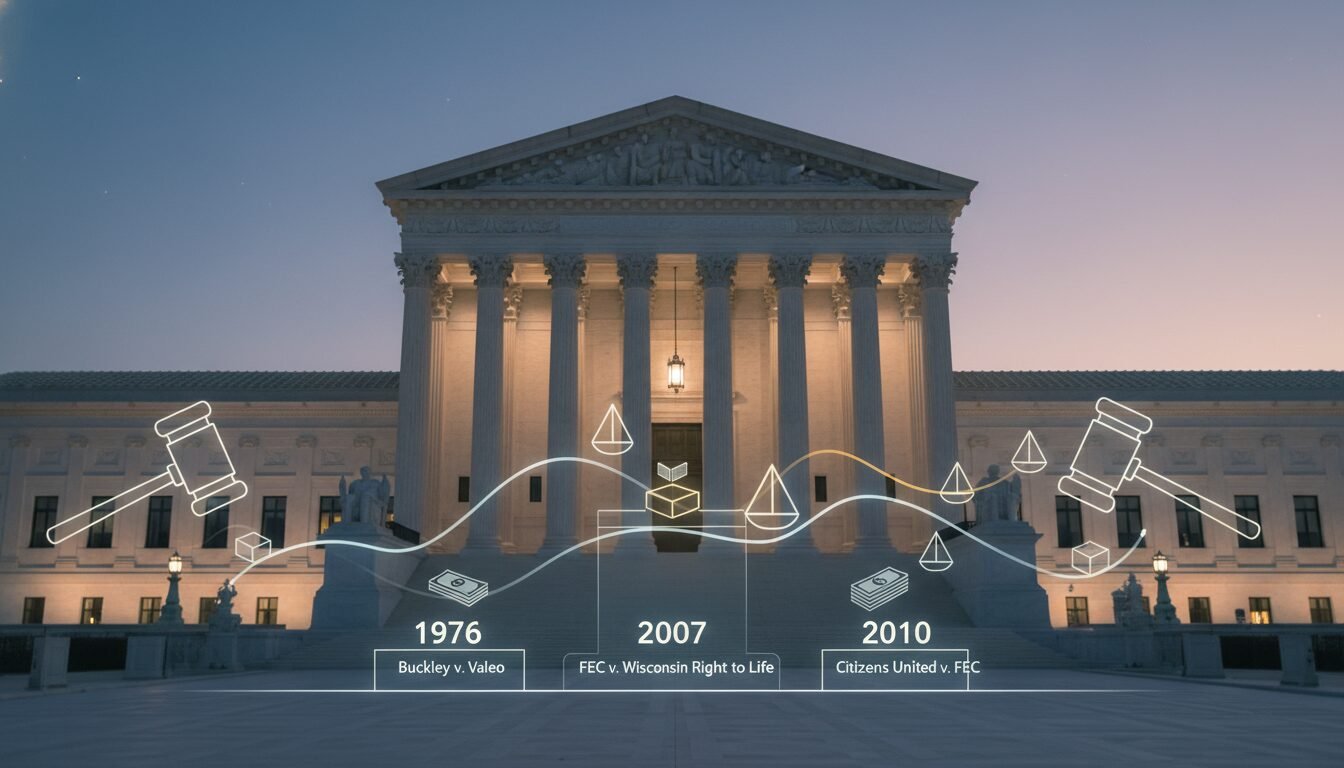
Citizens United v. FEC (2010): Unlimited Corporate Spending
This landmark this kind of campaign finance case emerged from a conservative nonprofit’s attempt to air a film critical of Hillary Clinton during the 2008 primary season. The 5-4 ruling declared that the Bipartisan Campaign Reform Act’s restrictions on corporate-funded political broadcasts violated the First Amendment. The decision enabled corporations and unions to spend unlimited sums independently, and lower courts used it to authorize super PACs. In the 2024 election, this contributed to over $1 billion in dark money, including at least $182 million funneled through party-aligned groups, per the Brennan Center.
McCutcheon v. FEC (2014): Aggregate Contribution Limits
Another decisive ruling came in McCutcheon v. FEC. The Court, again 5-4, invalidated aggregate biennial limits on how much an individual could give to all federal candidates, parties, and PACs combined. The FEC had capped the total at $117,000 per two-year cycle. Chief Justice Roberts argued that only individual base limits were necessary to prevent corruption, not cumulative caps. This allowed a single donor to max out contributions to every candidate, effectively buying influence across the entire ballot (FEC).
Coordinated Party Expenditure Limits Under Fire

The NRSC v. FEC Challenge
A current dispute, NRSC v. FEC, could further reshape the rules. The National Republican Senatorial Committee and others are challenging limits on coordinated spending between parties and candidates. In 2001, the Court upheld these limits in Colorado II (5-4), but the Sixth Circuit noted that subsequent rulings have “tightened the free-speech restrictions,” calling the precedent “questionable.” During December 2025 oral arguments, Justice Alito expressed skepticism about the challengers’ standing, while Chief Justice Roberts questioned whether potential enforcement by a future administration justified dismissing the case (SCOTUSblog). Notably, the Trump administration reversed the government’s prior position, arguing the coordinated spending limits are themselves unconstitutional.
Implications for Political Parties and Candidates
If the Supreme Court strikes down coordinated limits, it would upend decades of the court campaign finance regulation. According to the Center for American Progress, parties could then funnel unlimited special-interest money directly to candidates, bypassing contribution caps. This would effectively turn parties into pass-throughs for wealthy donors, eroding the distinction between independent and coordinated spending (American Progress). The Campaign Legal Center warns that such a development would further drown out everyday voters.
The Impact of Supreme Court Campaign Finance Rulings on Elections
Rise of Super PACs and Dark Money
The practical result of the supreme court campaign finance revolution has been an explosion of outside spending. Super PACs, permitted after Citizens United, can accept unlimited donations and spend independently, though many coordinate informally with campaigns. In the 2024 presidential election, billionaire-backed super PACs closed fundraising gaps and even took over core campaign operations like voter outreach, per the Brennan Center. Dark money, meaning funds from groups that don’t disclose donors, topped $1 billion, with at least $182 million funneled through party-aligned groups.
Wealthy Donor Influence and Billionaire Spending
A direct consequence of deregulation is the dominance of ultra-wealthy individuals in electoral politics. Elon Musk’s large-scale contributions in 2024 exemplified how a single billionaire can sustain political operations at scale. Most Americans have noticed: a broad majority believe unlimited money weakens democracy, according to polling cited by the Brennan Center. The ability to give millions, often anonymously, shifts policy priorities toward donor interests, creating a system of wealth-based political access that Buckley and its successors have made nearly impossible to dismantle through ordinary legislation.
Current Legal Landscape and Ongoing Debates
The Role of the FEC and Enforcement Gaps
The Federal Election Commission, tasked with enforcing campaign finance limits, has struggled with partisan deadlock and chronic underfunding. In the NRSC case, the Trump administration issued an executive order barring enforcement of the coordinated spending limits, highlighting how political winds can render rules inert before any court even rules. Private parties can sue to fill the gap, but without robust FEC action, many violations go unpunished. The Campaign Legal Center emphasizes that illegal coordination often occurs with impunity under the current enforcement regime.
Calls for Reform: Legislation and Constitutional Amendments
Reform advocates push for both statutory and constitutional changes in response to the current status quo. Proposed legislation like the For the People Act would mandate donor disclosure and strengthen small-dollar public financing programs. A constitutional amendment to overturn Citizens United has been introduced in Congress but faces steep political hurdles, requiring two-thirds approval in both chambers plus ratification by three-fourths of states. At the state level, initiatives for public financing and transparency are gaining real traction.
Legislative Responses: Federal Bills and International Comparisons
Beyond the For the People Act, Congress has debated the DISCLOSE Act, which would require super PACs and dark money groups to identify their major donors publicly. As of 2026, neither bill has cleared the Senate, largely due to the 60-vote threshold needed to overcome a filibuster. Internationally, the contrast is stark. Canada caps third-party election advertising at roughly $500,000 CAD per cycle, and the United Kingdom limits national party spending to around £30 million during a general election campaign. Both systems treat campaign spending as a regulable activity rather than protected speech, a constitutional distinction that makes direct comparison difficult but instructive for reform advocates.
State-Level Campaign Finance Responses
State Public Financing Models
As the federal framework constrains Congress, states have become laboratories of reform. Maine, Arizona, and Connecticut operate clean elections programs that provide public matching funds to qualifying candidates. These systems amplify small donors and reduce dependency on large contributions, though they face ongoing legal challenges under the First Amendment. New York City’s matching funds program, which provides up to 8-to-1 matches on small donations, is frequently cited by reformers as a model worth scaling.
Disclosure Laws and Litigation
Many states have enacted stricter disclosure requirements for independent spending, even as the Supreme Court has struck down certain content-based restrictions. California’s DISCLOSE Act, for instance, requires clear identification of top donors on political ads. Dark money groups exploit loopholes by laundering funds through multiple entities to obscure true sources. Ongoing litigation tests how far states can go to promote transparency without running afoul of supreme court campaign finance precedent, and the outcomes of those cases will shape the next decade of election law.
The Future of Campaign Finance Regulation in a Roberts Court
Potential Outcomes of NRSC v. FEC
A ruling in NRSC v. FEC is expected by mid-2026. If the Court sides with the plaintiffs, it could eliminate the last meaningful restraint on party-candidate coordination, continuing a clear deregulatory trend. A narrow ruling focused on standing might leave the limits intact but invite future challenges. Analysts note that Justice Gorsuch’s silence and Justice Barrett’s minimal questioning during oral arguments make predictions difficult, per SCOTUSblog’s December 2025 coverage.
Predictions and Trends for 2026 and Beyond
Looking ahead, supreme court campaign finance jurisprudence is likely to face cases testing the limits of super PAC independence and dark money disclosure requirements. The 2026 midterms are shaping up to be among the most expensive in history, showcasing the compounding effects of decades of deregulation. Meaningful change will likely require altering the Court’s composition or passing a constitutional amendment, both of which are significant undertakings. Reformers are betting on state-level momentum and public pressure to keep the issue alive.
“The Supreme Court’s campaign finance rulings have fundamentally transformed American democracy by equating money with speech. As a result, the voices of ordinary citizens are increasingly drowned out by billionaires and corporate treasuries.” – Daniel I. Weiner, Brennan Center for Justice
“Ingenuity in drafting disclosure requirements can ensure that voters have the information they need about who is funding political speech, even within the constitutional limits the Court has set.” – Trevor Potter, Campaign Legal Center
Comparison of Landmark Supreme Court Campaign Finance Decisions
| Case Name & Year | Key Holding | Effect on Regulations |
|---|---|---|
| Buckley v. Valeo (1976) | Upheld contribution limits; struck independent spending limits as speech. | Established the contribution/expenditure divide at the core of all subsequent supreme court campaign finance analysis. |
| Citizens United v. FEC (2010) | Allowed unlimited corporate/union independent spending. | Opened door to super PACs and massive dark money, reversing century-old bans. |
| McCutcheon v. FEC (2014) | Struck down aggregate contribution limits ($117,000 biennial cap). | Enabled donors to give the maximum to every candidate, vastly amplifying individual influence. |
| NRSC v. FEC (pending 2026) | Challenges coordinated party expenditure limits. | Could allow unlimited funding to flow through party committees directly to candidates, eroding contribution caps. |
Frequently Asked Questions
What is the most important Supreme Court campaign finance case?
Citizens United v. FEC (2010) is widely considered the most consequential, as it removed restrictions on corporate political spending and sparked the super PAC era. The 5-4 decision reversed a century-old ban and reshaped how billions of dollars flow into American elections.
How has Citizens United changed elections?
It led to billions in outside spending, the rise of dark money groups, and greater influence for wealthy donors, making elections more dependent on private capital. In the 2024 cycle alone, dark money topped $1 billion, per the Brennan Center.
What are super PACs?
Super PACs are political committees that can raise and spend unlimited sums independently from candidates, a direct result of the Court’s decision in Citizens United. They cannot legally coordinate directly with campaigns, though critics argue informal coordination is widespread.
Can Congress overturn Citizens United?
Congress cannot overturn a constitutional ruling by statute alone. A constitutional amendment would be required, though disclosure mandates and public financing bills can mitigate some of its effects without directly reversing the ruling.
What is the NRSC v. FEC case about?
It challenges federal limits on how much parties can spend in coordination with candidates, arguing those limits violate free speech under the First Amendment. Oral arguments were held in December 2025, with a ruling expected by mid-2026.
The supreme court campaign finance trajectory over the past five decades has systematically removed guardrails on political money. From Buckley to Citizens United and now NRSC, the Court has prioritized corporate and wealthy donor speech over competing interests of electoral integrity and equality. As the 2026 midterms approach, the consequences are plain: billions in spending, dark money opacity, and heightened donor influence. Whether reforms can survive the Roberts Court’s skeptical eye remains the central question for the next chapter of American election law.
I think about this a lot as someone building companies in an era where policy shapes markets. The rules around political money don’t just affect elections. They shape which industries get favorable treatment, which regulations get written, and ultimately which startups operate in a fair competitive environment. If you want to discuss how the regulatory and political landscape intersects with your business strategy, connect with me directly. I’m always up for that conversation.
Enjoyed this article?
Connect with me for collaboration, ventures, or just a good conversation about building things.
Get in Touch