Startup Financing: Every Option Founders Need

Key Takeaways
- Startup financing is the capital you raise to launch and grow your business, ranging from personal savings to complex equity deals.
- No single funding source works for everyone. The best mix depends on your industry, stage, and risk appetite.
- Modern models like revenue-based financing and government set-aside programs widen access for underrepresented founders.
- Always match your financing to a data-driven business plan and clear milestones.
- As of 2026, AI-underwritten loans and Reg CF crowdfunding have expanded the options available to early-stage founders significantly.
Startup financing is the capital founders raise to launch and grow a new business. It covers personal savings, loans, equity investments, and grants, each with distinct trade-offs in cost, control, and speed.
What Is Startup Financing?
The Core Definition
Startup financing is the process of securing monetary resources to turn an idea into a viable enterprise. It answers one fundamental question: how will you pay for product development, inventory, marketing, and operating expenses before revenue catches up? Without a clear funding strategy, even the most brilliant concept can stall before it finds customers.
According to the U.S. Small Business Administration (SBA), there are no federal grants for starting a general business, so founders must look elsewhere. The SBA’s funding portal outlines three primary pathways: self-funding, investors, and loans, each with distinct requirements. Understanding these categories is the foundation of any smart capital strategy.
Why Getting This Right Is Critical
A CB Insights study found that running out of cash is the top reason startups fail. Proper funding not only buys you runway. It shapes your operational structure. Debt financing demands predictable cash flow for repayments, while equity financing often brings strategic partners onto your board. Choosing the right model at the right stage can mean the difference between scaling gracefully and shutting down.
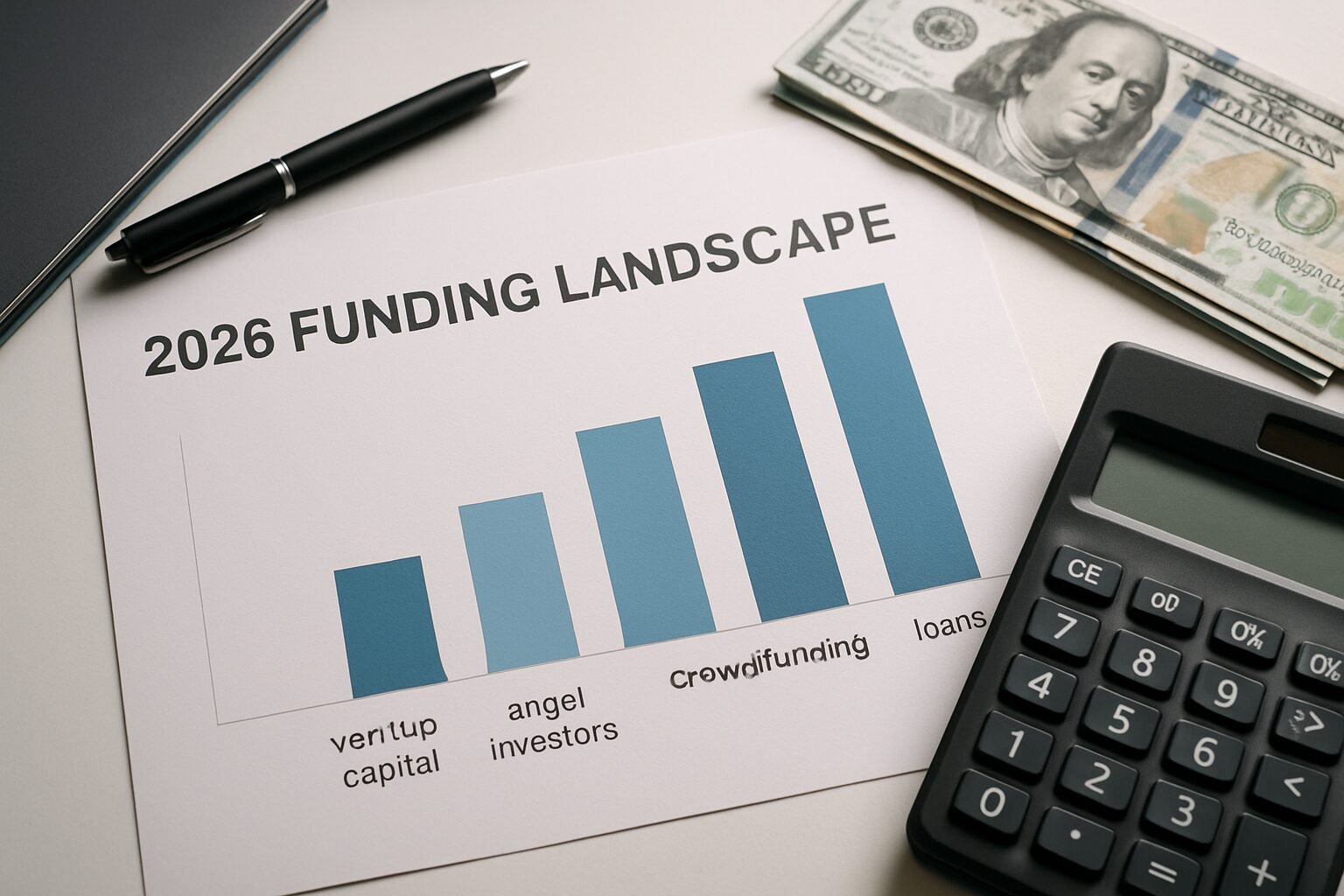
As of 2026, the funding landscape has evolved to include AI-underwritten loans, revenue-based instruments, and hyper-targeted government grants. Founders who ignore these shifts risk missing the most cost-efficient capital for their growth phase.
The 2026 Funding Landscape
From Bootstrapping to AI-Powered Lending
The startup financing options available today look nothing like what existed a decade ago. Online lenders like SoFi can approve and fund a term loan in as little as 24 hours, while AI platforms analyze cash-flow data to offer lines of credit within minutes. These innovations dramatically speed up access to capital, especially for early-stage companies with thin credit files. SoFi’s marketplace, for instance, can connect founders with up to $2 million in business funding.
Economic Factors Shaping Access
Interest-rate environments and tightened credit standards still influence who gets funded and on what terms. In 2025, the SBA backed over 60,000 loans, showing that government-guaranteed programs remain a lifeline when conventional banks hesitate. Meanwhile, private markets have shifted toward revenue-based financing, a model where you repay investors a fixed percentage of monthly revenue until you return a predetermined multiple of the original capital.
For founders in critical sectors like climate-tech, new incentives have emerged. The Inflation Reduction Act allocates billions in grant funding for clean-energy startups, adding a powerful option to the mix. Staying current on funding mechanisms is as vital as product development.
Bootstrapping and Self-Funding Strategies

Using Personal Savings and Retirement Accounts
Bootstrapping means funding your business with your own resources: checking accounts, savings, even retirement accounts. It keeps you in full control but concentrates all risk on you personally. The SBA warns that tapping retirement funds early can trigger penalties and damage your long-term savings. Yet for many first-time founders, this is the first form of capital they access because it requires no external approval.
Personal credit lines are often the easiest bridge for small business owners with a reliable income and a credit score above 620. This route works best when you need quick working capital and can manage interest payments monthly without straining operations.
The Role of Friends and Family Capital
Friends and family ranked as a top funding source in multiple surveys of early-stage founders. They often lend at lower rates than banks and are more flexible on repayment. However, mixing personal relationships with business debt can strain bonds if the startup struggles. Clear, written terms, even a simple promissory note, protect both sides and professionalize the arrangement.
Despite its informality, family capital remains a critical piece of the early-stage puzzle, especially for pre-revenue ventures that lack the track record traditional lenders demand.
Debt-Based Financing Options
SBA Microloans and 7(a) Loans
Government-backed debt is one of the most reliable startup financing sources in the U.S. The SBA microloan program provides up to $50,000 for working capital, inventory, equipment, and other startup costs. These loans require a personal guarantee and often collateral, but repayment terms can extend to six years, making them more manageable for cash-strapped founders.
Larger SBA 7(a) loans can go up to $5 million, though startups typically need strong collateral and a detailed business plan. Because the SBA guarantees a portion of the loan, banks are more willing to extend credit, bridging a gap that would otherwise shut many founders out entirely.
Online Lenders and Business Credit Lines
Nonbank lenders have reshaped access to capital by lowering barriers significantly. Some, like Fundbox, require as little as three months in business and a credit score of 570 to qualify for term loans. The trade-off is higher interest rates and fees. Platforms like NerdWallet showcase products where funds can hit your account in 24-48 hours, a speed impossible with traditional banks.
Business credit lines offer ongoing access to capital up to a set limit. You pay interest only on what you draw. This flexibility makes them a favorite for founders when cash needs fluctuate, say, during seasonal inventory builds or pre-launch marketing pushes.
Peer-to-Peer Lending
Peer-to-peer (P2P) lending platforms connect founders directly with individual investors willing to fund loans outside the traditional banking system. Platforms like LendingClub and Funding Circle have originated billions in small business loans. Rates vary widely based on creditworthiness, but P2P can be a viable middle ground between a bank loan and an equity raise, especially for founders who want speed without giving up ownership.
Equity Financing Essentials
Angel Investors and Venture Capital
Equity financing means selling a share of ownership in exchange for capital. Angel investors, often wealthy individuals who meet the SEC’s accredited investor standard (net worth above $1 million or annual income above $200,000), typically invest between $25,000 and $100,000 in early-stage companies, according to BDC data. They also bring mentorship and industry contacts, but they’ll expect a seat at the table, often as board observers.
Venture capitalists manage pooled funds and write larger checks, frequently $1 million or more. They focus on high-growth sectors like AI, fintech, and biotech. VC-backed companies must accept board seats for the investors and a longer horizon of 5-7 years before exits. This model accelerates growth but dilutes founder equity significantly over multiple rounds.
Equity Crowdfunding and Convertible Notes
Regulation Crowdfunding (Reg CF) now lets startups raise up to $5 million from non-accredited investors. This democratizes access, expanding the investor pool well beyond the wealthy. Campaigns demand strong marketing and transparency, but the community-building effect can double as early customer acquisition.
Convertible notes remain a popular hybrid instrument: a loan that converts into equity during a future priced round. They delay valuation negotiations, giving founders runway while preserving control. In 2026, most seed-stage rounds begin with convertible instruments for their speed and simplicity. SAFEs (Simple Agreements for Future Equity), popularized by Y Combinator, work similarly and have become the default at many accelerators.
Alternative Financing Models
Revenue-Based Financing: Pay as You Earn
Revenue-based financing (RBF) is one of the fastest-growing funding models for 2026. Instead of fixed loan payments, you share a percentage of monthly revenue, typically in the 2-7% range, until you return 1.3-2x the original investment. This aligns repayment with business performance, easing pressure during slow months. RBF is particularly attractive for SaaS and e-commerce startups with recurring revenue streams.
Because RBF doesn’t require personal guarantees or board seats, founders keep control while accessing growth capital. Companies like Pipe and Clearco have made this form of funding mainstream, underwriting through real-time financial data rather than credit scores alone.
Business Incubators and Accelerators
Incubators and accelerators are an underrated source of early capital and resources. Programs like Y Combinator and Techstars invest $125,000-$500,000 in exchange for small equity stakes (typically 5-7%), but the real value is the network, mentorship, and credibility that come with acceptance. Getting into a top accelerator can compress years of relationship-building into a single cohort. For pre-product founders, this is often the most efficient first institutional capital available.
Grants and Government Incentives for Underserved Founders
Targeted grant programs support specific groups: women-owned, minority-owned, veteran-owned, and rural businesses. The SBA’s Office of Women’s Business Ownership funds over 100 centers that provide training and micro-grants. The SBIR and STTR programs award competitive grants for R&D-focused startups, often up to $1.5 million across phases. These require no repayment or equity, making them the purest form of non-dilutive capital available to founders.
In 2026, climate-tech and social-impact ventures can tap grant pools totaling billions through the Inflation Reduction Act. The application process is rigorous and slow, often taking 6-12 months, but the payoff is capital that costs you nothing in ownership or interest.
Pros and Cons of Major Startup Financing Types
Pros
- Bootstrapping: Full ownership retained, no approval process, builds financial discipline from day one.
- SBA loans: Lower interest rates than most alternatives, longer repayment terms (up to six years for microloans), government-backed security for lenders.
- Angel and VC equity: Large capital injections, strategic mentorship, and network access that accelerates growth.
- Revenue-based financing: No dilution, no personal guarantee, repayment scales with your actual performance.
- Grants: Zero repayment, zero equity loss, and often come with credibility signals that attract follow-on investors.
Cons
- Bootstrapping: Personal financial risk is high, limits growth speed, and can burn out founders who are funding operations from savings.
- SBA loans: Slow approval process (weeks to months), require collateral and personal guarantees, and demand a detailed business plan upfront.
- Angel and VC equity: Significant ownership dilution, loss of some decision-making control, and pressure to hit aggressive growth targets on investor timelines.
- Revenue-based financing: Only works if you have consistent revenue, total repayment cost can exceed a traditional loan, and availability is limited for pre-revenue companies.
- Grants: Highly competitive, application timelines of 6-12 months, strict eligibility criteria, and often restricted to specific industries or demographics.
How to Choose the Right Financing Mix
Assessing Your Funding Needs and Milestones
Effective capital planning begins with an honest cost breakdown. How much do prototyping, market testing, and initial inventory really cost? Most first-time founders underestimate by a wide margin, often 40-60%. Attach each capital request to a concrete milestone: a working prototype, first 100 paying customers, break-even month. This milestone-based approach makes your pitch more credible and protects against wasteful dilution.
Balancing Debt vs. Equity Risk
Debt preserves ownership but adds fixed obligations that can crush a fledgling cash flow. Equity reduces monthly pressure but cedes control. The ideal blend often evolves over time: bootstrap to prove concept, use a convertible note for seed capital, then pursue VC once metrics justify a $10M+ valuation. Constantly re-evaluate as your business matures and your options expand.
“As a founder who has scaled three AI-driven startups, I’ve learned that the right funding strategy is never one-size-fits-all. Mixing personal savings with strategic SBA loans and revenue-based capital allowed us to maintain control while accelerating growth.” – Amin Ferdowsi
“According to Y Combinator’s guidance for founders, the best time to raise money is when you have enough traction to tell a compelling story, not when you desperately need it. Desperation is visible to investors and it costs you in valuation.” – Y Combinator, Startup School
5 Steps to Secure Startup Financing
Step 1: Build a Data-Driven Business Plan
Every lender and investor will ask for your business plan. Include market analysis, revenue projections, and a clear use of funds. A solid plan dramatically improves your approval odds because it signals seriousness and reduces perceived risk for whoever is writing the check.
Step 2: Determine Exactly How Much Capital You Need
Calculate fixed startup costs (licenses, equipment) and working capital for at least 6-12 months of operations. The SBA’s free cost calculator can help. Overestimating slightly is better than running out of cash mid-launch, a misstep that derails far too many early ventures.
Step 3: Match Your Stage to the Right Financing Type
Pre-revenue: personal savings and friends/family. Early traction: angel investors or revenue-based financing. Proven growth: venture capital or SBA loans. Aligning your stage with the right source avoids the pitfalls of raising too much too soon or too little too late.
Step 4: Prepare Your Financial Documents
Lenders want bank statements (typically 3-6 months), tax returns, a profit and loss statement, and a balance sheet. Investors want a cap table, pitch deck, and financial model. Having these ready before you start outreach cuts weeks off your fundraising timeline and signals operational maturity.
Step 5: Apply, Negotiate, and Close
Submit applications to multiple sources simultaneously where possible. For loans, compare APR, not just interest rate, to get a true cost comparison. For equity deals, understand the term sheet before signing. Startup financing is not a one-time event. It’s a continuous process that evolves with your business, so build relationships with lenders and investors before you need them.
Comparison of Startup Financing Methods
| Financing Type | Capital Range | Ownership Impact | Speed to Funding | Best For |
|---|---|---|---|---|
| Bootstrapping | $0 – $100,000+ | Full ownership retained | Immediate | Service businesses with low startup costs |
| SBA Microloan | Up to $50,000 | No dilution | Weeks to months | Working capital, equipment, inventory |
| Online Term Loan | $5,000 – $500,000 | No dilution | 1-3 days | Quick cash for expansion or emergencies |
| Angel Investment | $25,000 – $500,000 | Equity stake (10-30%) | 1-3 months | Early post-prototype stage |
| Venture Capital | $1M+ | Significant dilution | 3-6 months | High-growth scalable startups |
| Revenue-Based Finance | $10,000 – $5M | No dilution | 2-4 weeks | SaaS, e-commerce with recurring revenue |
| Crowdfunding (Reg CF) | $5,000 – $5M | Minimal to none (reward-based) | 1-3 months (campaign) | Consumer products, community-driven brands |
| Grants (SBIR/STTR) | $50,000 – $1.5M | No dilution, no repayment | 6-12 months | R&D, climate-tech, social impact |
| Accelerators (e.g., YC) | $125,000 – $500,000 | 5-7% equity | 3-6 months (cohort cycle) | Pre-product or early-traction startups |
Frequently Asked Questions
How does startup financing work?
Startup financing is the process of raising capital to launch and grow a new business. It can involve debt (loans you repay with interest), equity (selling shares for investment), or alternative models like grants and revenue-based financing. The right approach depends on your stage, industry, and how much ownership you’re willing to trade for speed and scale.
Can I get a startup business loan with no revenue?
Yes. Many online lenders and SBA microloan programs will lend to pre-revenue startups if you have a solid personal credit score (typically 620+) and a credible business plan. Some require collateral or a personal guarantee to offset the additional risk.
What credit score do I need for startup financing?
SBA microloans generally look for a minimum personal credit score of 620. Online lenders may accept scores as low as 570, but expect higher interest rates in exchange. Venture capital and angel investors rarely emphasize credit scores, focusing on growth potential and team quality instead.
Are there grants to start a business?
There are no federal grants for general business startup costs. However, targeted grants exist for R&D (SBIR/STTR), clean energy, women-owned, minority-owned, and veteran-owned businesses. Each has strict eligibility criteria and a competitive application process that can take 6-12 months to complete.
What is the difference between venture capital and angel investing?
Angel investors are individuals who invest their own money, usually $25,000-$100,000, in early-stage companies. Venture capitalists manage pooled funds and invest larger amounts, often $1 million or more, in high-growth startups, typically requiring board seats and a clear exit strategy within 5-7 years.
How long does it take to get startup financing?
Timelines vary widely by source. Personal savings are immediate. Online loans can fund in 24-48 hours. SBA loans take weeks to months. Angel and VC rounds usually require 2-6 months. Crowdfunding campaigns run 30-60 days. Grants can take 6-12 months from application to award.
If you’re building a venture and want to talk through which capital stack makes sense for your stage, connect with me at aminferdowsi.com. I’m always open to a conversation with founders who are serious about building something real.
Enjoyed this article?
Connect with me for collaboration, ventures, or just a good conversation about building things.
Get in Touch