Social Networking: How It Works, Types & Real Risks
Social networking is the use of online platforms to build relationships, share content, and engage with communities at scale. I’ve watched it reshape how founders recruit, how brands grow, and how crises spread faster than any press release ever could.
Key Takeaways
- Social networking platforms connect more than 4.76 billion people worldwide, making them the dominant global communication infrastructure.
- Platforms fall into four main categories: personal connections, professional networking, multimedia sharing, and niche communities.
- The benefits are real: stronger relationships, career access, and faster information flow. So are the risks: privacy erosion, mental health strain, and misinformation.
- LinkedIn hosts over 900 million members, and one Microsoft study found that 70% of recruiters have rejected candidates based on what they found online.
- Decentralized platforms, AI-driven feeds, and immersive virtual spaces are the next wave reshaping how social networking operates.
- Effective use requires intentional privacy management, active engagement over passive scrolling, and honest time limits.
How Social Networking Works
Social networking platforms operate on user-generated content, personal profiles, and digital connections. Unlike offline networks, which are cognitively limited to roughly 150 meaningful ties, online social networking lets users connect with thousands of people across geographic boundaries.
“By January 2023, more than 4.76 billion people worldwide were using social networks.” — DataReportal, Digital 2023 Global Overview Report
Most platforms rely on complex back-end systems: databases, ranking algorithms, and programming languages like Python or Ruby on Rails. When you post a status, share a photo, or send a message, the platform’s algorithm decides who sees it and when, based on factors like engagement history and relevance. That mechanism makes social networking a dynamic, real-time medium that constantly adapts to user behavior.
Profiles and Connections
At the heart of every social networking service is the user profile: a personal page displaying your name, photo, bio, and interests. Connections form through friend requests, follows, or mutual links. Some platforms, like LinkedIn, expect real-world professional relationships before connecting. Others, like Twitter/X, allow open following. These connections build a digital social graph, which algorithms then use to suggest new contacts and surface relevant content.
Content Sharing and Algorithms
Content sharing drives engagement. Users post text, images, videos, and links. Others like, comment, or reshare. Behind the scenes, ranking algorithms prioritize posts based on recency, relationship closeness, and popularity. Facebook’s News Feed algorithm, for example, evaluates thousands of potential stories to surface the few dozen it predicts you’ll find most relevant. This filtering makes social networking both a personal expression tool and a curated information channel.
Communication Tools
Direct messaging, group chats, live audio rooms, and video calls are now standard features. WhatsApp and Telegram focus on encrypted messaging. Zoom integrated into social networking during the pandemic to host virtual gatherings. These tools eliminate distance barriers, enabling real-time collaboration that feels immediate and personal.
Types of Social Networking Platforms
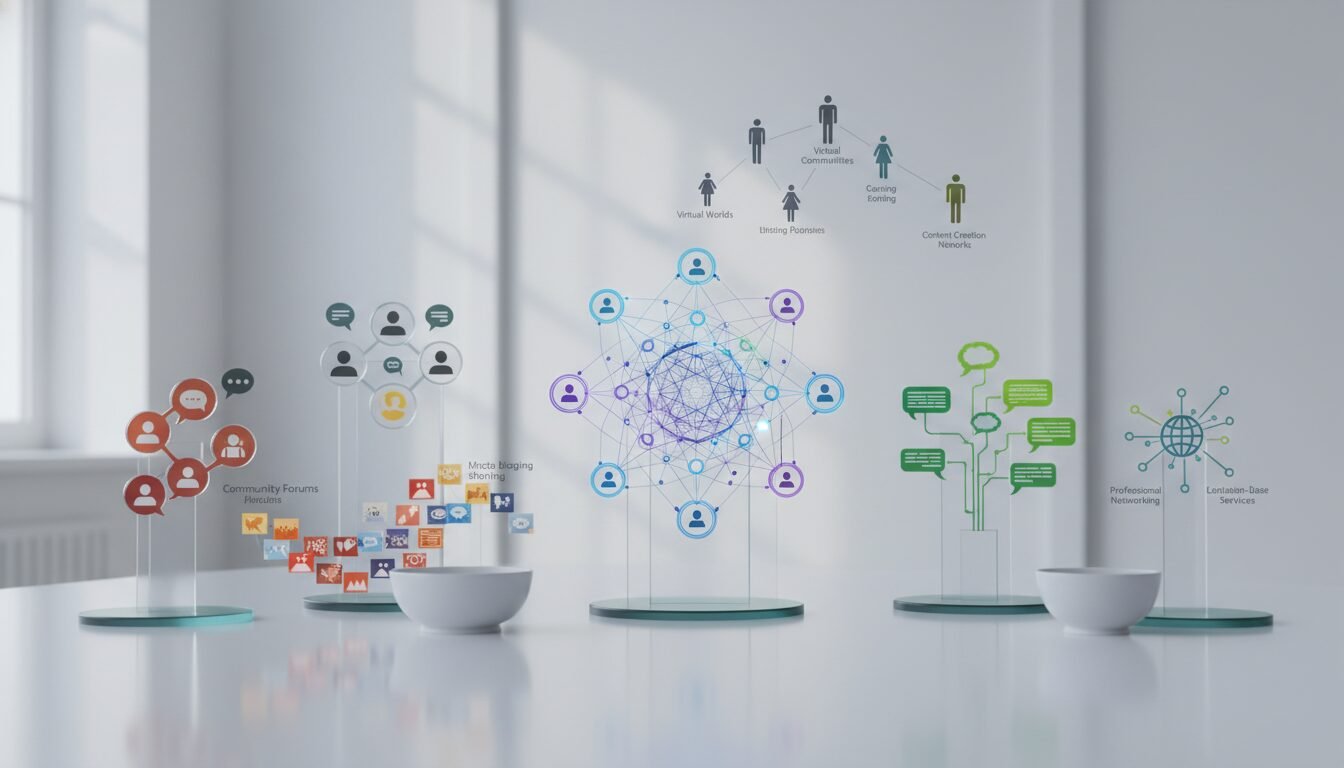
Not all social networking platforms serve the same purpose. They group into four main categories, each with distinct features and audiences. According to Pew Research Center, roughly 7 in 10 U.S. adult internet users visited social networking sites in 2021, reflecting broad adoption across every category.
Social Connections
Platforms like Facebook, Instagram, and Snapchat prioritize staying in touch with friends and family. They emphasize personal updates, photo sharing, and lightweight interactions. Facebook alone reported over 2.13 billion monthly active users back in 2017. These social networking giants form the backbone of daily communication for a massive share of the global population.
Professional Networking
LinkedIn is the dominant professional social networking service. It enables career-oriented connections, job hunting, and industry discussions. Unlike casual platforms, LinkedIn connections typically represent real-world professional relationships. That focus on trust makes it a powerful tool for recruiters and job seekers alike.
Multimedia Sharing
YouTube, TikTok, and Pinterest center on visual and video content. Creators build communities through shared media rather than biographical profiles. TikTok’s rise illustrates how algorithmic content discovery, without relying on a friend graph, can redefine social networking by promoting viral trends and niche interests to users who never searched for them.
Information and Niche Communities
Reddit, Stack Overflow, and Goodreads are built around shared interests rather than personal identity. Users join sub-communities to discuss specialized topics. This group-centric model contrasts with the individual-centered approach of general social networking sites, yet still facilitates online connection through threaded discussions and reputation systems.
| Type | Primary Purpose | Key Features | Examples |
|---|---|---|---|
| Social Connections | Maintaining personal relationships | News feed, stories, photo/video sharing | Facebook, Instagram |
| Professional Networking | Career development, recruiting | Resume profiles, job boards, endorsements | LinkedIn, Xing |
| Multimedia Sharing | Publishing and discovering visual content | Short-form video, filters, live streaming | YouTube, TikTok |
| Information & Niche | Community discussion, topic exploration | Forums, upvoting, themed sub-groups | Reddit, Stack Overflow |
Pros and Cons of Social Networking

Social networking delivers real value and real damage, often through the same features. Here’s my honest read after years of building products that live inside these ecosystems.
Pros
- Relationship maintenance at scale: Geographic distance stops mattering. Daily photos, messages, and video calls keep relationships alive that would otherwise fade.
- Career and business access: Platforms like LinkedIn surface job openings that never get publicly listed. Targeted ads let small brands compete with large ones for a fraction of traditional marketing budgets.
- Real-time information flow: During major events, social networks break stories faster than traditional media. Following scientists, journalists, and domain experts gives you a curated, direct feed of knowledge.
- Community and belonging: Niche communities on Reddit or Facebook Groups function as on-demand learning resources, connecting people around shared interests that local geography never could.
- Crisis communication: Officials use Twitter/X to issue evacuation orders. Facebook’s Safety Check let millions mark themselves safe after disasters. That immediacy saves lives.
Cons
- Privacy erosion: Every action generates data. Many platforms monetize browsing habits and location data through advertising, often without transparent consent from users.
- Mental health strain: Passive scrolling, constant social comparison, and fear of missing out are linked to increased anxiety and loneliness, particularly among younger users.
- Misinformation velocity: Because algorithms prioritize engagement, sensational content travels faster than verified news. False stories reach millions before corrections appear.
- Reputation risk: One Microsoft study found 70% of recruiters have rejected candidates based on information found online. Your digital footprint is permanent.
The Benefits of Social Networking

Social networking has become an indispensable tool for individuals and organizations. The advantages are concrete. By 2013, roughly 73% of U.S. adults were already using social networking sites, a figure that has only grown as mobile access expanded globally.
Strengthening Personal Relationships
Geographic distance no longer limits close connections. Through daily photos, messages, and video calls, people maintain ties that might otherwise weaken. Social networking platforms make it possible to witness life events in real time, share emotional support, and revive dormant friendships. That persistent availability builds a stronger sense of belonging.
Career and Business Opportunities
For businesses, social networking is a cost-effective marketing channel. Brands use targeted ads to reach specific demographics, while creators leverage their follower bases for revenue. On the career side, platforms like LinkedIn let users showcase expertise, connect with industry leaders, and discover job openings that were never publicly listed. That two-sided benefit makes social networking an engine of economic opportunity I’ve seen play out firsthand across multiple ventures.
Access to Information and Learning
Real-time news, educational content, and expert insights flow through social networks. During major events, platforms often break stories faster than traditional media. Users can follow scientists, journalists, and educators to get curated information directly. Communities of practice on Reddit or Facebook Groups function as on-demand learning resources, opening up knowledge that once required institutional access.
The Hidden Risks of Social Networking
The darker side of social networking is well-documented and worth taking seriously. Privacy erosion, mental health strains, and misinformation campaigns are real consequences of widespread platform use. Even Facebook’s massive scale became a liability when data collection practices came under public and regulatory scrutiny.
Privacy and Data Security
Every action on a social networking site generates data: cookies, location tags, browsing habits. Many platforms monetize this information through advertising, often without transparent consent. Security breaches can expose private messages and financial details. The FOAF (Friend-of-a-Friend) standard attempted to create interoperable profile data, but it also highlighted how easily personal information spreads beyond a user’s intended circle. Malicious actors exploit this environment for social engineering attacks, as noted in U.S. Army Cyber Command’s cybersecurity guidelines.
Mental Health and Well-Being
Excessive social networking has been linked to increased loneliness, anxiety, and depression. Constant comparison with curated highlight reels erodes self-esteem, while fear of missing out keeps many logged in longer than is healthy. Passive consumption, scrolling without interacting, may intensify these negative feelings. Researchers documented at Psychology Today how online social networks often fail to replicate the emotional depth of in-person connections.
Misinformation and Polarization
Because social networking algorithms prioritize engagement, sensational or divisive content often travels faster than verified news. False stories can reach millions before corrections appear. This dynamic contributes to political polarization and erodes trust in institutions. The same platforms that connect people can also fragment public discourse into echo chambers where only confirming viewpoints get amplified.
Social Networking in the Professional World
For career-focused individuals, social networking is no longer optional. It’s a strategic necessity. Recruiters actively mine platforms for talent, and a polished online presence can make the difference between getting hired or overlooked.
“One Microsoft study found that 70 percent of job recruiters rejected candidates based on information they found online.” — Microsoft
LinkedIn and Recruitment
LinkedIn hosts over 900 million members globally, making it the leading professional social networking service. Recruiters use it to post jobs, search for candidates with specific skills, and verify résumé claims. An incomplete or neglected profile signals disengagement. A complete one with recommendations and regular activity builds credibility that no résumé alone can match.
Personal Branding
Every post, comment, and share contributes to your online reputation. Thought leaders use Twitter/X to share insights and Instagram to showcase creative work. Consistency across platforms matters: your profile should tell a coherent story about who you are professionally. Even deleting old problematic content matters. The internet has a long memory, and anything that can be screenshotted can resurface.
Networking Strategies That Actually Work
Effective professional social networking requires intentionality, not volume. Here’s the four-step approach I’ve used across my own ventures:
Step 1: Optimize your profile with a clear headline, professional photo, and keyword-rich summary.
Step 2: Contribute value by writing articles, commenting on industry news, or sharing resources.
Step 3: Build relationships through direct messages, thanking connections, and requesting informational interviews.
Step 4: Stay active but not overwhelming. Posting once a week maintains visibility without becoming noise.
Offline vs. Online Social Networking: Key Differences
Online social networking expands what’s possible in offline relationships, but the two operate by fundamentally different rules. Understanding the contrast helps you use each more effectively.
| Characteristic | Offline Social Networking | Online Social Networking |
|---|---|---|
| Connection limit | Roughly 150 meaningful ties (Dunbar’s Number) | Thousands to millions of connections |
| Geographic reach | Local or regional | Global, borderless |
| Communication speed | Real-time, in-person | Real-time and asynchronous |
| Content persistence | Ephemeral, memory-dependent | Permanent, searchable, shareable |
| Trust signals | Body language, tone, context | Profile completeness, endorsements, activity |
| Privacy control | Inherent, situational | Settings-dependent, platform-controlled |
The cognitive limit of roughly 150 meaningful offline ties, often called Dunbar’s Number, doesn’t disappear online. It just gets masked by follower counts. The quality of your 150 closest connections still matters more than the size of your total network.
Emerging Trends: The Future of Social Networking
Social networking is branching into decentralized models and immersive experiences. As of 2026, these shifts are accelerating faster than most platform incumbents anticipated. The rapid global expansion seen in markets like India signals that the next wave of innovation won’t come exclusively from Silicon Valley.
Decentralized Platforms
Blockchain-based social networking aims to give users control over their data and content moderation. Instead of a single company owning the platform, these networks distribute data across many nodes, reducing censorship risks and data mining abuses. Early examples include Mastodon and Lens Protocol, which operate on open-source protocols. This shift could redefine ownership and trust in online communities in ways that centralized platforms structurally cannot.
AI-Powered Personalization
Artificial intelligence already shapes what we see, but future social networking will anticipate user needs even more precisely. AI models can generate personalized news summaries, suggest groups to join, and produce synthetic media that blends authenticity with algorithmic curation. The challenge will be maintaining transparency and avoiding filter bubbles that limit exposure to diverse viewpoints. This is an area I’m actively watching across my own AI infrastructure work.
The Metaverse and Immersive Social Networking
Virtual reality and augmented reality are giving rise to persistent 3D social spaces. Meta’s Horizon Worlds, Fortnite’s virtual concerts, and Roblox’s user-created worlds represent a new frontier where social networking becomes an embodied experience. Avatars replace profiles. Virtual economies emerge. New forms of identity and interaction follow. Whether this becomes mainstream or stays niche depends heavily on hardware costs dropping below the $300-500 consumer threshold.
Social Networking as a Crisis Communication Tool
Social networking platforms are among the first places people turn during emergencies. With more than 4.76 billion users worldwide, these networks provide real-time, two-way communication that traditional media cannot match in speed or reach.
Real-Time Disaster Response
During wildfires or floods, officials use Twitter/X to issue evacuation orders while citizens share on-the-ground conditions via hashtags. Facebook’s Safety Check allowed millions to mark themselves safe after crises. That immediacy closes the gap between event and response in ways that save lives.
Community Support and Fundraising
When a tragedy strikes, social networking galvanizes support fast. GoFundMe campaigns spread across Facebook and Instagram, raising money for medical bills or disaster relief within hours. These acts of collective action demonstrate the platform’s capacity to turn weak ties into concrete help.
Public Health and Safety Alerts
The COVID-19 pandemic proved the vital role of social networking in disseminating health guidance. The WHO and CDC used Twitter, WhatsApp, and Instagram to broadcast infection data and prevention tips. The same speed that aids public health also spreads rumors, which is why verified channels and user literacy matter more than ever.
Tips for Safe and Effective Social Networking
Maximizing benefits and minimizing downsides comes down to informed, intentional use. With roughly 7 in 10 U.S. adults active on these platforms, taking control of your digital life is a practical necessity, not a luxury.
Mastering Privacy Settings
Review the privacy options on every platform you use. Adjust who can see your posts, who can message you, and what data the platform collects. Turn off location tagging for non-essential posts, and be cautious when granting third-party apps access to your profile. LinkedIn’s privacy dashboard, for instance, lets you limit how your data is used for advertising purposes.
Curating Your Online Reputation
Search for yourself periodically to see what a recruiter or new contact would find. Delete or untag embarrassing photos. Actively post content that reflects your interests and expertise. This builds reputation and pushes less flattering material down in search results. Everything you share becomes part of your permanent digital footprint.
Balancing Screen Time
Set intentional limits. Use built-in screen-time trackers to monitor app usage, and designate phone-free hours, especially before bed. Replace passive scrolling with active, meaningful interactions: comment thoughtfully on a friend’s post, join a live discussion, or simply message someone directly instead of broadcasting. Real-world connections, limited to roughly 150 people by cognitive capacity, still matter more than any follower count.
If you’re thinking through how AI and social networking intersect for your business strategy, I’d enjoy the conversation. Connect with Amin to discuss AI strategy for your business.
Frequently Asked Questions
What is social networking in simple terms?
Social networking is the practice of using websites and apps to connect with friends, family, and new people, share updates, and join communities online. The first recognized social networking site, SixDegrees.com, launched in 1997, and the model has scaled to billions of users since.
What are the main types of social networking?
They include personal connection networks (Facebook, Instagram), professional networks (LinkedIn), multimedia sharing platforms (YouTube, TikTok), and niche communities (Reddit, Goodreads). Each type serves a distinct purpose and attracts a different primary audience.
How does social networking benefit businesses?
Businesses use social networking for cost-effective marketing, brand awareness, customer engagement, and direct communication with target audiences through targeted advertising. The ability to reach specific demographics at a fraction of traditional media costs makes it particularly valuable for early-stage companies.
What are the privacy risks of social networking?
Risks include data mining by platforms, identity theft from leaked information, and social engineering attacks that exploit publicly available profile data. Users should regularly audit privacy settings and limit the personal data they share across platforms.
Can social networking lead to mental health issues?
Excessive use, especially passive consumption, is linked to increased anxiety, depression, and loneliness, according to research documented by Psychology Today and similar outlets. Balanced, active engagement and regular digital detoxes can meaningfully reduce these effects.
How will social networking change in the future?
Decentralized platforms built on open-source protocols, AI-driven content personalization, and immersive virtual-reality social spaces will reshape how we interact online. These shifts will give users more control over their data and richer, more embodied experiences than current platforms offer.
Enjoyed this article?
Connect with me for collaboration, ventures, or just a good conversation about building things.
Get in Touch