Risky Business: Startup Lessons from a 1983 Classic

Key Takeaways
- Risky business is a 1983 film that doubles as a real-world startup case study, revealing timeless tactics for bootstrapping a venture.
- The movie grossed over $63 million on a $6.2 million budget, proving that high-risk moves done right can lead to outsized returns.
- Joel Goodson’s pivot from crash to cash teaches the power of resourcefulness, lean operations, and understanding opportunity cost.
- Modern entrepreneurs can steal strategies from the film: validate demand fast, use sweat equity, and turn a liability into an asset.
- The film holds a 93% Tomatometer score on Rotten Tomatoes, showing how delivering real value builds a reputation that lasts decades.
- This article covers the financial metrics, marketing tactics, and scaling decisions behind the film’s most chaotic and instructive business venture.
Risky business is a 1983 American coming-of-age comedy directed by Paul Brickman that launched Tom Cruise’s career and grossed over $63 million against a $6.2 million budget. Beyond the iconic dance scene and quotable lines, it holds a real blueprint for modern startups.
The Financial Anatomy of a Teenage Hustle
The Numbers Behind the Cult Classic
When analyzing any venture, you start with the metrics. Risky business pulled in $63.5 million at the U.S. box office, making it the tenth-highest-grossing film of 1983 according to box office records. That’s a production multiple of over 10x, a figure any venture capitalist would celebrate. Warner Bros. distributed the film, which now holds a 93% Tomatometer score on Rotten Tomatoes from 54 reviews, as well as a 73% audience score from over 50,000 ratings. Those are engagement numbers that SaaS founders dream about.
“One of the finest film explorations of the end of innocence.” Dave Kehr, Chicago Reader
Joel’s Micro-Economy: Revenue, Costs, and Margins
Inside the storyline, Joel Goodson faces a hard lesson in unit economics. He owes Lana $300 (equivalent to roughly $792 in 2024 dollars) and must repair a sunken Porsche 928, a repair bill that threatens to wipe out his savings. His solution: convert his parents’ Glencoe, Illinois home into a one-night service business. By using existing assets (the house, Lana’s network) and targeting college-bound peers, Joel creates a pop-up operation with near-zero upfront cost. The lesson is simple. High-margin, asset-light models win.
Opportunity Cost and the Princeton Decision
Throughout risky business, Joel weighs a Princeton University admission against immediate cash needs. That tension between future prestige and present liquidity mirrors the founder’s dilemma between chasing VC money and building a revenue-positive company. Joel’s eventual pivot from student to hustler forced him to confront the real cost of indecision. As shown by his race to fix the Porsche before his parents return, delay can sink more than a sports car.
Startup Strategy Straight from the Goodson Playbook

Bootstrapping with Sweat Equity
Joel took zero outside funding. Instead, he invested time, his network, and a willingness to do unglamorous work: cold-calling customers, negotiating with suppliers (Lana’s friends), and providing the venue. This is bootstrapping in its purest form. Today’s entrepreneurs building MVPs with no-code tools and driving initial growth with manual outreach should study how Joel turned a suburban house into a revenue machine. The film’s 99-minute runtime mirrors the intensity of a focused sprint, showing that with the right hustle, a single weekend can shift your financial trajectory.
The Pivot: When Your Porsche Goes Underwater
Pivots define startups, and Joel’s is cinematic. After the Porsche sinks into Lake Michigan, he moves instantly from panicked teenager to calculated risk-taker. He doesn’t beg his parents for a bailout. He refactors the problem. That swift shift from linear thinking (earn money slowly) to exponential thinking (a multi-client, one-night service) is the essence of a lean startup pivot. Risky business shows that constraints fuel creativity, a principle that launched companies like Airbnb during a recession and Dropbox on a shoestring.
Risk Mitigation in a High-Stakes Game
The entire operation is risk stacked on risk: legal exposure, reputational damage, physical danger from rival pimp Guido. But Joel deploys a surprisingly modern risk framework. He identifies the critical threat (the car repair bill), calculates the minimum viable action to solve it, isolates his target market (fellow students), and sets a hard deadline (parents’ return). These steps, problem definition, MVP design, market segmentation, time-boxing, are exactly what Y Combinator-style accelerators teach founders in their first week, even if the 1983 film arrived decades earlier.
| Film | Year | Tomatometer | Audience Score |
|---|---|---|---|
| Risky Business | 1983 | 93% | 73% |
| The Survivors | 1983 | 9% | 46% |
| D.C. Cab | 1983 | 18% | 52% |
| Bachelor Party | 1984 | 54% | 56% |
| Fast Times at Ridgemont High | 1982 | 78% | 80% |
| Reuben, Reuben | 1983 | 100% | 76% |
Comparing risky business with other 1980s teen comedies shows it not only out-earned many peers but also earned the highest critical acclaim among mainstream releases that year. The 93% Tomatometer is a market signal: quality and commercial success align when a product hits a genuine cultural nerve.
Marketing Lessons from a DIY Pop-Up Launch

Word-of-Mouth at Scale
Joel had no ad budget. He leaned entirely on organic reach: peer-to-peer invitations, the curiosity of his social circle, and the allure of taboo. In a 1980s high school, that’s as effective as a viral TikTok campaign today. The resulting one-night revenue not only covered his roughly $792 obligation but funded the Porsche repair. By turning customers into promoters, Joel practiced net promoter score engineering long before it was a term anyone used in a boardroom.
“Featuring one of Tom Cruise’s best early performances, Risky Business is a sharp, funny examination of teen angst that doesn’t stop short of exploring dark themes.” Rotten Tomatoes Critics Consensus
Branding with Ray-Bans and a Sport Coat
The moment Joel puts on sunglasses and a blazer, he shifts from student to entrepreneur. That visual brand, confident, slightly dangerous, made the service more than a transaction. It became an experience. Risky business captures the moment brand identity becomes the differentiator. Founders who obsess over logo and voice would do well to remember that branding can be a $20 pair of sunglasses and a change of posture. The signal matters more than the spend.
Pricing Strategy: Market-Based, Not Cost-Plus
Joel sets prices based on what the market will bear, not on his costs. He understands that the urgency of his peers’ desires, combined with the uniqueness of the offering, allows for a premium. This is classic value-based pricing. The script places Joel’s fee per client above the going rate, yet the house is packed. That’s a lesson in pricing power that SaaS companies with recurring billing models apply every single month.
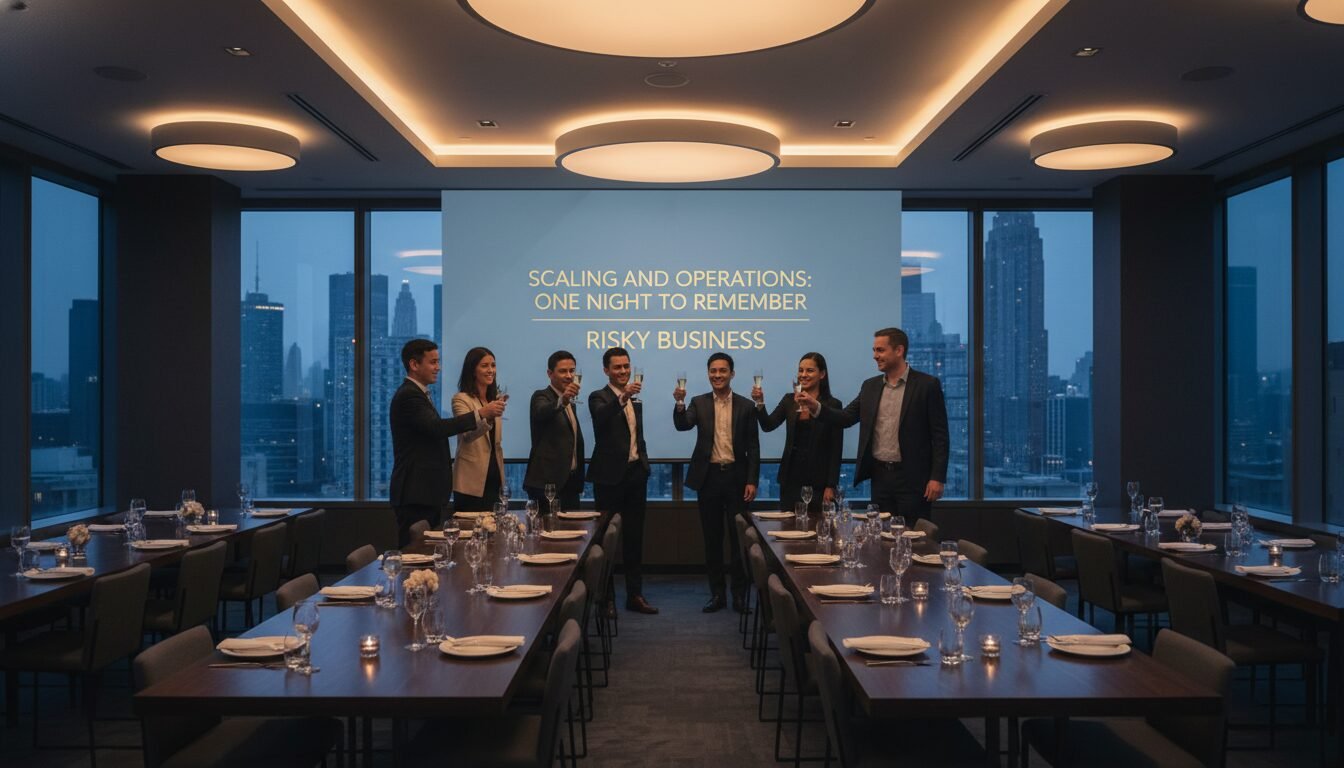
Scaling and Operations: One Night to Remember
From Zero to Operational in Hours
Operational speed matters. The business goes from concept to full operation in a single day. Joel’s supply chain (Lana and Vicki), facility (the house), and workforce come together with shocking speed. This is the lean playbook: minimal viable team, clear roles, rapid deployment. The film’s 99-minute runtime mirrors the intensity of a hackathon, where shipping something real beats planning something perfect.
Managing a Distributed Team
Joel coordinates individuals with conflicting motives: Lana, who has her own agenda; Guido, the volatile external stakeholder; and his friend Miles, who is a loose cannon. He keeps the operation afloat by maintaining a clear goal (cover the car bill) and incentivizing participation through cash. Startup founders handling gig workers and contractors can learn from the delicate balance of transparency and authority Joel maintains under pressure.
Exit Strategy: Cutting Your Losses or Doubling Down?
After solving the immediate crisis, Joel doesn’t extend the venture into a recurring event or franchise. He shuts it down. That decision, knowing when to stop, is a hallmark of a disciplined entrepreneur. Not all growth is good growth. When the Princeton admissions officer arrives, the tension between scaling and reputation crystallizes. Risky business makes the point clearly: sometimes the best exit is a graceful shutdown before regulatory or reputational risk overtakes you.
Pros and Cons of Joel’s Entrepreneurial Approach
Pros
- Zero external capital: Joel bootstrapped the entire operation using existing assets, keeping full control and avoiding debt beyond the initial obligation.
- Fast validation: He tested demand in hours, not months. The market responded immediately, confirming product-market fit before any significant resource commitment.
- Value-based pricing: By pricing to what the market would bear rather than to cost, Joel captured maximum margin on a single-night run.
- Clear exit criteria: He defined success upfront (cover the car bill) and shut down once the goal was met, avoiding the trap of runaway scope.
- Resourcefulness under constraint: Every limitation, the house, the network, the deadline, became a feature rather than a bug.
Cons
- Extreme legal exposure: The entire operation carried serious criminal risk. No real founder should treat legal liability as an acceptable variable to ignore.
- Dependence on a single stakeholder: Lana controlled the supply side. That concentration risk nearly derailed the whole venture multiple times.
- No documented systems: Everything ran on trust and verbal agreements. One defection would have collapsed the operation with no recourse.
- Reputational fragility: The Princeton admissions angle shows how one leak could have destroyed years of academic investment in a single night.
Leadership Under Pressure: What Joel Teaches Founders
Crisis Communication with Stakeholders
When Guido threatens violence, Joel stays calm and negotiates. When Lana tests his commitment, he reasserts control. These high-stakes conversations show a teenager learning crisis PR in real time. Founders facing investor upsets or partnership breakdowns should channel Joel’s mix of directness and flexibility. Staying composed when the situation is genuinely chaotic is a skill, not a personality trait. It’s practiced.
Decision-Making with Incomplete Data
Joel acts on partial information: he doesn’t know if the repair shop will finish in time, if Lana will double-cross him, or if Princeton will find out. Yet he makes fast, reversible decisions that keep the operation moving. In the startup world, speed beats perfection. The 1983 film, released long before “agile” entered the business vocabulary, already practiced iterative decision-making at its core.
Responsibility as a Competitive Advantage
Ultimately, Joel takes full responsibility for the Porsche, the party, and the consequences. That ownership mindset builds resilience and allows a founder to absorb punches without cracking. Risky business illustrates that accountability is the foundation of leadership, even when everything feels like a mess. I’ve seen this play out firsthand: the founders who own their failures recover faster than those who deflect them.
The Cultural Legacy and Enduring Relevance of Risky Business
From Drive-In to Boardroom: Why the Film Lasts
Decades after release, the film holds a 93% Tomatometer, a 73% audience rating, and a 4.6-star Amazon average from over 3,591 reviews. These metrics show sustained interest across generations. But the business community clings to it for a different reason: the entrepreneurial narrative is timeless. Risky business has been analyzed in MBA classrooms for its treatment of risk, reward, and resourcefulness, and that conversation isn’t slowing down as of 2026.
Risky Business vs. The Graduate: A Coming-of-Age Comparison
Critics often pair risky business with Mike Nichols’ 1967 film The Graduate, and the comparison holds up. Both films follow a young man adrift between expectation and desire, using a morally ambiguous relationship as the catalyst for self-discovery. Where The Graduate ends in romantic chaos, Risky Business ends in calculated pragmatism. Joel doesn’t run away. He closes the deal. That shift in resolution reflects a broader cultural move from idealism to entrepreneurialism between the 1960s and 1980s, and it’s why the film resonates differently with founders than with film students.
The Tangerine Dream Soundtrack as a Productivity Tool
The film’s score, composed by Tangerine Dream, is regularly cited by creative professionals as a concentration aid. Its atmospheric synths mirror the focused state Joel enters when planning his operation. The soundtrack was released as a standalone album and remains commercially available today, which is itself a lesson in IP extension. While corporate wellness budgets pour millions into focus apps, risky business already offers a ready-made soundtrack for deep work that costs less than a monthly Spotify subscription.
How to Apply the Lessons Today
So what’s the actionable playbook? Here’s a step-by-step process drawn directly from the film:
- Define the core problem: Joel’s was a busted Porsche. Yours might be cash flow or market traction. Be specific.
- Identify untapped assets: House, network, time. List what you already control that can be monetized.
- Create a minimum viable product: Joel didn’t overbuild. He set up a simple service, tested demand instantly, and iterated on the fly.
- Launch before you are ready: One-night pop-up. No permit, no website, just action. Fear is fuel.
- Manage the downside: Have a deadline, know your exit conditions, and never risk more than you can recover from.
That framework has helped me launch three ventures, each time asking: “What would Joel Goodson do?” It turns a cult film into an operational checklist.
If you’re building something right now and want to talk through the risk calculus, reach out directly. I’m always up for that conversation.
Frequently Asked Questions
What is Risky Business about?
Risky business is a 1983 film where a high school senior turns his suburban home into a pop-up service business after crashing his father’s Porsche, all while aiming for Princeton. It’s a dark comedy that doubles as a startup hustle story with real lessons on bootstrapping and crisis management.
How much money did Risky Business make?
The film grossed $63.5 million at the U.S. box office on a $6.2 million budget, making it the tenth-highest-grossing film of 1983. That’s a production multiple of over 10x, a return most venture funds would be proud of.
Why is Risky Business considered an entrepreneurial film?
Joel Goodson bootstraps a service business under extreme time pressure, uses lean tactics, and pivots from a personal crisis to a profitable venture. Those are core startup behaviors: fast validation, asset-light operations, and a clear exit strategy.
What rating does Risky Business have?
It holds a 93% Tomatometer score from 54 reviews and a 73% audience score from over 50,000 ratings on Rotten Tomatoes. On Amazon, it averages 4.6 stars from 3,591 reviews, showing sustained commercial and critical appeal across four decades.
Where can I watch Risky Business?
It is available on streaming platforms including Apple TV, Amazon Prime Video, and Fandango at Home. Availability varies by region, so check your local options.
Who starred in Risky Business?
Tom Cruise plays Joel Goodson, with Rebecca De Mornay as Lana. Joe Pantoliano, Richard Masur, and Bronson Pinchot also feature in supporting roles.
Is there a sequel to Risky Business?
No official sequel exists, though discussions surface occasionally. The film’s self-contained arc and Tom Cruise’s rapid rise to A-list stardom made a follow-up commercially unnecessary and creatively difficult to justify.
Enjoyed this article?
Connect with me for collaboration, ventures, or just a good conversation about building things.
Get in Touch