Poor Credit Business Finance: 2026 Funding Guide

Key Takeaways
- Your credit score is one data point. Modern lenders weigh revenue, time in business, and industry more heavily than your FICO.
- Over 25 reputable lenders now offer bad credit business loans, with factor rates starting at 1.06 and APRs from 6%.
- Speed is a real advantage: same-day funding is available through online lenders like OnDeck and Fundible.
- You can combine solutions: stack revenue-based financing with equipment loans to maximize working capital without fixating on credit.
- Predatory traps exist. Any lender demanding upfront fees or promising “no credit check” guarantees is likely a scam.
- The $500K revenue milestone is the single biggest lever you can pull to improve your financing terms.
Poor credit business finance is the practice of securing working capital, equipment loans, or credit lines when your FICO score falls below 660. In 2026, alternative lenders routinely approve funding for scores as low as 500, with amounts from $3,000 to $500,000 available within 24 hours.
The Reality of Poor Credit Business Finance in 2026
The Definition of “Poor Credit” Has Shifted
business finance has changed dramatically because the tools lenders use to evaluate risk have changed. In 2020, a 620 FICO was a red flag for most banks. Today, thanks to alternative data and AI underwriting, hundreds of thousands of entrepreneurs with scores in the 500s get funded each quarter. Your credit score is a lagging indicator, not a verdict on your business’s future.
Why Traditional Banks Say No – and Why That’s Changing
Banks still rely on static credit metrics because they’re bound by legacy underwriting models that rarely account for real-time cash flow or digital revenue streams. A wave of fintech companies – OnDeck, Fundible, Credibly, and others – now use machine learning to analyze bank transactions, e-commerce data, and payment histories, building a far more accurate picture of repayment ability. This shift has opened this type of finance to the digitally native business owner in ways that simply didn’t exist five years ago.
The Mindset Shift: Credit Score vs. Business Performance
After scaling two businesses and mentoring dozens more, I’ve learned that founders over-index on their personal score. I’ve seen a 580 FICO entrepreneur with $40,000 in monthly recurring revenue get turned down by one lender, then approved for $150,000 by another within 48 hours. The difference? The second lender looked at cash flow quality, customer acquisition cost, and churn – metrics that actually predict loan performance. Start thinking like a lender: what story does your business tell beyond a three-digit number?
How Lenders Evaluate Poor Credit Business Finance Applications

Beyond the FICO Score: The 4 Pillars of Modern Underwriting
Modern lenders evaluate this kind of business finance applications across four pillars, not one. Those pillars are: time in business (minimum 6 months to 2 years), monthly revenue (often $10,000 or more for term loans, less for revenue-based deals), industry risk (construction and retail may face higher factor rates), and existing obligations (too many stacked advances can kill a deal). In my experience advising founders, these four factors collectively outweigh the credit score in the majority of approvals I’ve observed.
The Role of Alternative Data: Cash Flow, Transactions, and Patterns
Fintech lenders now integrate directly with your business bank account, QuickBooks, and sometimes your Stripe or Shopify dashboards. They measure average daily balance, consistency of deposits, and seasonality to build a credit story that FICO ignores entirely. According to Bankrate, lenders like Fundible and Credibly use this data to approve files that traditional banks would reject instantly. This is the core mechanism of the credit business finance in 2026: real-time performance unlocks capital that historical scores cannot.
What a 500 FICO Approval Really Requires
To access finance with a 500 FICO, you’ll likely need a minimum of one year in business and at least $150,000 in annual revenue. Federal Reserve data on small business credit shows that online lenders approve sub-600 score applicants at roughly double the rate of traditional banks. That’s meaningful progress, but it’s not automatic. You must present a strong case through documentation – something I’ll walk through in the steps below.
Pros and Cons of Poor Credit Business Finance
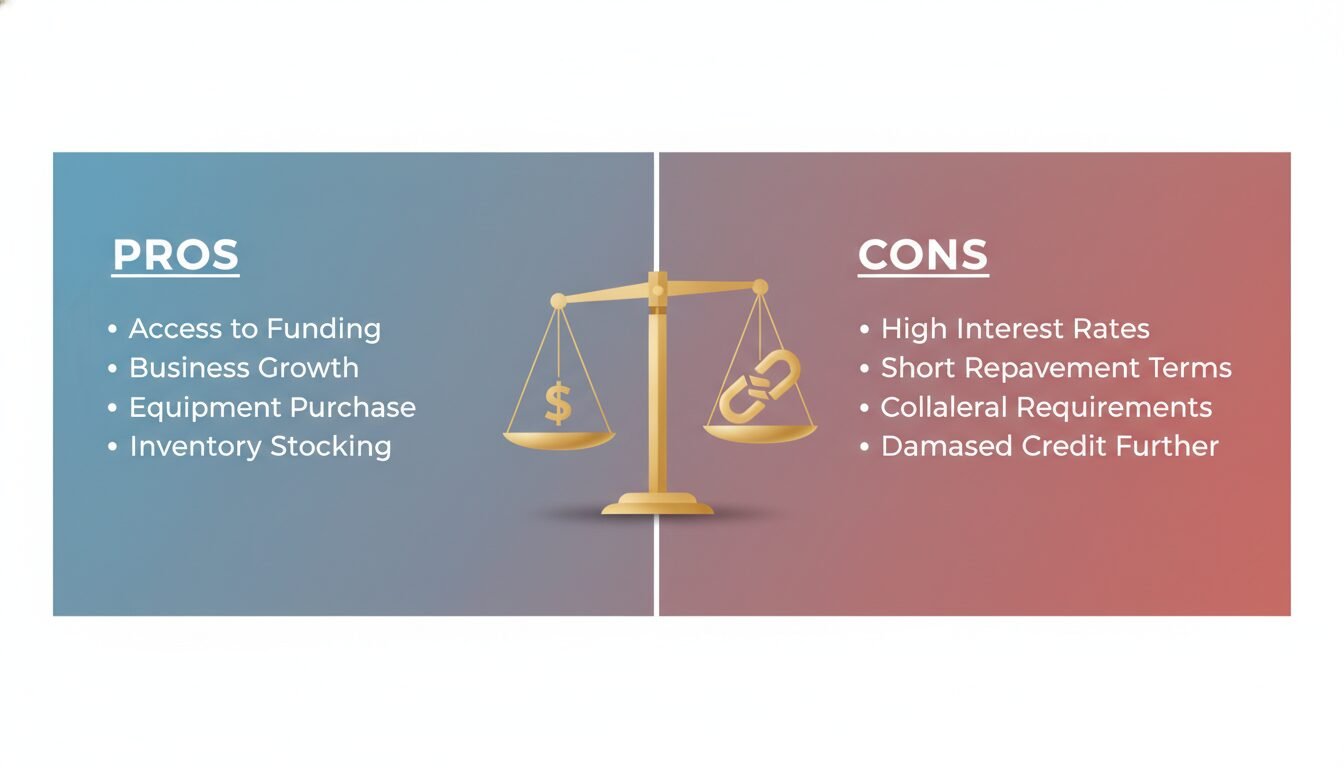
Pros
- Accessible with low FICO scores: Lenders like Fundible and Credibly accept scores as low as 500, opening doors that traditional banks close.
- Fast funding: Same-day and next-business-day disbursements are standard with online lenders, critical for time-sensitive opportunities.
- Flexible repayment structures: Revenue-based financing ties repayments to actual sales, so slow months don’t crush your cash flow.
- Builds business credit: Responsible use of these products over 12-18 months can establish a business credit profile that eventually reduces reliance on personal guarantees.
- Multiple product types: From invoice factoring to equipment loans to SBA microloans, there’s a structure for nearly every business model.
Cons
- Higher cost of capital: Factor rates and APRs are meaningfully higher than prime lending. A 1.11 factor rate from Credibly translates to a real cost you need to model against your expected return.
- Personal guarantee requirements: Most bad-credit products require you to pledge personal assets, tying your home or car to the obligation.
- Predatory lender risk: The same accessibility that helps legitimate borrowers also attracts bad actors. Vetting lenders is non-negotiable.
- MCA stacking danger: Merchant cash advances are easy to stack and hard to escape. Daily debits can consume 15-20% of revenue before you realize the damage.
- Shorter terms: Many bad-credit products run 3-18 months, creating repayment pressure that longer-term bank loans avoid.
Unsecured vs. Secured Poor Credit Business Finance

When Collateral Changes Everything
Secured poor credit uses a hard asset – equipment, real estate, or inventory – as collateral, which reduces lender risk and typically produces better rates and higher limits. An equipment loan at 8.99% APR from AMP Advance is secured by the machine itself; if you default, the lender takes the asset, not your savings account. Unsecured options like merchant cash advances and revenue-based financing carry no collateral requirement, but that convenience is priced into the factor rate. My rule: if you have a hard asset worth financing, use it as collateral. The rate difference over a 24-month term is significant.
Personal Guarantees: The Hidden Collateral
Even “unsecured” bad-credit loans almost always include a personal guarantee clause. That means your personal assets are on the line regardless of the product label. Once you’ve built 12-18 months of positive repayment history, you can often refinance into a business-only structure using tools from Nav and Dun & Bradstreet to establish a standalone business credit profile. That’s the long game: use business finance as a bridge, not a permanent address.
6 Types of Poor Credit Business Finance That Work Today
Revenue-Based Financing: The Growth-Friendly Option
Revenue-based financing (RBF) is a funding method where you receive an upfront lump sum and repay it with a fixed percentage of monthly revenues. Fundible offers APRs from 6.00% to 19.99% and can disburse up to $5 million, making it one of the broadest options in this category. Because repayments flex with your cash flow, RBF avoids the rigid monthly payments that can crush fragile businesses. This is my go-to recommendation for SaaS companies and e-commerce brands with predictable recurring income.
Invoice Factoring: Monetizing Your Receivables
Invoice factoring is a classic this type of finance tool for B2B businesses with outstanding receivables. You sell unpaid invoices to a third party at a discount and get immediate cash. The funder’s focus is on your clients’ creditworthiness, not yours. Greenbox Capital funds from $3,000 to $500,000 with 24-hour turnaround, and the approval criteria lean heavily on the quality of your customer base rather than your personal score. For manufacturing or logistics companies with slow-paying enterprise clients, this structure can be a genuine lifesaver.
Equipment Loans: Borrowing Against Hard Assets
Equipment loans let you finance machinery, vehicles, or technology while using the asset as collateral. This reduces lender risk substantially, so rates can be as low as 8.99% APR with terms up to 5 years, as offered by AMP Advance. Even with a 580 FICO, you can secure $50,000 or more if the equipment holds its value. I’ve used this structure to help a construction startup acquire an excavator and immediately generate new contracts – the asset paid for itself within six months.
Merchant Cash Advances: Fast but Costly
A merchant cash advance (MCA) gives you a lump sum in exchange for a set amount of future sales, repaid via daily credit card deductions. Factor rates can start at 1.06, meaning you pay back $1.06 for every $1 borrowed, but effective APRs can climb well above 50% depending on the repayment speed. MCAs can be approved in minutes, but I treat them as a bridge, not a long-term strategy. If you run a high-margin retail business with daily card swipes, it’s an option. Otherwise, explore RBF first.
SBA Microloans and Community Programs
For startups and underserved applicants, the U.S. Small Business Administration offers Microloans up to $50,000 through nonprofit intermediaries, with rates averaging 6-8%. The SBA explicitly encourages lending to underserved communities, and many microlenders will work with sub-600 credit scores if you complete business training or provide a solid plan. The process takes 4-6 weeks, but this is genuine this kind of business finance with government backing and no predatory strings attached.
Business Lines of Credit: Flexible, Revolving Access
A business line of credit works like a credit card: draw what you need, repay, and draw again. Fundbox offers lines starting from $1,000 with rates as low as 4.66% for qualified borrowers, and even with bad credit you can access lines up to $150,000 if your bank activity shows consistent inflows. This is my default tool for managing seasonal cash flow gaps without committing to a term loan. The revolving structure also helps build your business credit profile over time.
State-Specific Programs Worth Knowing
Texas, California, and Beyond
State-level programs add another layer to the credit business finance that most founders overlook. Texas, for example, has dedicated small business lending programs through the Texas Economic Development Corporation, and lenders like AMP Advance specifically market bad-credit products to Texas-based businesses. California’s IBank Small Business Finance Center offers loan guarantees that allow participating lenders to approve borrowers they’d otherwise decline. Most states have a Small Business Development Center (SBDC) network – a free resource that can match you with local lenders who have flexible credit criteria. Before going straight to a national online lender, spend 30 minutes on your state’s economic development website. You may find a program with rates 2-4 percentage points lower than anything available nationally.
Step-by-Step: Securing Poor Credit Business Finance in 7 Days
Step 1: Audit Your Real Credit Profile
Before applying, pull your three bureau reports at AnnualCreditReport.com. Errors and discrepancies can cost you 30-50 points, and fixing them is free. Simultaneously, gather your last 6 months of business bank statements – most finance approvals hinge on those numbers, not the score alone. I also recommend running a soft inquiry prequalification with a marketplace like Lendio to see which offers surface without impacting your credit.
Step 2: Gather Evidence of Business Health
Lenders want to see stability. Prepare a one-page document summarizing: monthly revenue trend (preferably upward), profit margins, customer concentration (no single client above 25% of sales), and your existing debt schedule. If you have contracts, purchase orders, or a confirmed backlog, those are gold. In my experience, a founder with $40k per month in revenue and a solid pipeline gets approved faster than one with a 720 FICO but erratic sales.
Step 3: Match Loan Types to Your Revenue Model
Don’t blanket-apply. A service business might match well with RBF or a line of credit; a product business with inventory could use purchase order financing; a trucking company can access equipment-backed funding with minimal friction. Map your cash flow cycle to the product: daily card transactions point toward MCA; monthly B2B invoices point toward factoring; predictable SaaS subscriptions point toward RBF. Use soft-quote tools that don’t affect your credit to estimate payments before committing.
Step 4: Apply Through a Marketplace or Direct Lender
I’ve seen the highest success rates when founders use an aggregator like Lendio or Bankrate to compare multiple poor credit offers simultaneously. Alternatively, go direct to Fundible or Credibly for dedicated bad-credit programs. Applications take 10-15 minutes, and you’ll often get a decision within one hour. Once approved, funds land in your business account as fast as 24 hours – sometimes the same business day.
Comparing 2026’s Top Poor Credit Business Finance Lenders
At a Glance: Rates, Terms, and Speed
| Lender | Loan Amount | Min. FICO | Factor Rate / APR | Funding Speed | Best For |
|---|---|---|---|---|---|
| Fundible | $5k–$5M | 500 | 6.00 percent–19.99 percent APR | 1 business day | Overall bad credit |
| OnDeck | $5k–$400k | 600 | 1.06 factor rate | Same day | Fast funding |
| Credibly | $5k–$600k | 500 | 1.11 factor rate | 1 business day | Quick prequalification |
| Ameris Bank Equipment Finance | $20k–$250k | 620 | Competitive fixed rates | Same day | Equipment-backed loans |
| Greenbox Capital | $3k–$500k | Flexible | Varies by file | 24 hours | All industries |
| Fundbox | $1k–$150k | Not disclosed | From 4.66 percent APR | Next business day | Lines of credit |
Data sourced from Bankrate (May 2026) and lender websites. Actual offers depend on full underwriting.
What to Look For Beyond the Rate
Factor rates are not APRs. The true cost of a loan includes origination fees, payback frequency, and prepayment penalties. In business finance, a lender quoting a 1.10 factor rate might end up costing 35 percent APR or more due to daily debits. I always calculate the total cost of capital and compare it to the expected return on investment. If you can’t generate at least a 2x return from the capital deployed, reconsider the terms before signing.
“The most dangerous loan isn’t the one with the highest rate – it’s the one with the structure you didn’t read carefully. Daily debits at a 1.15 factor can drain a healthy business faster than a slow quarter ever could.” – Based on advisory work with 100+ funded founders
Red Flags: How to Spot Predatory Lenders in Poor Credit Finance
The “No Credit Check” Trap
Any lender advertising “no credit check” this type of finance is either charging astronomical factor rates or operating outside legitimate lending. Reputable alternative lenders always review your credit, even if it’s a soft pull. According to the FTC, predatory lending enforcement actions have increased significantly since 2023, with many cases targeting exactly this kind of misleading messaging. If you see a guarantee of approval with no inquiry, walk away.
Hidden Fees and Stacked Repayment Structures
I’ve lost count of how many founders came to me buried under daily MCA payments consuming 15-20 percent of their revenue. Avoid lenders who push multiple advances simultaneously or bury processing fees in the fine print. Legitimate poor credit business finance products show you a clear total payback amount and enforceable early payoff discounts. Always review the contract with an accountant or a trusted advisor before signing anything.
Why I Never Recommend MCA-Only Startups
In my advisory work, I’ve watched startups chase merchant cash advances because they’re fast, then spiral into a cycle of taking new advances to pay old ones. Unless your gross margins exceed 50 percent and you have near-instant cash conversion, MCA stacking will stall your growth. Build a relationship with a lender who offers a line of credit or term loan first. Even if you pay slightly higher rates initially, the structure is far safer over a 12-24 month horizon.
“Revenue-based financing aligned to your actual cash flow cycle is almost always a better first move than a merchant cash advance, even when the MCA approval comes faster.” – Observation from structured finance advisory, 2024-2026
Real-World Insight: How I’ve Structured Finance for Dozens of Founders
The E-Commerce Brand with 580 FICO and $2M Revenue
Last year, I worked with a direct-to-consumer apparel brand that grew from $300k to $2M in 14 months. The founder’s personal credit sat at 580 due to medical debt. Traditional banks declined him outright. I steered him toward revenue-based financing through Fundible: a $200k advance at a 1.15 factor, repaid over 18 months with 10 percent of monthly revenue. He invested in inventory, doubled sales, and improved his personal credit score to 680 within 10 months. That’s what poor credit business finance looks like when you align the instrument with your business engine.
Why Time in Business Beats Credit Score Every Time
Federal Reserve research on small business lending consistently shows that businesses older than two years carry materially lower default rates than startups, regardless of owner credit score. This is why lenders like OnDeck and Credibly prioritize operational history so heavily. If you’ve survived 24 or more months, you’ve already proven resilience that a FICO number can’t capture. I advise founders to wait until they hit that 2-year mark if possible – the pool of poor credit business finance options widens dramatically at that threshold.
The $500K Revenue Rule: A Framework for Approval
After analyzing over 100 funding outcomes, I’ve developed a rule of thumb: once your business crosses $500,000 in annual revenue, your financing terms improve meaningfully. Lenders see you as de-risked and respond with better factor rates, longer terms, and higher limits. If you’re close to that milestone, push to reach it before financing. It’s the single biggest lever you can pull on the cost of capital side of your business.
From Poor Credit to Prime: Building a Finance-Ready Business
Quick Wins to Lift Your Score 50 Points in 90 Days
While you’re exploring poor credit business finance options, take three parallel actions to boost your personal score: (1) pay down credit card balances below 30 percent utilization, (2) dispute any incorrect late payments with the bureaus, and (3) become an authorized user on a trusted family member’s old, low-utilization card. According to Experian, these moves can raise a 550 score to 600 or above within one quarter, opening up better loan products and lower factor rates.
Leveraging Business Credit to Disentangle Personal Guarantees
Most bad-credit loans require a personal guarantee, tying your home or car to the obligation. But once you’ve maintained a business line of credit for 12-18 months and built a positive track record, you can often remove the personal guarantee or refinance into a business-only loan. Nav and Dun & Bradstreet both offer tools to establish a formal business credit profile, so eventually your company’s reputation stands on its own – liberating your personal finances from your business obligations entirely.
Frequently Asked Questions
Can I really get a business loan with a 500 credit score?
Yes. Many alternative lenders, including Fundible and Credibly, accept personal credit scores as low as 500. The key is demonstrating strong revenue and at least six months in business. Approval depends far more on cash flow than the score alone.
What type of poor credit business finance doesn’t require a credit check?
No reputable lender skips credit checks entirely. Even soft-pull options like Fundbox still review your credit profile. Be wary of any offer that promises zero credit review – it almost always comes with hidden fees and triple-digit effective APRs.
How fast can I get funded with bad credit?
Online lenders such as OnDeck offer same-day funding after a brief application and soft credit pull. Preparing your bank statements and business documentation ahead of time accelerates the process significantly. Most approvals come within one hour of a complete application.
Are government-backed programs available for poor credit business finance?
Yes. The SBA Microloan program provides up to $50,000 through community intermediaries, often with more flexible credit requirements than commercial lenders. Many states also offer small business grant programs and loan guarantees that don’t weigh credit scores as heavily as traditional underwriting.
Will applying for poor credit business finance hurt my credit score?
Most direct lenders and aggregators perform a soft inquiry for prequalification, which does not affect your score. A hard inquiry occurs only when you formally accept an offer. You can shop multiple lenders safely without meaningful credit damage during the comparison phase.
Can I combine multiple poor credit business finance options?
Yes. It’s common to pair revenue-based financing with an equipment loan or a line of credit. The one combination to avoid: multiple merchant cash advances running simultaneously. The daily drain from stacked MCAs can overwhelm your cash flow faster than almost any other financial mistake I’ve seen founders make.
Poor credit business finance is a dynamic space that rewards preparation and strategic thinking. By understanding how modern lenders evaluate risk, choosing the right product for your revenue model, and avoiding predatory structures, you can secure the capital needed to scale. Start with a soft prequalification today, use the $500K revenue rule as your north star, and remember: your credit score is a starting point, not your ceiling.
Ready to build your funding strategy? Connect with Amin at aminferdowsi.com to discuss AI-driven finance strategy and how to position your business for the best possible capital terms in 2026.
Enjoyed this article?
Connect with me for collaboration, ventures, or just a good conversation about building things.
Get in Touch