Identity Management on Blockchain: 2026 Guide

Identity management on blockchain is a decentralized approach to verifying and controlling digital credentials using distributed ledger technology. It removes central points of failure and gives users direct control over their personal data without relying on any third party.
Key Takeaways
- Breach Prevention: Blockchain’s distributed architecture removes the single honeypot that attracts attackers, dramatically cutting breach risk across your identity stack.
- User Sovereignty: Individuals own and manage their digital identities through private keys. No permission needed from any central authority.
- Cost Efficiency: Organizations can lower identity verification expenses by automating trust and cutting manual KYC/AML overhead, with early adopters reporting 30-40% cost reductions.
- Interoperability: Standards like W3C Decentralized Identifiers (DIDs) let identities move across platforms and ecosystems without rebuilding from scratch.
- Regulatory Alignment: Built-in data minimization helps meet GDPR, CCPA, and similar privacy mandates without extra engineering overhead.
- AI Readiness: Decentralized identifiers for AI agents will let businesses audit which model made a decision, when, and with what credentials.
What Is Identity Management on Blockchain?
Identity management on blockchain replaces the traditional model, where a company server or government database stores and validates your credentials, with a distributed system where you hold the keys. According to the Identity Management Institute, centralized systems become honeypots for attackers, making breaches both likely and catastrophic when they happen.
“After building three startups that depend on digital identity, I’ve seen firsthand how centralized databases become irresistible targets. Moving to a blockchain-based model dramatically reduced our breach surface without adding friction for users.” Amin Ferdowsi
The Basics: DLT, DIDs, and Verifiable Credentials
A blockchain is a shared, immutable ledger. In identity management on blockchain, two core specifications do the heavy lifting. Decentralized Identifiers (DIDs) are globally unique, user-controlled identifiers stored on-chain. Verifiable Credentials (VCs) are cryptographically signed claims, like a digital driver’s license, that can be instantly verified without contacting the issuer. Together, they replace passwords and manual document checks with machine-verifiable trust.
How It Differs from Federation and SSO
Federation, like “Log in with Google,” still funnels users through a centralized identity provider. Single Sign-On (SSO) simplifies access but does nothing to curb the provider’s data monopoly. Decentralized identity flips the model: the user holds the credential, and verifiers check a blockchain record instead of calling the issuer’s API. This eliminates the synchronization headache where email addresses or phone numbers go stale across dozens of silos.
Pros and Cons of Identity Management on Blockchain
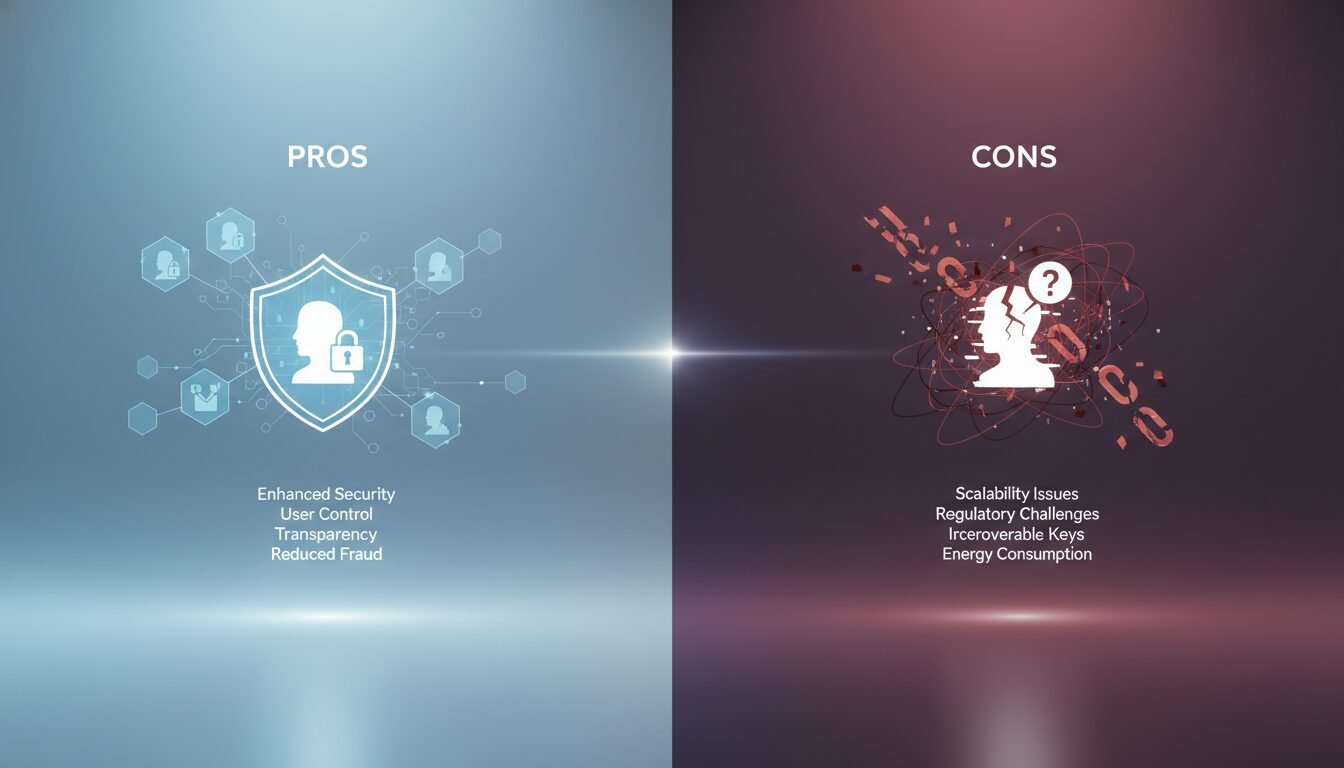
Pros
- No single point of failure: Distributed architecture means one compromised node exposes nothing of value to attackers.
- User-controlled data: Self-sovereign identity puts credential ownership in the user’s hands, not a corporation’s database.
- Reusable credentials: A verified credential issued once can be reused across dozens of services, shrinking onboarding from days to seconds.
- Privacy by design: Zero-knowledge proofs let users prove attributes, like being over 21, without revealing the underlying data.
- Immutable audit trails: Every credential issuance and verification is logged on-chain, reducing compliance evidence-gathering from weeks to minutes.
Cons
- Key management risk: Lose your private key and you lose your identity. There’s no “forgot password” link on a blockchain.
- Regulatory tension: GDPR’s right to be forgotten can clash with blockchain’s immutability if the system isn’t designed carefully.
- Throughput limits: Public blockchains like Ethereum process roughly 15-30 transactions per second, which requires layer-2 or permissioned networks for high-volume use cases.
- Legacy integration complexity: Bridging blockchain identity layers with existing LDAP directories and Active Directory deployments takes real engineering effort.
- Nascent standards: The W3C DID and VC specifications are still maturing, and interoperability across different blockchain networks remains a work in progress.
The Core Problems With Traditional Identity Systems
Current IAM tools, from LDAP directories to modern IDaaS platforms, have served well. But their architecture is cracking under modern threat volumes. Four pain points make the case for a new approach.
1. Centralized Data Breaches
When every identity lives in a single database, one successful intrusion exposes millions of records. Okta’s analysis highlights that identity theft in the digital world is far more damaging than physical document theft because digital identities can be reused instantly across platforms. Identity management on blockchain distributes the data, so breaching one node yields nothing of value.
2. Friction-Filled User Experience
The average person manages 70-80 passwords across work and personal life, leading to password fatigue and risky reuse. Federation helped, but it created new privacy problems: social logins track behavior across sites. A blockchain-based identity wallet changes that equation. One wallet, dozens of reusable credentials, zero third-party tracking.
3. Expensive, Slow KYC/AML
Banks and fintechs spend billions annually on manual Know Your Customer checks. Relying on a central authority to vouch for an identity means repeating the same due diligence for every new service. With identity management on blockchain, a verified credential issued by a trusted entity can be reused instantly, shrinking onboarding from days to seconds and cutting per-check costs by a meaningful margin for early adopters.
How Blockchain Transforms Identity Verification

The World Economic Forum reported that banks increased blockchain investment from $75 million in 2015 to $400 million in 2019. That’s not speculative interest. That’s capital chasing real ROI in decentralized identity and settlement infrastructure.
Step-by-Step: Verifying a Credential On-Chain
- Issuance: A trusted organization, say a university, writes a DID for the graduate and signs a digital diploma as a Verifiable Credential.
- Storage: The graduate stores the VC in a mobile identity wallet. Only the hash of the VC hits the blockchain, never the raw personal data.
- Presentation: When applying for a job, the graduate shares the VC. The employer’s system automatically checks the blockchain to confirm the issuer’s signature and that the credential hasn’t been revoked.
- Verification: The system returns a simple yes/no answer. No human intervention, no API call to the university, no privacy leak.
Zero-Knowledge Proofs Add Anonymity
A verifiable credential can embed a zero-knowledge proof, allowing a user to prove they are over 21 without revealing their birth date. This data-minimization technique is practically impossible with traditional databases. It’s also a key tool for GDPR compliance, since you’re sharing proof of an attribute rather than the attribute itself. The cryptographic math ensures the verifier learns exactly what they need and nothing more.
Key Benefits of Decentralized Identity Management
Moving identity management onto a blockchain isn’t just a security upgrade. It’s a strategic business decision that affects cost, speed, and user trust across every touchpoint.
1. Reduced Verification Costs
International Data Corporation (IDC) forecast global blockchain spending reaching $19 billion by 2024, up from $6.6 billion in 2021, driven largely by identity and supply-chain use cases. Early adopters report a 30-40% drop in per-verification costs once reusable credentials are live. That’s not a rounding error. That’s a budget line that moves.
“The IDC spending forecast reflects a compound annual growth rate of over 40%. That acceleration is fueled by enterprises swapping high-friction KYC processes for one-click, blockchain-backed credential checks that take seconds instead of days.” IDC Blockchain Spending Guide
2. Data Portability and User Control
Users can carry their identity across platforms through a concept called self-sovereign identity. This is already live in countries like Estonia and Singapore, where citizens use government-issued digital identities to access both private and public e-services without creating new accounts for each one. Estonia’s e-Residency program, launched in 2014, now serves tens of thousands of digital residents worldwide and is one of the most cited real-world examples of government-backed digital identity at scale.
3. Enterprise-Grade Interoperability
Products like IBM Verify and Dock now bridge legacy IAM systems with blockchain identity layers. A company running Active Directory can integrate DID-based logins without ripping out existing infrastructure. That hybrid approach satisfies both the security team and the compliance team, which is usually the hardest part of any enterprise technology rollout.
Enterprise Adoption: A Business Strategy, Not Just Technology
For a C-suite executive, identity management on blockchain isn’t a crypto experiment. It’s a way to cut liability, speed up onboarding, and unlock new revenue streams. Here’s the playbook I’ve seen work in practice.
Start With a Closed-Loop Ecosystem
Don’t try to replace all identity infrastructure overnight. Pick one high-friction journey, whether that’s employee background checks, contractor access, or customer KYC, and deploy a permissioned blockchain network among trusted partners. A consortium of three hospitals, for example, can share patient identity verification without centralizing sensitive health data on any single server.
Measure Hard ROI From Day One
Track three metrics from the start: time per verification (target under 10 seconds), breach incident rate (should drop to zero for the covered journey), and compliance audit cost (blockchain’s immutable logs reduce evidence-gathering from weeks to minutes). If you can’t measure it, you can’t defend the budget in year two.
The AI Connection
As AI agents begin to interact autonomously online, they need verifiable digital identities too. Decentralized identifiers for AI will let businesses audit which model made a decision, when, and with what credentials. This turns opaque algorithms into accountable business tools. I think this is one of the most underappreciated applications of identity management on blockchain over the next three to five years.
Real-World Use Cases Across Industries
Blockchain identity solutions are already in production across multiple sectors, not just white papers and conference decks.
Financial Services and KYC
The World Economic Forum notes that the $400 million investment surge in banking blockchain is funding reusable KYC utilities. A consortium of 12 European banks now shares KYC attestations on a private blockchain, reducing onboarding time for business clients from 30 days to under 48 hours. That’s the kind of operational improvement that justifies a board-level conversation.
Healthcare and Patient Data
Patients can hold their vaccination records, prescriptions, and insurance credentials in a blockchain wallet. During a public health emergency, this allows instant, privacy-preserving health status checks at borders or facilities without exposing full medical histories to every checkpoint operator.
Supply Chain and IoT Devices
With roughly 22 billion IoT devices projected by 2025, according to industry estimates, each sensor needs a machine identity. A blockchain-based IAM system for IoT lets factories automatically authenticate sensors and log data with tamper-proof timestamps. This is crucial for food safety traceability and pharmaceutical cold-chain verification, where a single falsified record can trigger a costly recall.
Challenges and Pragmatic Considerations
No technology solves every problem cleanly. Here’s what can go wrong with identity management on blockchain and how to mitigate it before it becomes expensive.
Key Management Is Everything
If a user loses their private key, they lose their identity. There’s no password reset flow. Enterprises must invest in social recovery models or hardware security modules (HSMs) to make key loss survivable for non-technical users. This is the single biggest UX challenge in the space right now, and any vendor who tells you it’s solved is overselling.
Regulatory Immaturity
GDPR’s data-minimization principle aligns well with blockchain design. But the right to be forgotten can clash with immutability if you’re not careful. Smart architecture keeps personal data entirely off-chain, with only hashes and signatures on the ledger. Zero-knowledge proofs handle the rest. This approach satisfies most regulators, but you’ll want legal counsel familiar with both blockchain and privacy law before you go live.
Scalability and Throughput
Public blockchains like Ethereum process roughly 15-30 transactions per second on the base layer. For high-volume identity verification, layer-2 solutions or permissioned networks are more practical. The good news: identity transactions are small, just hashes and signatures, so even modest throughput can serve thousands of verifications per second once you’re off the base layer.
Legacy System Integration
Most enterprises run identity on LDAP, Active Directory, or a commercial IDaaS platform. Integrating a blockchain identity layer on top of that stack requires careful API design and, often, a middleware layer that translates between the old world and the new. Products like Microsoft ION and IBM Verify are specifically built to bridge this gap, but budget 3-6 months of integration work for a mid-size enterprise deployment.
Getting Started With Blockchain Identity Solutions
Choosing a platform is the first real decision. The table below compares the three dominant approaches to identity management on blockchain so you can match the right tool to your organization’s size and risk tolerance.
| Approach | Sample Platforms | Best For | Cost Structure | Complexity |
|---|---|---|---|---|
| Open-Source DLT Frameworks | Hyperledger Indy, Sovrin | Consortia that want full control and custom governance | Free software; high setup and node-operation costs | High: requires blockchain and IAM expertise |
| Commercial IDaaS with Blockchain | Dock, MATTR, SpringRole | Mid-size enterprises that want rapid deployment | Monthly per-credential or per-verification pricing | Medium: APIs and SDKs with straightforward configuration |
| Hybrid IAM Extensions | IBM Verify, Microsoft ION | Large organizations integrating with existing LDAP/Active Directory | Annual enterprise license, often seat-based | Low-medium: familiar IAM consoles with blockchain add-ons |
Build vs. Buy Decision
If your organization already runs Okta or Azure AD, start with hybrid extensions. You’ll get 80% of the benefit with a fraction of the migration risk. If you’re building a greenfield web3 marketplace or a new fintech product, native blockchain identity via Dock or a similar platform will get you to market faster and with a cleaner architecture from day one.
The Future of Identity Management on Blockchain
Three trends will define the next 24 months for anyone building or buying in this space.
1. Wallet-Native Authentication
Apple and Google are building cryptographic identity wallets directly into their operating systems. Soon, a user will scan a QR code and present a verifiable credential from their device’s secure enclave without installing any additional app. That brings identity management on blockchain to a potential audience of over a billion smartphone users without requiring them to understand the underlying technology.
2. Credential Chaining for AI Agents
Autonomous AI agents will need to prove who they represent and what they’re authorized to do. I expect to see “AI Passports” issued as W3C Verifiable Credentials, allowing bots to negotiate contracts, access APIs, and make purchases with full audit trails on-chain. This is where decentralized identity and AI strategy intersect in ways most enterprises haven’t planned for yet.
3. Global Interoperability via the Decentralized Identity Foundation
The Decentralized Identity Foundation (DIF) and the W3C are aligning their specifications so that a DID created on Ethereum can be verified on a Hyperledger network. As of 2026, true cross-chain identity is no longer a research project. It’s entering production deployments, and the organizations that have already built on open standards will have a significant head start.
Frequently Asked Questions
What is identity management in blockchain?
Identity management on blockchain uses distributed ledger technology to give individuals direct control over their digital identities. Instead of a central server storing passwords and credentials, users hold cryptographic keys and share only what’s necessary for each specific verification.
What are the 4 pillars of IAM?
The four pillars are authentication, authorization, administration, and auditing. Blockchain strengthens all four by providing cryptographically secure authentication, smart-contract-based authorization, decentralized administration, and immutable audit trails that can’t be altered after the fact.
What are the 4 types of blockchain?
The four types are public (e.g., Ethereum), private (e.g., Hyperledger Fabric), consortium (e.g., R3 Corda), and hybrid. For identity management on blockchain, consortium and private networks are most common because they balance privacy with the benefits of distributed consensus.
How do I verify my identity on blockchain?
You present a verifiable credential from your digital wallet. The verifier checks the blockchain to confirm the issuer’s signature and that the credential hasn’t been revoked, with no phone call, email, or manual document upload required.
Can blockchain identity systems comply with GDPR?
Yes, if designed with data minimization from the start. No personal data is stored on-chain, only hashes and signatures. Zero-knowledge proofs can further hide sensitive attributes while still conveying the necessary proof, aligning with GDPR’s privacy-by-design requirements.
Which industries benefit most from blockchain identity management?
Financial services (KYC/AML), healthcare (patient records), supply chain (product traceability), and education (credential verification) are the earliest and most active adopters. Any sector that relies on expensive, repeated identity checks stands to gain meaningful operational savings.
Want to think through how identity management on blockchain fits your specific business model? Connect with Amin Ferdowsi at aminferdowsi.com to discuss AI and identity strategy for your organization.
Enjoyed this article?
Connect with me for collaboration, ventures, or just a good conversation about building things.
Get in Touch