Family Business: Succession, Strategy & Longevity

Family Business: Succession, Strategy, and Sustainability
Key Takeaways
- Family-owned enterprises represent a significant share of global GDP and employment, often outperforming public companies over multi-decade horizons.
- Succession planning and governance structures are critical for multi-generational survival most don’t make it past the second generation.
- The three circles model helps align family, business, and ownership goals by clarifying who holds which roles.
- Common challenges include conflict resolution, estate tax burdens, and adapting to digital disruption.
- Adopting innovation and sustainability practices like those at Lundberg Family Farms after six generations can extend longevity well beyond what most founders imagine.
- A family office, formal board governance, and written succession plans are the three structural moves that separate enterprises that last from those that don’t.
Family business is a commercial organization where a family holds significant ownership or control, influencing management decisions across generations. These enterprises range from small local shops to global corporations and face unique governance and succession challenges.
What Is a Family Business?
Definition and Core Characteristics
A family-owned enterprise is typically defined by the intersection of family, management, and ownership. According to Wikipedia, it is “a type of commercial organization in which management decisions are made or influenced by multiple generations of a family, related by blood, marriage, or adoption.” Key characteristics include family control over strategic direction, long-term orientation, and a commitment to legacy. Unlike publicly traded corporations, these enterprises often prioritize stability and generational continuity over quarterly profits.
Ownership can be concentrated in one family or spread among many relatives. The level of family involvement varies: some have members in day-to-day operations, while others hire professional managers. This flexibility allows the enterprise to adapt quickly to market changes while preserving core values.
Types of Family Businesses
These enterprises can be classified by size, ownership structure, and generational involvement. Small family-run shops often operate as sole proprietorships, while large multinationals like Pella Corporation and Lundberg Family Farms are fifth- and sixth-generation enterprises respectively. Some are family-owned but professionally managed, while others keep executive roles reserved for family members. Hybrid structures also exist, where a family office oversees both operating businesses and investment portfolios.
A family-controlled enterprise may also be publicly traded while retaining control through super-voting shares a model used by companies like Ford Motor Company. The common thread is the family’s influence on the board and long-term strategy.
Why This Model Matters
Family-owned enterprises power economies worldwide. In the U.S., they account for a substantial share of GDP and job creation, rivaling that of large corporations. They tend to have higher employee retention and deeper community engagement. Their resilience through economic cycles is often attributed to patient capital and a stewardship mindset. That long-term focus makes them a bedrock of economic stability in ways that quarterly-driven public companies simply aren’t.
The Three Circles Model
How the Model Works
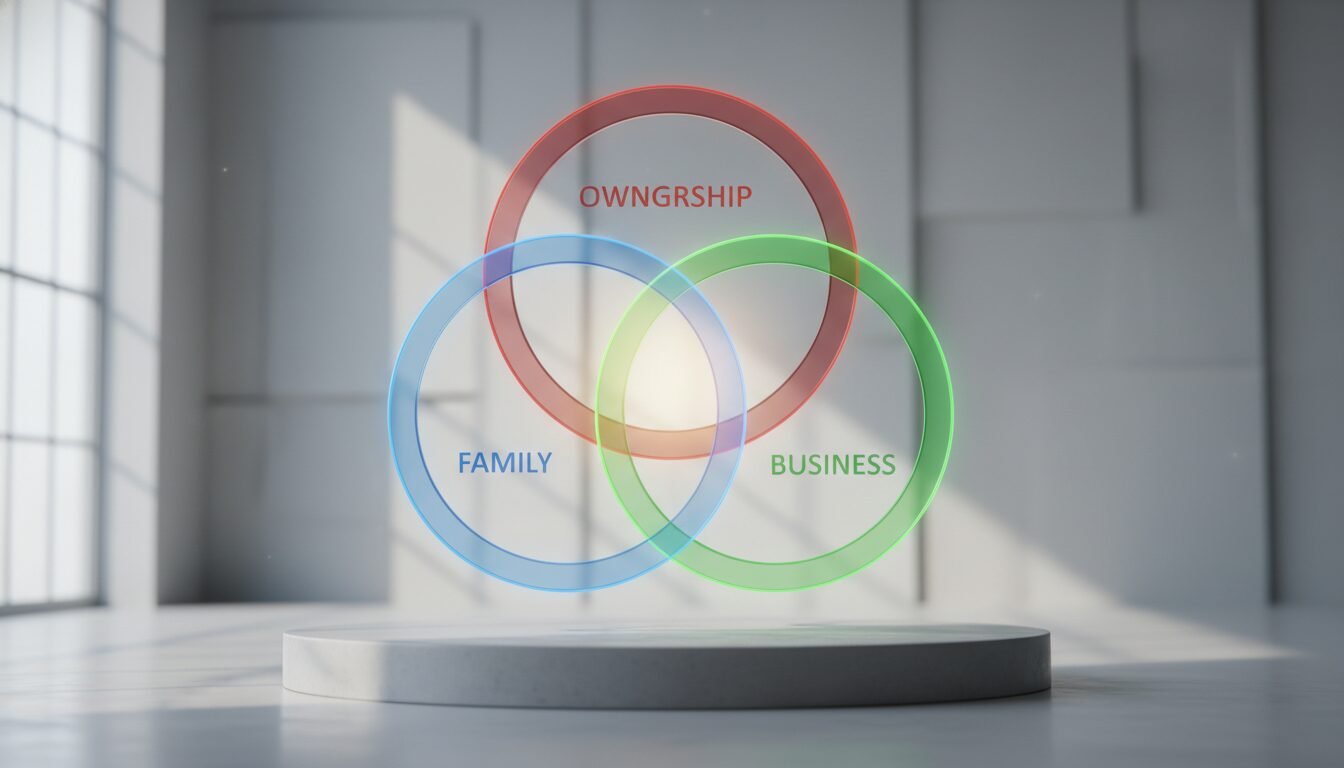
The three circles model, developed by Renato Tagiuri and John Davis at Harvard, illustrates the three overlapping systems in a family enterprise: family, business, and ownership. Each circle represents a stakeholder group, and individuals occupy one or more areas. A founder who is also the CEO falls in the center overlap. This framework helps clarify roles and reduce conflict by visually mapping competing interests.
One person might be a family member, owner, and employee simultaneously, while another could be only an owner with no operational role. Understanding these overlapping identities is the first step toward professionalizing the enterprise.
Applying the Model to Reduce Conflict
When family members understand their positions in the model, decision-making becomes more transparent. A next-gen family member with no ownership stake but working in management has different priorities than an owner who is not employed by the company. The model encourages structured communication and helps in drafting shareholder agreements and job descriptions.
Regularly reviewing the three circles can prevent misunderstandings during succession. It also reveals where independent outside voices might be needed to balance family dynamics something I’ve seen firsthand in advising founder-led companies through leadership transitions.
Beyond the Three Circles: The Genogram
Many advisors also use genograms family diagrams that map relationships and emotional bonds to uncover hidden dynamics. This tool adds an emotional layer to the structural model, aiding in succession and conflict resolution. While the three circles focuses on systems, the genogram examines interpersonal histories, making it a powerful complement for any enterprise navigating generational transitions.
Common Problems in Family Business

Succession Trouble and Leadership Gaps
Succession planning is the single most common failure point in family-owned enterprises. Only a fraction survive to the second generation, and even fewer to the third. A 2026 article from Family Business Magazine highlights that proactive transition is essential, noting that founders who wait too long often create the very crises they were trying to avoid.
“It is always better to leave before you’re asked to. A culture of succession must be built from the top.” Family Business Magazine, 2026
Without a clear plan, internal rivalries can erupt and the enterprise may lose key talent. Leadership transition must be treated as a multi-year process rather than a single event.
Financial Pressures and Tax Burdens
Estate taxes, liquidity needs, and unequal asset distribution can strain even the most successful enterprise. The Tax Cuts and Jobs Act of 2017 altered federal estate tax thresholds, but state-level taxes remain a significant concern. A four-part liquidity strategy, as outlined by family business experts, can help owners plan for these pressures without sacrificing growth. The four parts include assessing current liquidity, projecting future cash needs, evaluating funding sources, and structuring tax-efficient transfers.
Proper planning can prevent forced sales just to cover tax liabilities, ensuring the enterprise remains intact for future generations.
Conflict and Communication Breakdowns
According to familybusiness.org, there are 12 hidden fault lines that threaten family enterprises, from death and divorce to disruption and disrepute. These risks can tear apart even the most successful companies if not addressed through open communication and formal governance. Regular family meetings and councils are essential for navigating these vulnerabilities.
Ignoring these fault lines often leads to expensive litigation or a forced sale. Proactive advisors recommend annual family retreats and clear communication charters as minimum baseline practices.
Succession Planning and Leadership Transition

Why Succession Planning Fails
Succession planning fails most often because founders assume the next generation will naturally step in. A lack of preparation leads to abrupt leadership voids. A survey by Family Business Magazine in 2025-2026 found that executive compensation in family firms is increasingly tied to performance metrics, yet many boards lack clear succession timelines. This disconnect creates uncertainty for both family and non-family executives.
Emotional factors a founder’s reluctance to relinquish control often delay critical decisions by years. I’ve watched this play out repeatedly: the longer the delay, the messier the transition.
Steps to a Smooth Transition
- Start early: Begin discussions 10-15 years before the expected handover.
- Assess competencies: Identify gaps and provide leadership training for successors.
- Create a written plan: Document roles, timelines, and contingency measures.
- Communicate openly: Involve all stakeholders to minimize surprises.
- Test the waters: Allow the successor to lead projects before full transition.
This phased approach, recommended by family business consultants, increases the likelihood of a clean handover. The 10-15 year runway isn’t excessive it’s realistic.
Case Study: Pella Corporation
Pella Corporation, a fifth-generation family-owned window manufacturer, demonstrates what long-term stewardship actually looks like. According to Family Business Magazine, the company’s focus on service and stewardship has guided it into its second century of operation. Their board includes non-family members to ensure fresh perspectives, proving that an enterprise can professionalize while retaining its founding values.
Governance and Board Structure
Why Formal Governance Matters
Without formal governance, family dynamics can override business logic. A board of directors with independent outsiders brings objectivity and holds the family accountable. Effective boards evaluate performance, shape strategy, and oversee risk including cybersecurity, as noted in the article “AI Guardrails and Corporate Governance” from Family Business Magazine.
For any family-controlled enterprise, establishing a board with at least 2 independent directors is a best practice that aligns interests and reduces emotional decision-making. It’s also a signal to non-family executives that the company is serious about professional management.
Comparing Governance Models: Family vs. Non-Family
| Aspect | Family Business | Non-Family Business |
|---|---|---|
| Decision-making speed | Faster due to concentrated ownership | Slower, requires board and shareholder votes |
| Longevity focus | Generational (6+ generations possible) | Quarterly or annual, often short-term |
| Employee loyalty | Higher, family-like culture | Lower, more transactional |
| Risk tolerance | More conservative, patient capital | Higher, driven by market demands |
| Board composition | Often family-dominated, with some independents | Fully independent directors |
This comparison highlights why family-controlled enterprises often outperform during crises but can struggle with innovation. Installing a balanced board mitigates weaknesses in both areas.
Recruiting and Retaining Non-Family Executives
To attract top talent, the enterprise must offer competitive compensation. Vantage Bank Texas, for instance, built its executive compensation on five pillars, aligning pay with long-term stewardship rather than short-term profits. This model differs from the typical two-metric system (stock price and EPS) used by many public companies. By broadening performance metrics to include customer satisfaction and sustainability goals, the company motivates leaders to think generationally rather than quarterly.
Financial and Tax Strategies
Estate Planning and Wealth Transfer
A new estate tax rate reduction bill, discussed in Family Business Magazine in 2026, shows shifting legislative priorities. Owners must stay informed to minimize transfer taxes. Liquidity events such as selling shares to an employee stock ownership plan (ESOP) or a family office can unlock value without losing control.
Using vehicles like grantor retained annuity trusts (GRATs) and intentionally defective grantor trusts (IDGTs) can freeze estate values and pass wealth tax-efficiently. Every enterprise should review these strategies every 3-5 years as laws change what worked in 2020 may not be optimal today.
Compensation Planning
The 2025-2026 compensation survey revealed that executive pay in family-controlled firms is increasingly tied to long-term performance metrics such as revenue growth and sustainability goals. This aligns the interests of family and non-family executives and reduces turnover. Designing a plan with a base salary, short-term bonus, long-term equity, and perquisites creates a balanced mix that reflects stewardship values.
Avoiding Common Tax Traps
Poorly structured buy-sell agreements, lack of valuation discounts, and failure to use lifetime gift exemptions can result in hefty tax bills. Expert advisors recommend regular appraisals and proactive documentation. A smart move: conduct a tax “fire drill” every 2 years to test readiness for a triggering event like death, disability, or divorce.
Wealth Integration and Family Health
Aligning Family Well-Being with Wealth Strategy
One area that separates thriving multi-generational enterprises from struggling ones is how they integrate family health with wealth planning. Financial wealth without relational health is a liability. Families that invest in communication training, conflict resolution processes, and shared values documentation tend to preserve both their capital and their cohesion across generations.
This means treating the family itself as a system that needs maintenance not just the business entity. Annual family retreats, facilitated by a neutral advisor, can surface tensions before they become crises. Some family offices now include a “family wellness” budget alongside investment and legal budgets, recognizing that the human capital of the family is as important as its financial capital.
The Family Office: Evolution and Technology
A family office manages the wealth and affairs of a family, often including investment management, estate planning, and philanthropic activities. As of 2026, family offices are increasingly adopting technology platforms to manage reporting, compliance, and communication across geographically dispersed family members. Cloud-based portfolio management tools and AI-powered analytics are reducing the cost of running a single-family office, making the model accessible to enterprises with holdings in the $50-100 million range, not just billionaire dynasties.
Not every owner needs a formal family office, but for those with substantial holdings, it provides strategic coordination across generations that no other structure replicates.
Innovation and Sustainability
Driving Digital Transformation
Digital transformation is no longer optional for family-controlled enterprises. While many rely on traditional methods, AI-powered analytics and cloud-based ERP systems are becoming essential. Firms like Vermeer Corporation are connecting generations through technology upgrades, as highlighted in Family Business Magazine. Adopting knowledge management systems can help preserve tacit knowledge when senior family members retire.
“A leader’s tacit knowledge can make the company more successful, but it’s a challenge to understand what’s behind it or how to pass it down to next-gens.” familybusiness.org, “How Leaders Can Transfer Their Great Instincts to Successors”
Investing in cybersecurity and digital literacy is a competitive necessity. Based on my experience building and advising tech-enabled businesses, the enterprises that treat technology as a cultural shift not just a tool purchase are the ones that actually capture the benefit.
Sustainability as a Competitive Edge
Six generations of stewardship at companies like Lundberg Family Farms prove that environmental responsibility drives customer loyalty over the long run. Sustainability isn’t a buzzword here it’s a long-term imperative that aligns with the ethos of leaving a legacy. Implementing ESG metrics can also attract impact investors and improve brand reputation in ways that traditional marketing budgets can’t replicate.
Many family-controlled enterprises lead in sustainability because they think in decades, not quarters. Solar installations, zero-waste programs, and regenerative farming are just a few examples of how values translate into measurable competitive advantage.
Balancing Short-Term and Long-Term Goals
Resilient family firms draw on past lessons and trusted relationships to navigate crises without sacrificing future vision, according to familybusiness.org. This dual focus sometimes called ambidexterity is a key differentiator. By using four strategy tools (Porter’s Five Forces, SWOT analysis, customer value propositions, and unit economics), an enterprise can maintain clarity in turbulent markets without losing sight of generational goals.
International Perspectives on Family Business
How Family Enterprises Operate Globally
Family-controlled enterprises are not a uniquely American phenomenon. In Argentina, Mexico, and Spain, multigenerational family groups control significant portions of national GDP and often operate across industries simultaneously from agriculture to banking to real estate. These international examples show that the core challenges of succession, governance, and conflict are universal, even if the legal and cultural contexts differ.
In Spain, for instance, family-owned enterprises account for a large share of private sector employment and have historically been more resilient during financial crises than their publicly traded counterparts. The governance models used in these markets often blend formal board structures with deeply embedded family councils, offering a useful template for enterprises in any geography.
Pros and Cons of the Family Business Model
Pros
- Patient capital: Owners think in decades, not quarters, enabling long-term investments that public companies can’t justify to shareholders.
- Faster decisions: Concentrated ownership means strategic pivots can happen in days, not months.
- Higher employee loyalty: Family culture tends to produce lower turnover and stronger institutional knowledge retention.
- Resilience during crises: Stewardship mindset and conservative balance sheets often outperform during economic downturns.
- Legacy and values alignment: A shared mission across generations creates brand authenticity that’s difficult to manufacture.
Cons
- Succession risk: Most don’t survive to the third generation without deliberate planning and governance investment.
- Nepotism and talent gaps: Prioritizing family members over qualified outsiders can create leadership deficits at critical moments.
- Conflict spillover: Personal relationships and business decisions are intertwined, making disputes harder to resolve objectively.
- Tax and liquidity pressure: Estate taxes and illiquid assets can force sales or dilution at the worst possible times.
- Innovation drag: Conservative culture and risk aversion can slow adoption of new technologies or business models.
Frequently Asked Questions
What is the definition of a family business?
A family business is a commercial organization where a family holds majority ownership or exerts significant influence over management decisions across generations. The key distinction from other company types is the family’s ongoing role in shaping strategy and culture, not just holding equity.
How many generations can a family business last?
Most family-owned enterprises do not survive beyond the second generation, and very few reach the third. However, with diligent succession planning and strong governance, some like Pella Corporation thrive for five or more generations, and Lundberg Family Farms has reached six.
What are the biggest challenges for family businesses?
Common challenges include succession planning, conflict resolution, estate tax burdens, and adapting to digital disruption. Family business advisors often cite the 12 hidden fault lines including death, divorce, and disrepute as the most common triggers for enterprise collapse.
How can family businesses improve governance?
Establishing a board with at least 2 independent directors, holding regular family councils, and adopting formal bylaws can professionalize decision-making and reduce emotional conflict. The three circles model is a practical starting point for mapping who holds which roles and interests.
Are family businesses more successful than non-family businesses?
Family-controlled enterprises often exhibit higher employee loyalty and long-term resilience. They may not always be more profitable in the short term, but their patient capital and stewardship focus can outperform public companies over multi-decade horizons particularly during economic downturns.
What is a family office and do all family businesses need one?
A family office manages the wealth and affairs of a family, often including investment management, estate planning, and philanthropic activities. As of 2026, technology is making family offices more accessible to enterprises in the $50-100 million asset range. Not every owner needs one, but for those with substantial holdings, it provides strategic coordination across generations that no other structure replicates.
Building a multi-generational enterprise is one of the hardest things a founder can attempt. If you’re thinking through succession, governance, or how AI fits into your long-term strategy, connect with Amin to discuss what actually works.
Enjoyed this article?
Connect with me for collaboration, ventures, or just a good conversation about building things.
Get in Touch