Digital Projects: The Complete 2026 Guide

Key Takeaways
- Digital projects are temporary endeavors that create or enhance digital products, services, or processes using technology-driven approaches.
- They span across industries, from AEC (using BIM software like Digital Project Suite) to marketing, education, and creative arts.
- Managing these initiatives requires a blend of traditional PM skills, modern Agile methods, and the right digital tools.
- Success depends on clear purpose, cross-functional collaboration, and early control of scope creep.
- As of 2026, AI and remote-first workflows are reshaping how projects get delivered and measured.
Digital projects are temporary undertakings that create or modify digital products, services, or processes using technology-driven approaches. They cover everything from website launches to complex BIM implementations.
What Is a Digital Project?
A digital project is a planned human undertaking aimed at introducing, transforming, or managing computer-based strategies and operations. Unlike routine operations, it has a defined start and finish and produces something unique.
The Core Definition
The Project Management Institute (PMI) describes a project as a temporary endeavor undertaken to create a unique product, service, or result. When the deliverable is digital, such as a software application, a website, a 3D BIM model, or an online content series, you are squarely working on digital projects.
“A project is a temporary endeavor undertaken to create a unique product, service or result.” Project Management Institute, PMBOK Guide
The 4 Dimensions That Make It Digital
According to The Digital Project Manager, four intermingling dimensions define a digital project:
- The digital nature of the product The primary output is a digital asset: an app, a model, or media.
- Strategic use of project management methodologies within a digital context Agile, Scrum, and hybrid approaches are common.
- The mix of disciplines required to create value through technology developers, designers, data analysts, and domain experts.
- The digital tools used to achieve the project’s objectives from cloud-based project management platforms to specialized software like Digital Project Suite for BIM.
Digital vs. Traditional Projects
Traditional projects center on physical deliverables: a skyscraper, a highway, a consumer product. Digital projects deliver intangible assets that can be iterated quickly. The construction of a 50-story tower follows a linear Waterfall plan. A website relaunch might roll out in two-week sprints. This flexibility blurs the line between “project” and “product,” a shift that most organizations are still working through.
| Aspect | Traditional Project | Digital Project |
|---|---|---|
| Primary Deliverable | Physical (building, machine) | Intangible (software, data, media) |
| Methodology | Waterfall, predictive planning | Agile, iterative, hybrid |
| Tools | Paper-based, standalone files | Cloud platforms, real-time dashboards |
| Team Structure | Co-located, functional silos | Distributed, cross-functional |
| Risk Management | Forecast early, change control boards | Continuous monitoring, adaptive responses |
Pros and Cons of Digital Projects
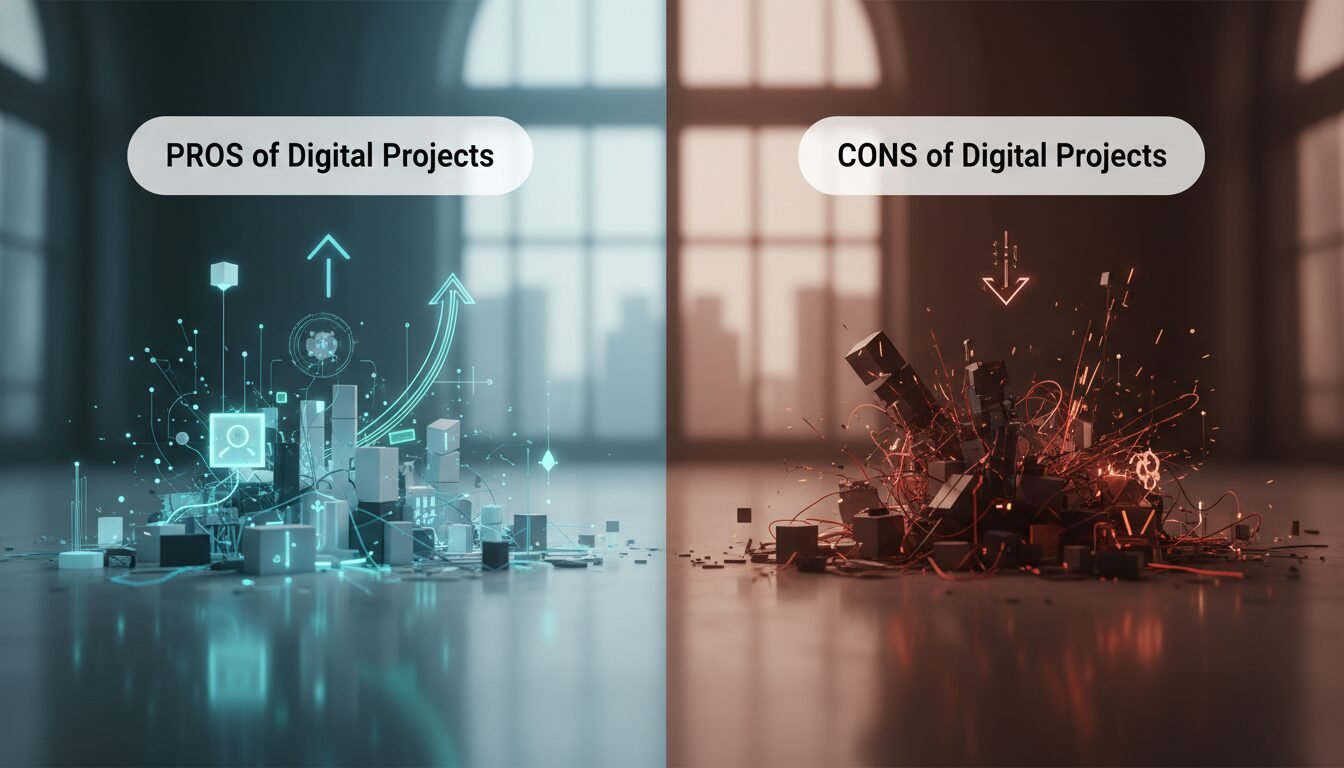
Digital projects offer real advantages over traditional approaches, but they carry distinct challenges that trip up even experienced teams.
Pros
- Speed of iteration: Two-week sprints let you ship, learn, and adjust faster than any physical build cycle allows.
- Global collaboration: Cloud-based tools mean a designer in London and a developer in Bangalore can co-author the same file in real time.
- Lower rework costs: Changing a line of code or a content block costs a fraction of what it costs to redo a physical structure.
- Measurable outcomes: Digital deliverables generate data from day one, so you can track performance against goals continuously.
- Scalability: A SaaS platform or data pipeline can scale to serve 10 users or 10 million without rebuilding from scratch.
Cons
- Scope creep risk: The ease of adding features makes it tempting to keep expanding, which kills timelines and budgets.
- Tool overload: Teams can end up juggling 8 to 12 platforms, creating fragmentation and communication gaps.
- Security exposure: Digital assets are vulnerable to breaches, data loss, and compliance failures in ways physical deliverables are not.
- Skill gaps: Rapidly evolving technology means the team skills required at kickoff may differ from what you need at launch.
Purpose and Strategic Alignment
Without a clear purpose, digital projects drift. Purpose aligns the team, secures stakeholder commitment, and gives you a real yardstick for success.
Why Purpose Matters
The goal must tie back to the broader organizational mission. Otherwise, the initiative risks becoming an expensive distraction. I’ve seen this firsthand: a manufacturing client launched an IoT monitoring initiative without connecting it to a measurable outcome. Six months in, the project was technically complete but operationally irrelevant. The lesson was simple. Define the business outcome first, then scope the project around it.
Key Questions to Define Your Digital Project’s Purpose
Project sponsors can ask seven questions to clarify intent before a single task gets assigned:
- What are we trying to achieve as an organization?
- What am I trying to achieve within my team?
- Why are we doing this now?
- How will we approach our goals at a high level?
- How will we achieve this specific goal?
- What are we doing today, and what could be done better?
- What specific outcome will this project produce?
Answering these before kickoff cuts the risk of scope creep and misaligned expectations, two of the most common reasons digital projects fail.
Types of Digital Projects
Digital projects take radically different forms depending on the industry and the intended output. Here is how they break down across the most common domains.
By Industry and Domain
In Architecture, Engineering, and Construction (AEC), digital projects often involve high-performance BIM models built with tools like the Digital Project Suite, which runs on the CATIA modeling engine. In marketing, projects center on website builds, SEO campaigns, and content hubs. Education sees student-led podcasts, interactive timelines, and digital portfolios, as detailed in “The Digital Projects Playbook” by John Arthur. Digital humanities at institutions like Lehigh University produce archives, databases, and GIS maps that preserve and analyze cultural heritage at scale.
Digital Projects for Students
Student-focused digital projects build real skills and produce portfolio pieces that matter to employers. “The Digital Projects Playbook” outlines six core project types students can execute with minimal resources: blog posts, multimedia presentations, podcasts, video essays, digital portfolios, and collaborative research databases. Each one teaches a distinct skill set, from audio production to data organization. The best student digital projects share one trait: they solve a real problem for a real audience, even if that audience is just the classroom.
Digital Humanities Projects
Digital humanities work sits at the intersection of scholarship and technology. Projects in this space typically include oral history archives, GIS-based mapping of historical events, digitized manuscript collections, and interactive timelines. Libraries like the UDC Library’s Learning Resources Division publish dedicated digital projects guides to help researchers scope, tool-select, and publish these initiatives. The output is often a public-facing web resource that lives beyond the original project timeline, which means documentation and long-term hosting need to be part of the plan from day one.
By Deliverable
We can classify digital projects into five broad categories based on what they produce:
- Web and App Development e-commerce sites, mobile apps, SaaS platforms.
- Content and Media video series, podcasts, infographics, blog networks.
- Data and Analytics dashboards, machine learning models, data warehouses.
- Design and Modeling BIM for construction, 3D visualizations, VR experiences.
- Process Automation workflow digitization, RPA implementations, AI chatbots.
Digital Project Management: A Unique Approach
Managing digital projects requires frameworks built for rapid change, not the rigid structures designed for physical construction or manufacturing.
Methodologies That Work
Waterfall suits projects with fixed requirements, such as regulatory compliance software where the spec is locked before development begins. Agile and Scrum dominate for customer-facing products where feedback shapes the final form. Many teams adopt a hybrid: high-level planning upfront, followed by iterative development cycles of 2 to 4 weeks. The right choice depends on how much uncertainty exists at the start and how often stakeholders need to weigh in.
The 5 Phases of a Digital Project Lifecycle
Regardless of methodology, most digital projects move through five distinct phases:
- Initiation Define the problem, assess feasibility, and charter the project.
- Planning Outline scope, budget, timeline, and risks, then assemble the team.
- Execution Design, develop, and test the digital deliverable.
- Monitoring Track progress, manage changes, and communicate status in real time.
- Closure Hand over the product, run a post-mortem, and archive knowledge for the next team.
Monitoring is not a separate stage. It runs parallel to execution, enabling real-time course corrections before small problems become expensive ones.
“The biggest failure mode I see in digital projects isn’t technical. It’s the gap between what stakeholders said they wanted in month one and what the team built by month six.” Based on patterns observed across multiple product builds and client engagements
Essential Tools for Digital Projects
The right toolstack can cut delivery time by weeks. The wrong one adds coordination overhead that kills momentum.
Project Management and Collaboration Platforms
Cloud-based platforms like Productive, Asana, and Monday.com provide a central hub for task management, Gantt charts, and resource allocation. They let distributed teams collaborate in real time, a critical capability when members span Los Angeles, London, and Bangalore. These tools typically integrate with version control systems like GitHub and communication apps like Slack, forming a cohesive digital workspace. Most teams running 3 to 5 concurrent digital projects find that a single platform with strong API support reduces tool-switching overhead significantly.
Specialized Software: The Digital Project Suite for BIM
In the AEC sector, Digital Project Inc., based in Los Angeles, CA, offers a high-performance BIM suite powered by the CATIA engine. It includes DP Designer for parametric 3D modeling, DP Manager for model review and 4D scheduling, and DP Extensions for MEP systems routing and subdivision surface modeling. The software handles geometrically complex structures from city-scale planning down to construction detail, making it a standard choice for demanding builds like airports, stadiums, and offshore platforms.
Tools for Creative and Educational Digital Projects
For content-driven work, Adobe Creative Cloud tools like Premiere Pro, Illustrator, and Audition are industry standards. Students create podcasts using Audacity or Anchor, design infographics with Canva, and build interactive maps with ArcGIS. No-code platforms like Bubble and Webflow have further opened up digital projects to non-technical users, making it possible to deploy a functional web app in days rather than months.
Avoiding Common Pitfalls in Digital Work
Most digital projects don’t fail because of bad technology. They fail because of bad process, unclear ownership, or tools that don’t match the team’s actual needs.
Unclear Goals and Scope Creep
The most cited reason digital projects fail is a lack of clear definition at the start. When scope expands without adjusting timelines or budgets, quality suffers and teams burn out. Define a minimum viable product (MVP) before development begins and enforce a change control process. Every new feature request should go through a formal review: what does it cost, what does it displace, and does it serve the original goal?
Insufficient Stakeholder Engagement
Digital projects often involve multiple stakeholder groups: end-users, IT, marketing, and executives. Without regular feedback loops, the final product can miss the mark entirely. Agile ceremonies like sprint reviews keep stakeholders involved and surface misalignments early, when they’re still cheap to fix. A distributed team might use video conferencing and shared whiteboard tools to stay aligned across time zones, but the cadence matters more than the tool.
Choosing the Wrong Tools
A mismatch between project needs and technology can stall progress for weeks. A small marketing team running a content migration doesn’t need the enterprise-grade BIM software used on Los Angeles skyscraper projects. Evaluate tools based on team size, budget, and integration requirements. For BIM work, look for platforms that support open standards like ISO 19650. For general digital projects, prioritize open APIs to avoid vendor lock-in as your stack evolves.
The Future of Digital Projects in 2026 and Beyond
The way digital projects get planned, staffed, and delivered is changing faster than most organizations can adapt. Here is where the real shifts are happening.
AI-Infused Project Management
As of 2026, AI is embedding itself across every phase of digital projects. Predictive analytics can flag risk weeks before it materializes. Generative design tools automate portions of the creative process that used to require senior specialists. Project management platforms are beginning to suggest task assignments and optimize resource allocation based on historical performance data. I’ve been testing several of these tools across my own builds, and the time savings on routine coordination tasks are real. The catch: AI recommendations are only as good as the data you feed them, so teams with messy project histories get messy suggestions.
Remote-First and Global Collaboration
Digital projects are now routinely executed by teams that never share a physical office. Cloud-based project management platforms, VR-based design reviews, and real-time document co-authoring have become baseline expectations rather than competitive advantages. Companies like Digital Project Inc. in Los Angeles demonstrate that complex BIM models can be reviewed and iterated across continents without a single in-person meeting. The organizations winning at this aren’t just using better tools. They’ve redesigned their communication rhythms around async-first workflows.
Sustainability and Green Digital Projects
Environmental considerations are increasingly written into project charters from day one. Whether it’s a data center migration targeting carbon neutrality or a BIM model simulating energy performance across seasonal conditions, digital projects are being evaluated on environmental impact alongside ROI. Standards like the ISO 14000 series and green building certifications such as LEED are becoming routine requirements on public-sector and enterprise contracts, not optional add-ons.
Frequently Asked Questions
What is an example of a digital project?
A website relaunch, a mobile app build, a BIM model for a new airport terminal, or a student podcast series are all examples of digital projects. Each has a defined start and end date, a specific deliverable, and a team assembled to produce it.
How do you make a digital project?
Start by defining a clear purpose and a measurable outcome. Then scope the deliverable, assemble a cross-functional team, select the right tools, and run the work through the five standard phases: initiation, planning, execution, monitoring, and closure. Agile teams add iterative cycles within the execution phase to incorporate feedback continuously.
What is the difference between a digital project and a traditional project?
A digital project primarily delivers digital products or services and typically uses iterative methodologies like Agile. Traditional projects focus on physical deliverables and follow linear, predictive processes. Digital projects can be changed and redeployed far faster than physical ones, which changes how risk and scope are managed.
What software is commonly used for digital projects?
Common tools include cloud-based project management platforms like Productive and Asana, BIM software like Digital Project Suite, creative tools like Adobe Creative Cloud, and no-code platforms like Bubble and Webflow. The right stack depends on the project type, team size, and integration requirements.
What are the four types of projects?
PMI and most project management frameworks categorize projects by complexity and uncertainty: simple, complicated, complex, and chaotic. Digital projects most often fall into the complicated or complex categories, where iterative approaches and continuous stakeholder feedback are essential to reaching a successful outcome.
How are digital projects evolving with AI?
AI is automating project scheduling, risk prediction, and portions of the design and content generation process, making digital projects more efficient and data-driven. As of 2026, the most practical gains are in routine coordination and early risk flagging. Human judgment remains essential for strategic decisions and stakeholder relationships.
Enjoyed this article?
Connect with me for collaboration, ventures, or just a good conversation about building things.
Get in Touch