Content Development: A Builder’s Guide to Strategic Growth

- Content development is a strategic, multi-step process that goes beyond simple writing to include research, optimization, and distribution.
- Businesses with a documented strategy are more likely to see consistent ROI and measurable marketing results.
- Key components include audience research, content audits, SEO integration, and performance analytics.
- Outsourcing to agencies can accelerate output, but in-house teams offer tighter brand control.
- AI tools are reshaping how we approach content development, enabling faster production and personalization at scale.
Content development is the strategic process of researching, creating, editing, optimizing, and promoting content to achieve specific business goals. It involves continuous measurement and iteration to maximize impact.
What Is Content Development?
Content development is the end-to-end discipline of conceiving, planning, producing, distributing, and governing content across all touchpoints of a customer journey. Unlike ad-hoc writing, it ties every asset to a measurable business objective, whether that’s driving organic traffic, nurturing leads, or reinforcing brand credibility. According to NYT Licensing, the process spans research, analysis, creation, optimization, and promotion, all governed by a documented strategy.
At its core, this discipline answers three questions: Who are we trying to reach? What content will move them toward our goal? And how will we produce, deliver, and refine that content over time? The term is sometimes used interchangeably with “content strategy,” but development emphasizes the full lifecycle, from ideation to retirement. On Wikipedia, content development is broadly described as the process of researching, writing, gathering, organizing, and editing information for publication.
The Role in Modern Business
In 2026, content development functions as the operational backbone of digital marketing. It’s no longer a separate department tucked inside communications; it’s woven into product launches, customer support, and sales enablement. Brands like HubSpot and Salesforce have built entire ecosystems around strategic content, proving that consistent, high-value output can reduce customer acquisition costs by building organic trust before a sales conversation even begins.
High-performing training organizations recognize its weight too. Training Industry research identifies content development as the second-most critical process capability for learning and development success, because the quality and relevance of content directly influence learner engagement and on-the-job performance. The same principle extends to marketing: content relevance drives engagement, and engagement drives revenue.
Why Strategic Content Matters for Your Business

“Content marketing is a strategic marketing approach focused on creating and distributing valuable, relevant, and consistent content to attract and retain a clearly defined audience.” , Joe Pulizzi, Founder of Content Marketing Institute
Driving Organic Traffic and SEO
Google’s 2026 algorithm updates continue to reward depth, expertise, and user satisfaction. Strategic content that prioritizes in-depth topic clusters over shallow keyword stuffing delivers measurably better organic visibility. When you structure content around a pillar page and supporting cluster articles, you signal topical authority, which search engines translate into higher rankings. This approach also feeds AI-driven answer engines like Google’s Search Generative Experience, which pulls structured, definitive answers from well-developed content.
Building Brand Authority and Trust
Trust is the currency of the modern buyer. Content development enables brands to demonstrate expertise consistently. A white paper that solves an industry pain point, a case study with verifiable metrics, or a regularly updated blog series all serve as trust signals. The cumulative effect is a reputation that shortens sales cycles, prospects arrive pre-educated and pre-disposed to buy. The alternative, sporadic publishing without a unifying strategy, confuses audiences and dilutes brand identity.
Generating and Nurturing Leads
Every piece of content should have a role in the funnel. Top-of-funnel blog posts attract cold traffic; mid-funnel whitepapers and webinars capture emails; bottom-funnel comparison guides and free trials convert. Strategic content development formalizes this journey, mapping each asset to a stage and an action. Companies that adopt this systematic approach see meaningful conversion rate improvements, as reported by multiple B2B marketing surveys.
Key Components of a Strategy

Audience Research and Persona Development
You cannot develop content that resonates unless you know precisely whom you’re speaking to. Persona development goes beyond demographics to capture pain points, goals, content consumption habits, and decision-making triggers. Tools like SparkToro or Google Analytics 4 provide behavioral data, while direct customer interviews yield qualitative insights. The output is a set of documented personas that guide topic selection, tone, and format.
Content Audits and Gap Analysis
A content audit inventories existing assets against performance metrics, traffic, engagement, conversions. The gap analysis then identifies missing topics (based on keyword research and competitor analysis) and underperforming content that needs refreshment. Regular audits, ideally quarterly, prevent content decay and ensure your library remains accurate and relevant. Many teams use spreadsheets or platforms like Screaming Frog and ContentKing to automate much of this work.
Distribution and Promotion Planning
Creation is only half the battle. A content development strategy outlines how each piece will be promoted, organic social, paid amplification, email newsletters, influencer outreach, or syndication. Planning distribution in advance prevents the “publish and pray” syndrome and ensures content reaches the intended audience. Distribution channels are selected based on where each persona spends its time, and timing is synced with editorial calendars.
The 6-Step Process
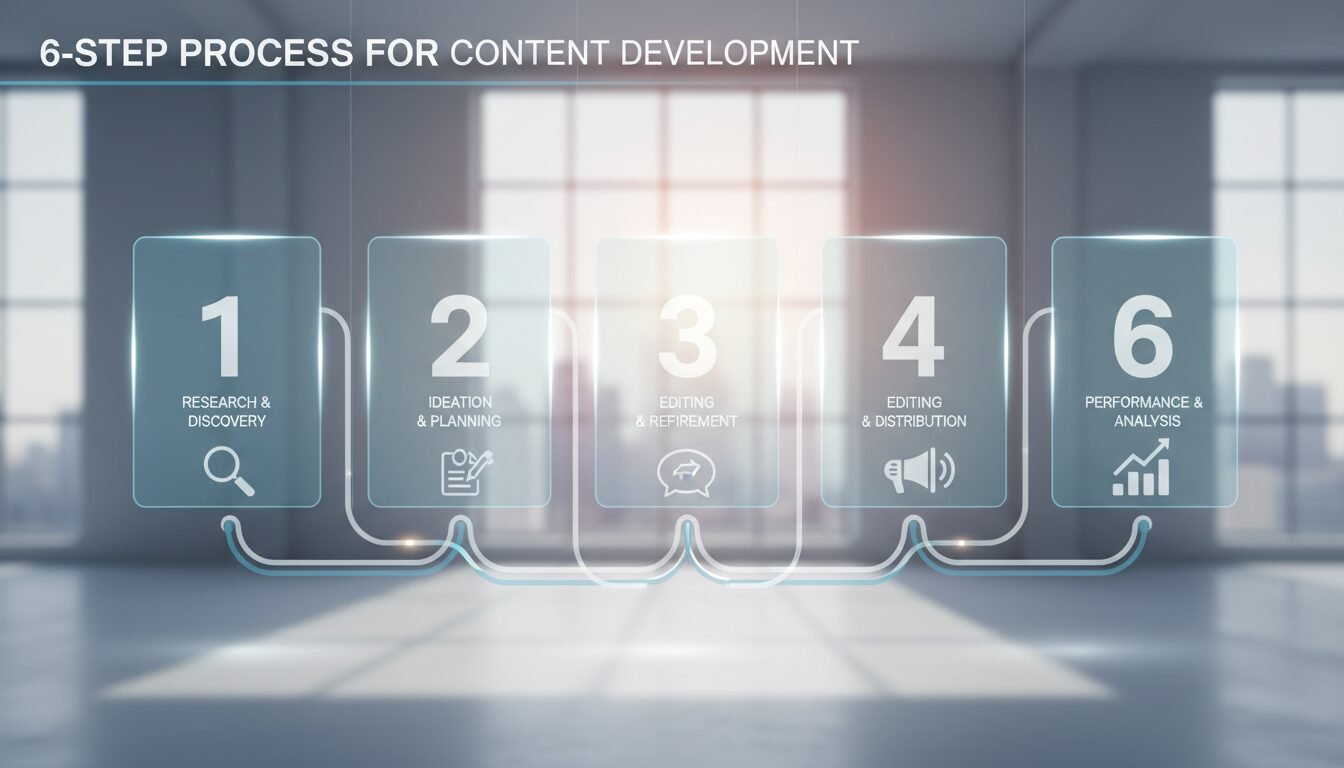
Step 1: Define Goals and Target Audience
Start with the business outcome: increase organic traffic by a specific amount, generate qualified leads per quarter, or reduce churn. Then attach audience specifics. For a B2B SaaS, the primary audience might be IT directors at mid-market firms who consume long-form written content and attend webinars. Documenting these parameters prevents scope creep and keeps the team aligned.
Step 2: Conduct Research and Ideation
Combine keyword research (via Ahrefs or Semrush), social listening, competitor content analysis, and sales team input to build a list of topic candidates. Score each idea against audience relevance, search volume, and business value. The best teams also mine support tickets and customer calls for questions that content can answer, this ensures topics are data-driven, not guesswork.
Step 3: Create a Content Plan and Editorial Calendar
Translate ideation into a living calendar that assigns owners, deadlines, and publication channels. The calendar should balance content types across the funnel, for example, four blog posts per week, two videos per month, and one whitepaper per quarter. Include planned updates for high-performing existing content. Tools like Asana, Trello, or CoSchedule help visualize the pipeline and prevent bottlenecks.
Step 4: Produce High-Quality Content
Production involves writing, designing, recording, or coding the asset. For written content, adherence to brand style guides, tone of voice, and readability best practices is non-negotiable. For video, scripting and storyboarding precede filming. At this stage, AI assistants like Jasper or Grammarly’s generative features can accelerate drafting, but human oversight remains essential for nuance and creativity.
Step 5: Edit, Optimize, and Approve
Editing checks for grammar, flow, and factual accuracy. Optimization layers in SEO elements, meta descriptions, header tags, internal links, and image alt text. For high-stakes assets, a peer review or legal review step may be necessary. Many agencies emphasize a triple-check process to eliminate errors before publication.
Step 6: Publish, Promote, and Measure
Go live according to the calendar, then immediately activate the promotion plan. Use UTM parameters to track the source of traffic and conversions. Within 30 days, review performance against the original goals. Did the whitepaper generate the expected downloads? Did the blog post climb to page one? Use these insights to iterate, update the content, change the promotion channel, or retire the asset if it underperforms.
Strategic vs. Ad-Hoc Creation
Process vs. One-Off Execution
Ad-hoc creation is reactive, a hastily written post triggered by a trending topic or a sudden gap in the calendar. Strategic content development is proactive: every output is planned, researched, and aligned with a documented objective. The former may bring a temporary traffic spike; the latter builds sustainable organic growth and brand equity.
In-House vs. Outsourced Teams
| Aspect | In-House Teams | Outsourced Agencies |
|---|---|---|
| Pros | Deep brand immersion, instant communication, long-term cost efficiency at scale, full control over editorial standards | Access to specialized expertise (SEO, design, video), ability to scale up or down quickly, faster turnaround for large campaigns, often lower initial cost |
| Cons | High fixed costs (salaries, tools), limited skill diversity, management overhead, slower to ramp up new formats | Risk of brand voice inconsistency, potential communication delays, less visibility into day-to-day progress, dependency on vendor reliability |
| Best For | Brands with ongoing, high-volume content needs and a clear, established voice | Companies launching a new website, running a short-term campaign, or needing specialized formats (e.g., animations, interactive eBooks) |
Agencies serve thousands of clients, offering bundled writing, design, and SEO services that can accelerate output when in-house resources are stretched. The choice often hinges on volume and strategic control.
Popular Formats and Their Strategic Value
Blogs and Articles
Articles remain the cornerstone of content development. Typical blog posts range from 800 to 2,500 words and serve as versatile tools for SEO and social media distribution. Regular publishing, three to four times per week, signals freshness to search engines and provides a steady stream of content to repurpose into email newsletters or social snippets.
White Papers and eBooks
White papers deliver deep-dive analysis on industry challenges or solutions. According to NYT Licensing, B2B marketers still use white papers to generate qualified leads, typically by gating them behind a form. eBooks offer a more design-forward alternative, often used at the top of the funnel to educate and engage.
Videos and Podcasts
Video consumption continues to climb, with platforms like YouTube and TikTok shaping B2B as well as B2C expectations. Short explainer videos (2–3 minutes) boost landing page conversions, while webinars provide interactive, mid-funnel value. Podcasts, meanwhile, build deep loyalty through regular, long-form audio, making them excellent for brand authority and thought leadership.
Infographics and Visual Assets
Infographics transform complex data into scannable visuals. They perform well on social media and earn backlinks when other sites embed them. Tools like Canva and Piktochart democratize infographic creation, enabling even small teams to produce professional visuals without a designer. For SEO, well-designed infographics earn backlinks when other sites embed them.
Essential Tools for Modern Teams
Research and Ideation Tools
BuzzSumo reveals top-performing content by topic and domain, while AnswerThePublic maps real user questions. For keyword research, Semrush and Ahrefs provide search volume, difficulty scores, and content gap analysis. These tools turn guesswork into data-driven topic selection, one of the foundational steps of effective content development.
Writing and Editing Software
Grammarly Business goes beyond spell-check to enforce brand tone and style. Hemingway Editor improves readability by flagging complex sentences. AI writing assistants like Jasper and Writesonic can generate first drafts or repurpose content into social posts, though they require human editing to ensure accuracy and brand alignment. A strong process always includes a human review gate.
SEO and Analytics Platforms
Google Search Console and Google Analytics 4 provide the ground truth on organic performance. For page-level optimization, Clearscope and Surfer SEO analyze top-ranking pages and recommend semantic keywords, headings, and word counts. Dashboards in Looker Studio or Databox consolidate metrics from multiple sources, giving managers a real-time view of performance.
How to Measure Success
Key Performance Indicators (KPIs)
Tracking the right KPIs separates effective content development from content clutter. Essential metrics include organic sessions, keyword rankings, time on page, bounce rate, scroll depth, conversion rate, and lead-to-customer velocity. Set baselines for each and monitor trends monthly. An upward trend in “engaged sessions” (GA4 metric) often predicts pipeline growth before lead volume increases.
Attribution and ROI Tracking
Attribution is notoriously tricky, but multi-touch models in CRM systems like HubSpot or Salesforce help assign credit across the buyer journey. Assign a dollar value to key conversions, for example, an email sign-up might be worth a specific amount based on historical lead-to-customer rates. This level of transparency forces accountability and continuous improvement in programs.
The Future: AI and Personalization
AI-Powered Creation and Optimization
Generative AI tools are already drafting meta descriptions, social captions, and even entire blog outlines. In 2026, the frontier is AI that not only writes but also tailors tone, reading level, and imagery to individual reader profiles in real time. Platforms like Adobe Express and Canva now embed generative AI that suggests layouts and copy variations during creation. But AI’s role should remain assistive, authentic insight, storytelling, and brand voice still require human judgment.
Hyper-Personalization at Scale
Personalization at scale is the holy grail of content development. By combining first-party data, behavioral signals, and AI, brands can serve unique content experiences, customized landing pages, email sequences, and even dynamic blog content, that shift based on industry, role, or past behavior. This requires a robust content architecture with modular, reusable components (often called “content blocks”) that can be assembled on the fly. Companies investing in this now are seeing meaningful engagement lifts over generic content.
Conclusion: Building for Long-Term Growth
Content development is not a campaign with an end date; it’s a permanent business function. Brands that treat it as an ongoing investment, staffing appropriately, adopting the right tools, and iterating based on data, will dominate their categories. The frameworks, tools, and formats discussed here provide a launchpad. Start with a documented strategy, execute consistently, and let measurement guide your evolution.
If you’re building or scaling your content engine, consider taking a structured course to deepen your skills. Coursera’s Adobe Marketing Specialist Professional Certificate, which has enrolled over 24,000 learners and holds a 4.7-star rating from 3,124 reviews, covers content strategy, branding, and generative AI, a practical way to future-proof your capabilities. The businesses that win in the next decade will be those that commit to content development not as a task, but as a core competitive strategy.
Connect with Amin to discuss AI strategy for your business.
Frequently Asked Questions
What is content development?
Content development is the end-to-end process of researching, creating, editing, optimizing, and distributing content to achieve specific business goals. It encompasses strategy, production, and performance measurement.
How is content development different from content creation?
Content creation is a subset, it focuses on producing the asset itself. Content development includes upstream activities like audience research and goal-setting, as well as downstream activities like optimization and analytics.
Why is a content development strategy important?
A documented strategy aligns content efforts with business objectives, prevents resource waste, and ensures consistency across channels. Without it, teams risk producing content that fails to move the needle.
What are the most common content development formats?
Formats range from short-form (blogs, social posts) to long-form (white papers, eBooks) to multimedia (videos, podcasts, infographics). The best mix depends on your audience and goals.
What tools support content development?
Tools span the entire lifecycle: research (Semrush, BuzzSumo), writing (Grammarly, Jasper), design (Canva, Adobe Express), project management (Asana, Trello), and analytics (Google Analytics 4, Looker Studio).
Can AI replace human content developers?
AI can accelerate research, drafting, and personalization, but it cannot replace strategic thinking, brand storytelling, or editorial judgment. The most effective content development blends AI efficiency with human creativity.
Enjoyed this article?
Connect with me for collaboration, ventures, or just a good conversation about building things.
Get in Touch