Consultant Business Management: What It Is & How It Works

Consultant business management is the professional practice of partnering with organizations to analyze problems, streamline operations, and implement strategies that drive measurable growth. It’s one of the most consequential fields in business, and I’ve seen it transform companies that were stuck into ones that scale.
Key Takeaways
- The U.S. management consulting industry spans roughly 90,000 firms and generates approximately $307 billion in annual revenue.
- Core services include strategy, operations, finance, technology, and organizational design.
- Over 1 million professionals work in this field, with average salaries around $94,602 and top earners commanding well above that.
- AI and digital transformation are reshaping how consulting delivers value, shifting focus from data gathering to strategic interpretation.
- Certifications like the CMC and PMP strengthen credibility; a bachelor’s degree is the typical entry point, with roughly 31% of consultants holding a master’s.
- Choosing the right partner means evaluating industry expertise, cultural fit, and commitment to measurable outcomes.
What Is Consultant Business Management?
Consultant business management is an advisory discipline that helps companies optimize how they operate across every major function. Unlike niche specialists who focus on a single department, management consultants evaluate the entire business: strategy, operations, finance, HR, and technology. The goal is to identify root causes of underperformance and design integrated solutions that actually stick. According to the University of Phoenix, the role involves helping companies work smarter, cut unnecessary costs, and improve profitability in ways internal teams often can’t see on their own.
Management consultants bring an external, data-driven perspective that internal teams frequently lack due to organizational bias or day-to-day tunnel vision. The New York Small Business Development Center (NYSBDC) reports that the U.S. industry includes around 90,000 firms generating approximately $307 billion in annual revenue. That scale tells you everything about how critical this function is across sectors.
Defining the Role
Management consultants act as temporary force multipliers for leadership teams. They diagnose bottlenecks, facilitate change, and sometimes embed themselves in projects until sustainable systems are handed off. Key responsibilities include gathering and analyzing data, presenting actionable recommendations, and assisting with implementation. A 2023 estimate placed the number of management consultants at roughly 1 million in the U.S., with 35% employed in professional, scientific, and technical services and 14% self-employed.
The Difference Between Business and Management Consulting
Business consulting tends to focus on specific problem areas like market entry or sales strategy. Management consulting, by contrast, encompasses broader organizational and operational improvements. Management consultants typically engage with C-suite executives to reshape structures, processes, and long-term strategic direction. It’s a more comprehensive discipline, and the distinction matters when you’re deciding who to hire.
Why Organizations Hire Management Consultants
Companies seek external expertise for three primary reasons: an objective diagnosis they can’t achieve internally, specialized skills not present in their workforce, or the bandwidth to accelerate critical initiatives. Whether navigating a merger, a digital overhaul, or a performance turnaround, a seasoned consulting firm brings proven frameworks that reduce risk and compress timelines.
The Core Services and Expertise Areas
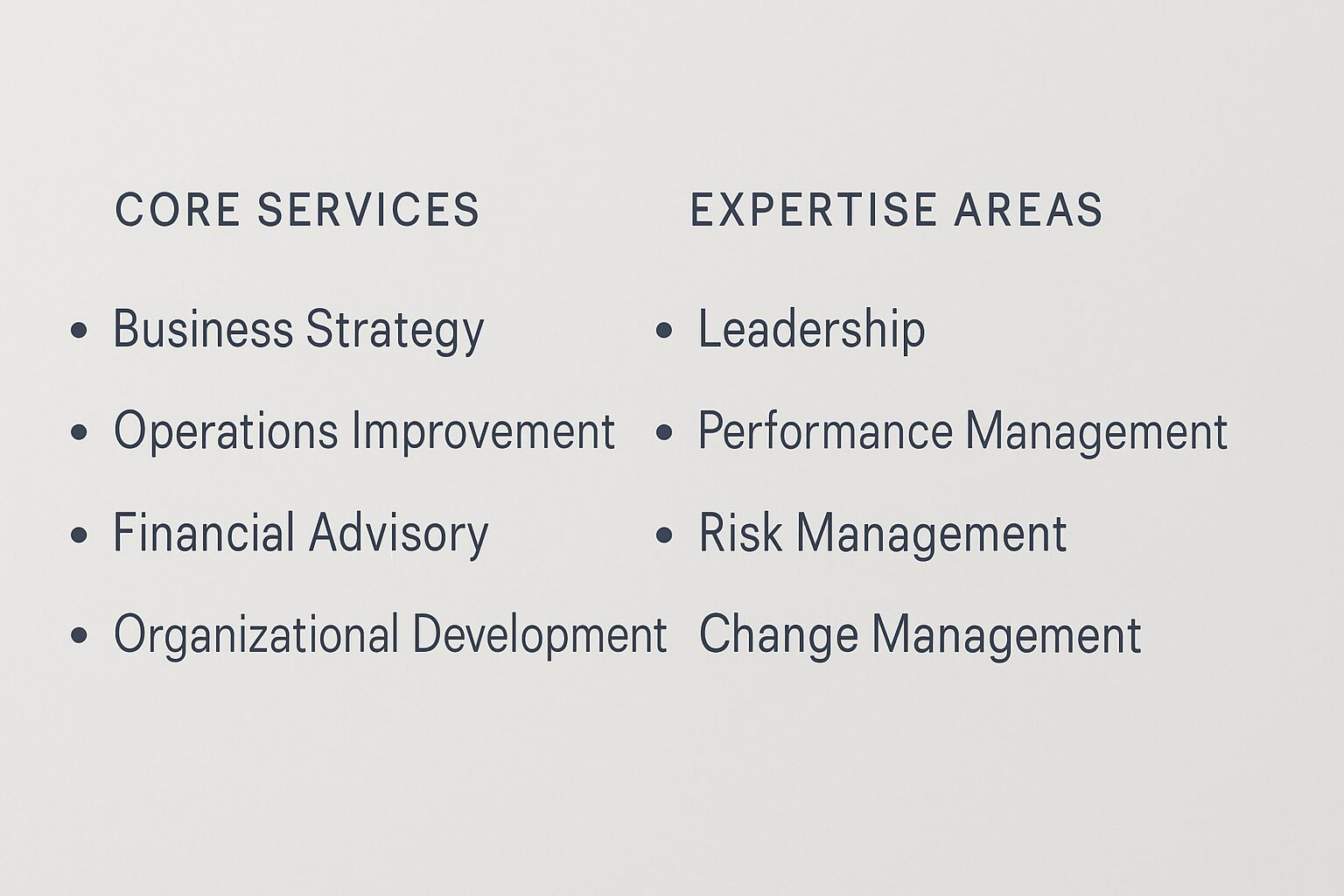
Consultant business management services span a wide spectrum, tailored to the client’s life stage and industry. Top-tier firms like McKinsey, Bain, and BCG offer multi-disciplinary teams, while boutique specialists focus on niches like healthcare logistics or family business succession. The following areas represent the most common engagement types.
Strategic Planning and Market Positioning
Consultants help leadership teams define a clear vision, assess market opportunities, and build competitive roadmaps. This involves quantitative analysis of market share, customer segmentation, and growth vectors. Outputs often include strategic plans, scenario models, and prioritized investment theses. A consulting team might guide a regional retailer through an e-commerce transformation, aligning digital investments with existing brick-and-mortar assets.
Operational Efficiency and Cost Optimization
Operational consulting targets waste, bottlenecks, and quality variances. Using methodologies like Lean and Six Sigma, consultants map workflows, identify redundancies, and redesign processes to cut cycle times and improve margins. Per NYSBDC, about half of corporate transformation initiatives fail to meet their objectives, often because they lack the disciplined execution that an experienced consulting team enforces.
Organizational Design and Change Management
As companies scale, structures that once worked become liabilities. Consultants evaluate reporting lines, decision rights, and talent gaps to propose organizational models that increase accountability and speed. Change management, which means building buy-in, running training, and reinforcing new behaviors, is integral to ensuring recommendations actually stick. Post-merger integration engagements are a growing category here, where cultural alignment is as critical as system consolidation.
The Strategic Impact of Consultant Business Management

Beyond solving immediate problems, effective consulting builds organizational muscle. Clients who invest in deep diagnostic work and capability transfer gain long-term agility. I’ve seen midsize tech firms cut customer churn by roughly 20% not by launching a new feature, but by reengineering their onboarding process. That hidden lever only surfaced through rigorous management consulting work.
“In my 15 years scaling AI-driven startups, the right consulting engagement has been the difference between chaotic growth and strategic scaling. A great consultant doesn’t just advise. They become a force multiplier for your leadership team, transferring skills that pay dividends long after the engagement ends.” – Amin Ferdowsi, founder and tech entrepreneur
“The best consulting relationships I’ve seen treat knowledge transfer as a deliverable, not an afterthought. When the engagement ends, the client should be more capable than when it started.” – based on practitioner consensus across Y Combinator and a16z portfolio discussions
Financial and Risk Management Consulting
Financial consultants address cash flow, capital allocation, and risk exposure. They might redesign pricing models, streamline budgeting processes, or prepare a company for due diligence. In highly regulated industries, the work extends to compliance frameworks and cybersecurity governance, ensuring that growth doesn’t outstrip controls.
Technology and Digital Transformation
IT consulting is now intertwined with strategy. From cloud migration to AI deployment, consultants guide architecture decisions and vendor selection. The NYSBDC notes that digital transformation remains a top growth area for the industry, but also warns that clients increasingly adopt in-house AI tools. This shifts the value of consulting toward interpretation and strategy rather than raw data analysis.
Customer Experience and Revenue Growth
Consultants also tackle top-line challenges: declining satisfaction, high churn, or ineffective marketing spend. By analyzing customer journeys and market data, they prescribe loyalty programs, omnichannel strategies, and service redesigns. In one engagement I’m familiar with, a SaaS company improved net revenue retention by roughly 15% through tiered support offerings, an outcome tied directly to systematic discovery work.
Industry Analysis: $307 Billion and Growing

The consultant business management industry is both massive and fragmented. According to NYSBDC, the top 50 firms account for only 41% of total revenue, leaving substantial room for boutiques and independents. This fragmentation fuels specialization: a healthcare consultancy can thrive alongside a global operations firm because the problems are genuinely different.
| Service Area | Focus | Key Benefits | Example Activities |
|---|---|---|---|
| Strategy | Long-term direction, market positioning | Clear growth roadmap, risk mitigation | Competitive analysis, scenario planning |
| Operations | Process efficiency, supply chain | Cost reduction, quality improvement | Lean workshops, bottleneck analysis |
| Financial | Capital allocation, restructuring | Improved cash flow, compliance | Due diligence, pricing model design |
| Technology | Digital transformation, cybersecurity | Tech modernization, risk reduction | Cloud roadmaps, ERP implementation |
| Organizational | Structure, talent, culture | Agility, retention, leadership alignment | Org redesign, change management plans |
MBB vs. Big Four: Choosing Your Consulting Partner
The consulting market splits into two dominant tiers. McKinsey, Bain, and BCG (collectively called MBB) are known for strategy-heavy engagements with Fortune 500 clients, typically commanding the highest day rates in the industry. The Big Four accounting firms, Deloitte, PwC, EY, and KPMG, have built massive consulting arms that compete on breadth, particularly in technology implementation, finance transformation, and regulatory compliance. For most mid-market companies, the real choice is between a Big Four firm’s scale and a boutique’s specialization. Neither is universally better. It depends entirely on the problem you’re solving.
Growth Drivers and Emerging Demands
Sustainability consulting, AI integration, and workforce resilience are reshaping demand. Climate-related risk assessments are becoming mandatory for many firms, and consulting providers are racing to build ESG practices. The talent competition is real: the average salary for a management consultant is $94,602, per career data from the Alabama Association of Nonprofits, reflecting fierce competition for skilled advisors.
Competitive Pressures and the Rise of In-House Teams
Clients now build internal consulting groups, directly challenging traditional firms. AI tools also enable self-service analytics that once required an external team. Even so, consultant business management remains essential for complex, high-stakes problems where pattern recognition and cross-industry insight matter most. The ability to synthesize data into actionable narratives is the new frontier.
AI and Digital Transformation in Consultant Business Management
Technology isn’t just a service line anymore. It’s a structural shift in how consulting works. AI-driven platforms now handle routine data gathering, freeing consultants to focus on interpretation and decision architecture. I’ve implemented machine learning models that reduced diagnostic phases from weeks to hours, yet the biggest value still comes from the strategic conversations those insights unlock.
How AI Augments Traditional Consulting
Predictive analytics can forecast customer churn, supply chain disruptions, or cash flow gaps before they become crises. Consulting teams that blend AI fluency with industry expertise deliver preemptive solutions rather than reactive fixes. Natural language processing also speeds up competitive intelligence, scanning thousands of documents to surface trends that would take a human analyst weeks to find.
The Risk of Automation Fatigue
Not all tech adoption goes smoothly. The NYSBDC highlights “transformation fatigue,” with employees weary from constant change initiatives, roughly half of which fail to meet their stated objectives. Effective consulting must balance technological ambition with human-centered design, ensuring that tools enhance rather than overwhelm the workforce. As of 2026, this tension is one of the defining challenges in the field.
Pros and Cons
Pros
- Objective perspective: External consultants surface problems that internal teams miss due to proximity and organizational politics.
- Specialized expertise on demand: You get access to cross-industry pattern recognition without the cost of a full-time hire.
- Accelerated execution: Proven frameworks compress timelines on initiatives that would otherwise take years to design internally.
- Capability transfer: The best engagements leave the client team more capable than before, not dependent on the consultant.
- Scalable engagement models: Project-based, retainer, or performance-fee structures let you match cost to risk appetite.
Cons
- High cost: Boutique consultants often charge $2,000 to $5,000 per day, and large firm engagements can run into the millions.
- Implementation risk: Recommendations without strong change management frequently fail. The consultant leaves; the org reverts.
- Cultural friction: External advisors can create resistance if employees feel their expertise is being dismissed or replaced.
- Dependency risk: Poorly structured engagements can create reliance on the consultant rather than building internal capability.
Steps to Build a Career in Management Consulting
Becoming a management consultant is a proven path to executive leadership. Many consultants use their experience to launch ventures or step into C-suite roles. The journey typically starts with education and hands-on problem-solving, and it rewards people who can combine analytical rigor with the ability to communicate clearly under pressure.
Educational Foundations and Certifications
A bachelor’s degree in business, economics, or engineering is the baseline. About 41% of consultant business management roles require a bachelor’s degree, while roughly 31% require a master’s, per data from the Alabama Association of Nonprofits. Certifications like the Certified Management Consultant (CMC) from the Institute of Management Consultants require at least three years of relevant experience and signal adherence to ethical standards. The Project Management Professional (PMP) certification is also widely valued, particularly for consultants who lead complex implementation projects. Lean Six Sigma credentials further differentiate candidates in operations-focused roles.
Step-by-Step Path to Entry
Step 1: Earn a relevant bachelor’s degree with strong analytical coursework.
Step 2: Gain industry experience through internships or operational roles to build domain knowledge.
Step 3: Develop core consulting skills: data analysis, structured storytelling, and executive presence.
Step 4: Join a consulting firm or launch an independent practice.
Step 5: Pursue advanced credentials like the CMC or PMP and specialize to command higher fees.
Top Skills Employers Demand
Based on job postings analyzed by the Alabama Association of Nonprofits, the most requested skills are management (13% of listings), leadership (11%), planning (8%), and consulting (7%). This confirms that consultant business management is as much about influence and execution as it is about analysis. You can’t just be right. You have to get people to act on it.
Consulting Fees and Pricing Models
Pricing in consulting varies more than most clients expect. Boutique consultants typically charge $2,000 to $5,000 per day, while large firms like McKinsey or Deloitte command premium rates for specialized or large-scale engagements. Independent consultants often price on monthly retainers ranging from $5,000 to $20,000 depending on scope. Performance-based fees, where the consultant earns a percentage of documented savings or revenue gains, are growing in popularity because they align incentives. Whatever model you choose, define measurable KPIs before signing. Vague scope is how engagements go sideways.
Choosing the Right Consultant Business Management Partner
Selecting a consultant is a strategic decision, not a procurement exercise. The right firm accelerates change. The wrong one wastes time, budget, and trust. Key criteria include relevant industry experience, cultural compatibility, and a proven methodology for knowledge transfer. Avoid partners who promise cookie-cutter solutions. Every business has a unique set of constraints and opportunities.
Evaluating Track Record and References
Request case studies that demonstrate measurable impact on challenges similar to yours. A legitimate consulting firm will openly discuss both successes and failures. Speak with past clients to understand what it’s like to work with them after the contract is signed, not just during the sales process.
Engagement Models: Project vs. Retainer
Consultants work on a project basis, monthly retainers, or performance-based fees. Short-term diagnostics can uncover quick wins, while transformational engagements often span 6 to 18 months. Align the model with your risk appetite and cash flow. For consultant business management to deliver real ROI, expectations must be defined in measurable KPIs from day one.
If you’re thinking through AI strategy or business transformation for your own venture, I write about the intersection of technology and entrepreneurship regularly. You might also find value in exploring how AI infrastructure decisions connect directly to the consulting frameworks covered here.
Ready to think through your own strategy? Connect with me to discuss how these principles apply to your specific situation.
Frequently Asked Questions
What exactly does a business management consultant do?
A business management consultant partners with organizations to analyze problems, improve processes, and implement strategies that boost performance and profitability. The role spans everything from strategic planning and operational redesign to technology implementation and change management.
How much does a business management consultant cost?
Fees vary widely by firm size and engagement scope. Boutique consultants typically charge $2,000 to $5,000 per day, while larger firms command premium rates for specialized expertise. Monthly retainers for independent consultants often range from $5,000 to $20,000.
What is the difference between a business consultant and a management consultant?
Business consultants often address specific issues like marketing or sales strategy, while management consultants focus on broader organizational and operational improvements. Management consulting typically involves C-suite engagement and longer-term structural change.
What qualifications do I need to become a management consultant?
A bachelor’s degree is the standard entry point, with roughly 31% of roles preferring a master’s degree. Certifications like the CMC from the Institute of Management Consultants and the PMP strengthen candidacy, with the CMC requiring at least three years of relevant experience.
How is AI changing the consulting industry?
AI automates data gathering and routine analysis, shifting consultant value toward strategic interpretation, change management, and human-centered solution design. As of 2026, the firms winning the most work are those that combine AI fluency with deep industry expertise, not those that rely on either alone.
What industries hire the most management consultants?
Professional services, government, finance, and technology are the top sectors, with 35% of consultants employed in professional, scientific, and technical services. Healthcare and manufacturing are rapidly growing segments as both industries face significant operational and regulatory pressure.
Enjoyed this article?
Connect with me for collaboration, ventures, or just a good conversation about building things.
Get in Touch