Campaign Finance: Political Money Guide 2026
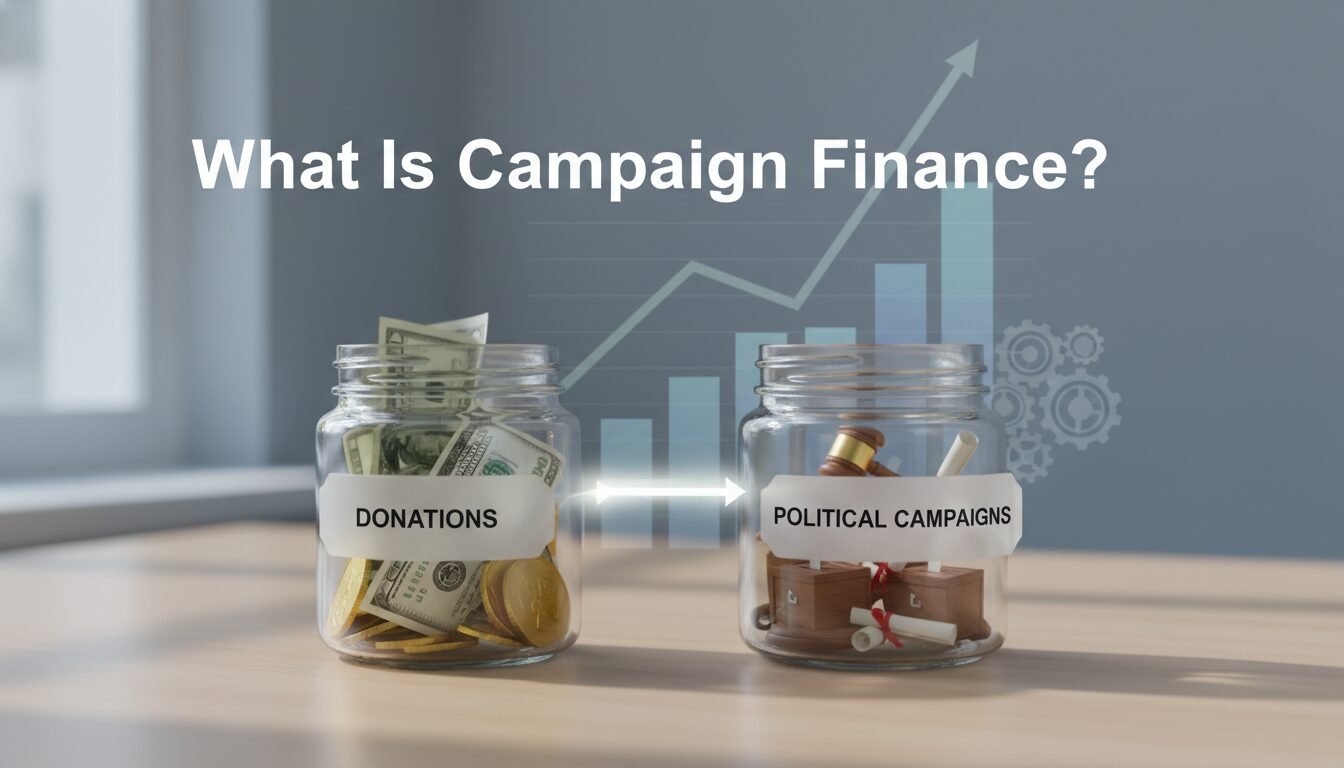
Campaign Finance: Political Money Guide 2026
Campaign finance is the funding of electoral campaigns, covering donations, spending, and public disclosures. The Federal Election Commission (FEC) tracks this money to ensure transparency, with public reports available for all federal races.
Key Takeaways
- Campaign finance includes all money raised and spent in political elections at federal, state, and local levels.
- The Federal Election Commission (FEC) maintains a public database of contributions and expenditures for federal candidates and committees.
- Private funding dominates U.S. elections, but public financing options exist in some states and cities, including New York City’s small-donor matching program.
- Super PACs and dark money groups have raised serious transparency concerns after the Citizens United ruling in 2010.
- Voters can search campaign finance reports online at fec.gov to track who funds their representatives.
What Is Campaign Finance?
Definition and Core Components
Campaign finance, also known as election finance or political donations, refers to the funds raised to promote candidates, political parties, or policy initiatives and referendums. It covers every dollar contributed by individuals, corporations, labor unions, and political action committees, as well as spending on advertising, staff, travel, and voter outreach. In the United States, the system is primarily regulated at the federal level by the FEC, which enforces limits and disclosure rules under the Federal Election Campaign Act.
Transparency in campaign finance helps voters understand who is attempting to influence elections. According to the Federal Election Commission, all contributions exceeding $200 must be reported with donor name, address, occupation, and employer, while contributions over $2,000 trigger heightened reporting requirements. The FEC’s website provides tools to compare candidate fundraising, explore committee profiles, and trace individual contributions, making this data more accessible than ever before.
The Role of Money in Elections
Running for office is expensive. Candidates need money for television ads, digital campaigns, mailers, and field operations. Academic research shows that 23% of statewide candidates spend more than half their scheduled time on fundraising, and over 50% spend at least a quarter of their time raising money. Those numbers illustrate how fundraising demands can pull candidates away from governance and voter engagement.
In many other democracies, governments provide free or subsidized media access, reducing the burden on candidates. Several European countries give political parties blocks of free television time. The U.S. model, by contrast, requires campaigns to purchase advertising directly, making fundraising capability a critical factor in electoral success.
“The current system unfairly stacks the deck in favor of the few donors able to give large contributions.” – Brennan Center for Justice
How Campaign Finance Works in the United States

Federal Campaign Finance Laws
The modern framework for federal campaign finance began with the Federal Election Campaign Act (FECA) of 1971, amended in 1974 to create the FEC and impose contribution limits and disclosure requirements. The Bipartisan Campaign Reform Act (McCain-Feingold) of 2002 attempted to regulate “soft money” spent by political parties. Then the Supreme Court’s 2010 decision in Citizens United v. FEC struck down many restrictions, allowing corporations and unions to spend unlimited amounts on independent political advertising.
Today, the FEC oversees thousands of candidate committees, party committees, and political action committees. All must file regular reports detailing receipts and disbursements. The agency also provides a public API and bulk data downloads for researchers and journalists, reinforcing the role of open data in democratic accountability.
Hard Money vs. Soft Money
Hard money refers to contributions made directly to a candidate’s campaign, subject to strict limits and full disclosure. These funds can only be spent on activities that expressly advocate for the candidate’s election or defeat. Soft money was historically donated to political parties for “party-building” activities like voter registration drives and was less regulated. Although McCain-Feingold banned soft money contributions to national parties, court decisions since then have opened new avenues for unlimited spending through outside groups.
Contributions of $2,000 or more trigger heightened reporting requirements. The FEC’s searchable database highlights these large donations, helping watchdog organizations like OpenSecrets track major donors and illuminate patterns in political funding.
Super PACs and Dark Money
Since 2010, Super PACs (independent expenditure-only committees) have become prominent players. They can raise unlimited sums from corporations, unions, and individuals, but must not coordinate directly with candidates. Alongside them, dark money groups (primarily 501(c)(4) social welfare organizations and 501(c)(6) trade associations) spend millions without disclosing their donors’ identities. OpenSecrets reported in May 2026 that dark money organizations poured significant sums into redistricting battles, demonstrating their growing role in shaping policy beyond candidate elections.
A Campaign Legal Center complaint in 2026 alleged that certain committees illegally funneled millions through shell companies to hide the true recipients of campaign spending, underscoring the need for stronger enforcement.
“Dark money allows wealthy special interests to influence elections anonymously, making it nearly impossible for voters to evaluate the credibility of political ads.” – OpenSecrets, 2026 analysis
Pros and Cons of the Current Campaign Finance System

Pros
- Broad participation: Private financing allows any individual to contribute to candidates they support, encouraging civic engagement across income levels.
- Public disclosure: Federal law requires detailed reporting for contributions over $200, giving journalists and watchdog groups real data to work with.
- Competitive fundraising: Candidates who build large small-donor bases can demonstrate grassroots support, as seen in several 2026 Senate races.
- Open data access: The FEC’s public API and bulk downloads let researchers, journalists, and citizens analyze political money flows independently.
Cons
- Wealthy donor influence: Large contributions from corporations and Super PACs give well-funded interests disproportionate access to policymakers.
- Dark money loopholes: 501(c)(4) and 501(c)(6) organizations can spend hundreds of millions without disclosing donors, undermining transparency.
- Fundraising time burden: 23% of statewide candidates spend more than half their time raising money, pulling focus away from constituent services.
- Coordination gray areas: The line between legal independent spending and illegal coordination with candidates remains contested and difficult to enforce.
Key Players and Entities in Political Funding

Candidates and Committees
Candidates form principal campaign committees to manage their election finances. These authorized committees must register with the FEC or state agencies, appoint a treasurer, and submit periodic reports. As of mid-2026, the Federal Election Commission lists Sen. T. Jonathan Ossoff (D-GA), James Talarico (D-TX), and Sen. Cory A. Booker (D-NJ) among the top-raising Senate candidates, a real-time snapshot of competitive fundraising in action.
Political action committees (PACs) include connected PACs (associated with corporations or unions), non-connected PACs (ideological groups), and leadership PACs (established by incumbent officeholders to support other candidates). Each type plays a distinct role in the broader funding ecosystem.
Super PACs and Independent Expenditure Groups
Super PACs may accept unlimited contributions as long as they do not coordinate with candidates. They frequently run attack ads and issue advocacy campaigns. Prominent Super PACs aligned with party leadership have raised and spent hundreds of millions in recent presidential cycles, making them a central focus of reform debates.
Dark Money Organizations
Dark money is spent by nonprofits not required to disclose their donors. These groups expanded significantly after Citizens United, with spending reaching hundreds of millions of dollars across U.S. presidential elections. Per the Brennan Center for Justice, such secret spending undermines voter confidence and enables special interests to dominate political discourse.
Public vs. Private Campaign Financing
Private Financing Models
In a private financing system, candidates rely on contributions from individuals, corporations, unions, and PACs. This model encourages broad participation but critics argue it gives wealthy donors disproportionate influence. Federal law mandates that campaigns report the name, address, occupation, and employer of contributors who give more than $200. State-level rules vary: Texas, for example, may redact certain personal information from online reports to protect privacy.
Public Financing Systems
Public financing uses government funds to support political campaigns. This can take the form of direct grants to parties (as in Germany), matching funds for small donations (as in New York City’s program), or tax credits for political contributions. The Brennan Center for Justice advocates small-donor matching systems, which amplify the impact of low-dollar contributions and reduce reliance on large donors.
Proponents argue that public financing reduces corruption and lets candidates focus on constituents rather than fundraising. Critics point to the cost to taxpayers and potential government entanglement in political speech. The debate remains active at both state and federal levels heading into 2026.
Comparing Financing Models
| Financing Model | Source of Funds | Donor Limits | Disclosure Level | Example |
|---|---|---|---|---|
| Private | Individuals, corporations, unions | Vary; federal limits (e.g., $2,900 per election) but Super PACs unlimited | High for direct contributions; weak for dark money | U.S. federal elections |
| Public Grant | Government budget | Often spending limits | High (transparent allocation) | German political parties |
| Small-Donor Matching | Mix: small private donations + government match | Donor limits, often low | High | New York City campaign finance system |
| Hybrid | Private contributions with public subsidies | Variable | Moderate to high | Sweden |
How to Search and Analyze Campaign Finance Data
Using the FEC Database
The FEC’s website makes it straightforward for anyone to explore political funding records. Follow these steps:
- Step 1: Go to fec.gov/data.
- Step 2: Use the search bar to look up a candidate, committee, or individual contributor by name or ID.
- Step 3: Filter results by year, office, or contribution amount. You can display all contributions over $2,000 or only those in the current cycle.
- Step 4: Review summary tables for total raised and spent, then click into detailed reports to see individual contributions and expenditures.
- Step 5: Download raw data or explore via the OpenFEC API for custom analysis.
State-Level Search Tools
Many states offer their own portals for transparency. The Texas Ethics Commission provides a simple search by filer name or treasurer, and requires special pre-election (telegram) reports within 30 days of an election for contributions of $1,000 or more. Reports show contributions and expenditures, though pre-2008 paper filings may not be available online. The Idaho Secretary of State runs a Campaign Finance Portal where candidates and PACs register and file reports that the public can view. North Carolina’s State Board of Elections links to a committee report search system and provides treasurer training resources, along with restrictions on fundraising during the legislative session.
Interpreting Disclosure Reports
Key details to look for include the donor’s name, contribution amount, date, and employer/occupation. Large, recurring donations from a particular industry can signal potential influence. Expenditure reports reveal how campaigns spend their money: on media buys, consulting, or administrative costs. Independent expenditure reports from Super PACs reveal outside spending not controlled by the candidate.
The Impact of Campaign Finance on Democracy
Wealthy Donors and Political Influence
A core concern is that big donors gain greater access to policymakers. The Brennan Center notes that the current system “unfairly stacks the deck in favor of the few donors able to give large contributions.” Studies suggest that while most donors give to candidates they already support, widespread public perception that donations buy influence erodes trust in government and fuels demand for reform.
Transparency and Voter Information
Public disclosure of political funding data is designed to let voters assess who is behind political messages. The FEC’s effort to make data accessible helps journalists and watchdog groups highlight conflicts of interest. But the growth of dark money, where donors remain hidden, undermines this transparency. OpenSecrets has documented hundreds of millions in dark money spending across presidential cycles, making it difficult for voters to evaluate the credibility of political ads.
Reform Efforts and Future Trends
Reform advocates push for measures such as the DISCLOSE Act to require more donor transparency, stronger FEC enforcement, and public financing programs at state and local levels. The Campaign Legal Center has filed complaints and lawsuits to close loopholes, including a 2026 challenge to an FEC advisory opinion permitting coordinated canvassing. Small-donor matching systems in places like New York City show real promise in shifting the balance away from large donors toward a more inclusive model.
Campaign Finance by the Numbers
Top Fundraisers in the 2026 Election Cycle
As of mid-2026, the Federal Election Commission lists Sen. T. Jonathan Ossoff (D-GA), James Talarico (D-TX), and Sen. Cory A. Booker (D-NJ) among the top-raising Senate candidates. Their financial reports are available on FEC.gov for detailed comparison, a real-time illustration of competitive political fundraising in action.
Dark Money Spending Growth
Dark money has become a fixture of modern elections. In each U.S. presidential election, such groups spend hundreds of millions of dollars on ads and voter outreach. OpenSecrets’ May 2026 investigation revealed dark money involvement in redistricting battles, indicating that these organizations extend well beyond candidate campaigns into structural political fights.
Fundraising Time Burden on Candidates
The pressure to raise funds is relentless. As noted earlier, 23% of statewide candidates devote over half their time to fundraising, and more than half spend at least 25% of their time on it. This reality often forces public servants to prioritize donor outreach over constituent services, raising fundamental questions about how the system should be redesigned.
Frequently Asked Questions
What is campaign finance?
Campaign finance is the system of raising, collecting, and spending money for electoral campaigns. It encompasses donations from individuals and groups, as well as the rules governing how those funds are used and reported to the public.
How can I look up campaign finance reports?
Federal reports are available at fec.gov/data. State and local reports can be found on state ethics commission or secretary of state websites. You can search by candidate name, committee, or contributor.
What is the difference between hard money and soft money?
Hard money refers to contributions made directly to candidates, which are limited and disclosed. Soft money is unregulated spending, often by interest groups or parties, typically used for broader political messaging not directly coordinated with a candidate.
What are Super PACs?
Super PACs, or independent expenditure-only committees, can raise unlimited amounts from corporations, unions, and individuals but are prohibited from coordinating directly with candidates. They were made possible by the Citizens United Supreme Court decision in 2010.
What is dark money in politics?
Dark money is political spending by nonprofit organizations that are not required to disclose their donors. This allows wealthy special interests to influence elections anonymously, which critics argue undermines transparency and accountability in the democratic process.
How does public campaign financing work?
Public financing uses government funds to support campaigns. Some systems match small donations at a multiple (e.g., 6-to-1 in New York City), while others provide flat grants to qualifying candidates. The goal is to reduce dependence on large private donors and encourage broader participation.
Enjoyed this article?
Connect with me for collaboration, ventures, or just a good conversation about building things.
Get in Touch