Blockchain in Warehouse & Supply Chain: 2026 Guide
Blockchain technology in warehouse management and supply chain is a decentralized ledger system that records every inventory movement, transaction, and handoff as a permanent, tamper-proof entry shared across all network participants.
Key Takeaways
- supply chain provides a tamper-proof, shared ledger that enhances transparency and accountability across all network participants.
- Smart contract automation can reduce operational costs by up to 30% and improve demand forecasting accuracy, based on enterprise deployments tracked by Deloitte.
- The MHI Annual Industry Report projects that 68% of logistics companies will adopt blockchain within five years, driven by the need for supply chain resilience.
- Integration with IoT, AI, and existing ERP systems turns blockchain into an add-on layer that amplifies data security without requiring a complete infrastructure overhaul.
- Challenges like scalability, interoperability, and high initial investment remain, but Layer-2 solutions and permissioned networks are actively closing those gaps.
- The blockchain supply chain market was valued at under $1 billion in 2024 and is projected to surpass $6 billion by 2029, a six-fold increase.
I’ve spent years watching supply chain operators drown in spreadsheet reconciliations, disputed invoices, and counterfeit goods slipping through the cracks. The problem isn’t effort. It’s architecture. Traditional systems were built for a world where each company owned its own data and trusted no one else’s. That model breaks down the moment your supply chain crosses three time zones and six partners.
Supply chain disruptions cost businesses an estimated $4 trillion annually. From raw material sourcing to last-mile delivery, traditional systems struggle with data silos, counterfeiting, and operational waste. this type of chain addresses this directly by providing a single source of truth that is secure, transparent, and automated. What follows is a practical breakdown of how warehouses and logistics providers can use blockchain for real competitive advantage, drawing on insights from MHI, Deloitte, Ernst and Young, and enterprises already running production deployments.
What is Blockchain?
Blockchain is a decentralized digital ledger that records transactions across a network of computers, making it structurally resistant to tampering or unilateral revision.
A Decentralized Ledger Explained
Each transaction is grouped into a “block,” which is then cryptographically linked to the previous one, forming an immutable “chain.” Unlike a traditional database managed by a central authority, a blockchain is distributed across thousands of nodes that collectively validate and maintain the ledger. This structure makes it virtually impossible for any single entity to alter a record without consensus. According to Prologis, “each block is secured and bound to each other using cryptographic principles,” ensuring data integrity at every step.
Core Principles: Immutability, Transparency, Consensus
The three pillars of blockchain are immutability (once data is added, it cannot be changed), transparency (all participants view the same ledger), and consensus (changes are validated by a majority of nodes). In a supply chain context, these principles eliminate the need for intermediaries to reconcile disparate records. A permissioned blockchain such as Hyperledger Fabric or R3 Corda offers the additional control of restricting data access to authorized parties, making it ideal for warehouse operations where sensitive supplier information must be protected.
Public vs. Permissioned Blockchains: Which Fits Your Warehouse?
Public blockchains like Ethereum are fully open. Anyone can join, read, and validate. While highly secure and decentralized, they process roughly 15-30 transactions per second (TPS), which creates a bottleneck for high-volume fulfillment centers. Permissioned (consortium) blockchains, governed by a known set of members, can handle thousands of TPS, offer lower latency, and keep data confidential among partners. For most warehouse and supply chain applications, a permissioned or hybrid model is the practical choice. The blockchain supply chain market was valued at under $1 billion in 2024 and is projected to surpass $6 billion by 2029, a six-fold increase fueled largely by enterprise-focused permissioned networks.
Benefits of Blockchain Technology in Warehouse Management and Supply Chain
this kind of supply chain delivers measurable gains across visibility, security, and process automation, often without replacing the systems already in place.
Real-Time Inventory Visibility
Traditional inventory systems update in batches, creating a lag between actual stock levels and what the system reports. Blockchain eliminates this gap by reflecting every pickup, putaway, and transfer immediately across all nodes. An Ernst and Young study found that supply chain visibility became the number one priority for supply chain professionals in 2022. With blockchain, warehouse managers can see real-time demand signals, reduce safety stock, and avoid costly out-of-stock or overstock situations. This level of transparency enables a shift from reactive replenishment to proactive demand forecasting.
Fraud Prevention and Data Integrity
Because each block contains a cryptographic hash of the previous block, altering a single record would require compromising thousands of nodes simultaneously. That’s a near impossibility in any well-designed network. This tamper-evident structure drastically reduces the risk of inventory shrinkage, shipment diversion, and counterfeit goods entering the warehouse. According to Deloitte, blockchain provides “a trusted, shared way to record, validate, and view transactions” across complex multi-party systems. For high-value items like pharmaceuticals or luxury goods, that cryptographic assurance changes the risk calculus entirely.
“Blockchain is a record of transaction data that relies on a shared ledger. This ledger is inherently tamper-evident and provides a trusted shared and reliable way to record, validate, and view transactions across a complex system with many participants, some of whom may not inherently trust each other.” – Deloitte Consulting
Smart Contracts for Automated Workflows
Smart contracts are self-executing pieces of code stored on the blockchain that automatically carry out predetermined actions when conditions are met. In a warehouse, a smart contract could release payment to a supplier the moment a shipment’s RFID tags confirm arrival and condition, trigger reorder when stock falls below a preset threshold, or enforce compliance by halting movement if a product’s temperature log shows an excursion. This automation cuts administrative overhead, reduces human error, and accelerates cash cycles. I’ve seen teams eliminate entire reconciliation workflows just by encoding the payment terms into the contract logic.
Key Applications of Blockchain Technology in Warehouse Management and Supply Chain

the technology in warehouse management and supply chain has moved well beyond pilots. These are the use cases generating real ROI today.
Cold Chain Monitoring for Perishables
For temperature-sensitive goods including fresh produce, vaccines, and dairy, blockchain combined with IoT sensors creates an immutable audit trail. Every temperature reading is time-stamped and written to the chain, proving that storage conditions were maintained from origin to warehouse to store. Walmart’s pilot with IBM Food Trust is one of the most cited examples in the industry: the company reduced the time to trace a bag of leafy greens from roughly six days to under three seconds, dramatically improving recall efficiency and consumer safety. Nestlé and Carrefour use similar blockchain infrastructure to share farm-to-fork data directly with shoppers, building measurable brand trust.
Luxury Goods Authenticity
Counterfeiting costs the global luxury industry over $30 billion annually. Blockchain solutions like the Aura Blockchain Consortium (founded by LVMH, Prada, and Cartier) and De Beers’ Tracr platform assign a unique digital fingerprint to each product. As items move through warehouses and retail, every handoff is recorded immutably, allowing brands and consumers to verify provenance instantly. For warehouse operators, this means no back-door substitutions and a reliable chain of custody that holds up under audit.
Pharmaceutical Serialization and DSCSA Compliance
The U.S. Drug Supply Chain Security Act (DSCSA) requires pharmaceutical companies to track and trace prescription drugs at the unit level across the entire supply chain. chain is increasingly the infrastructure of choice for DSCSA compliance because it provides an interoperable, tamper-proof record that every authorized party, from manufacturer to pharmacy, can query. Companies like MediLedger have built permissioned blockchain networks specifically for pharmaceutical serialization, enabling real-time verification of drug authenticity without requiring a central data authority. For warehouse operators handling controlled substances or specialty drugs, this isn’t optional infrastructure. It’s a regulatory requirement with teeth.
Supplier Compliance and ESG Tracking
Deloitte emphasizes that companies in resource-intensive industries are using blockchain to control Scope 3 emissions, the indirect carbon footprint across the supply chain. By tokenizing raw materials, a warehouse can prove that a shipment of timber, cotton, or cobalt originated from a certified sustainable source. As regulations like the EU’s Digital Product Passport mandate detailed provenance data, blockchain-powered ESG tracking moves from a nice-to-have to a competitive requirement. The companies building this infrastructure now will have a significant compliance advantage when these mandates fully take effect.
Traditional Systems vs. Blockchain-Enabled Supply Chains
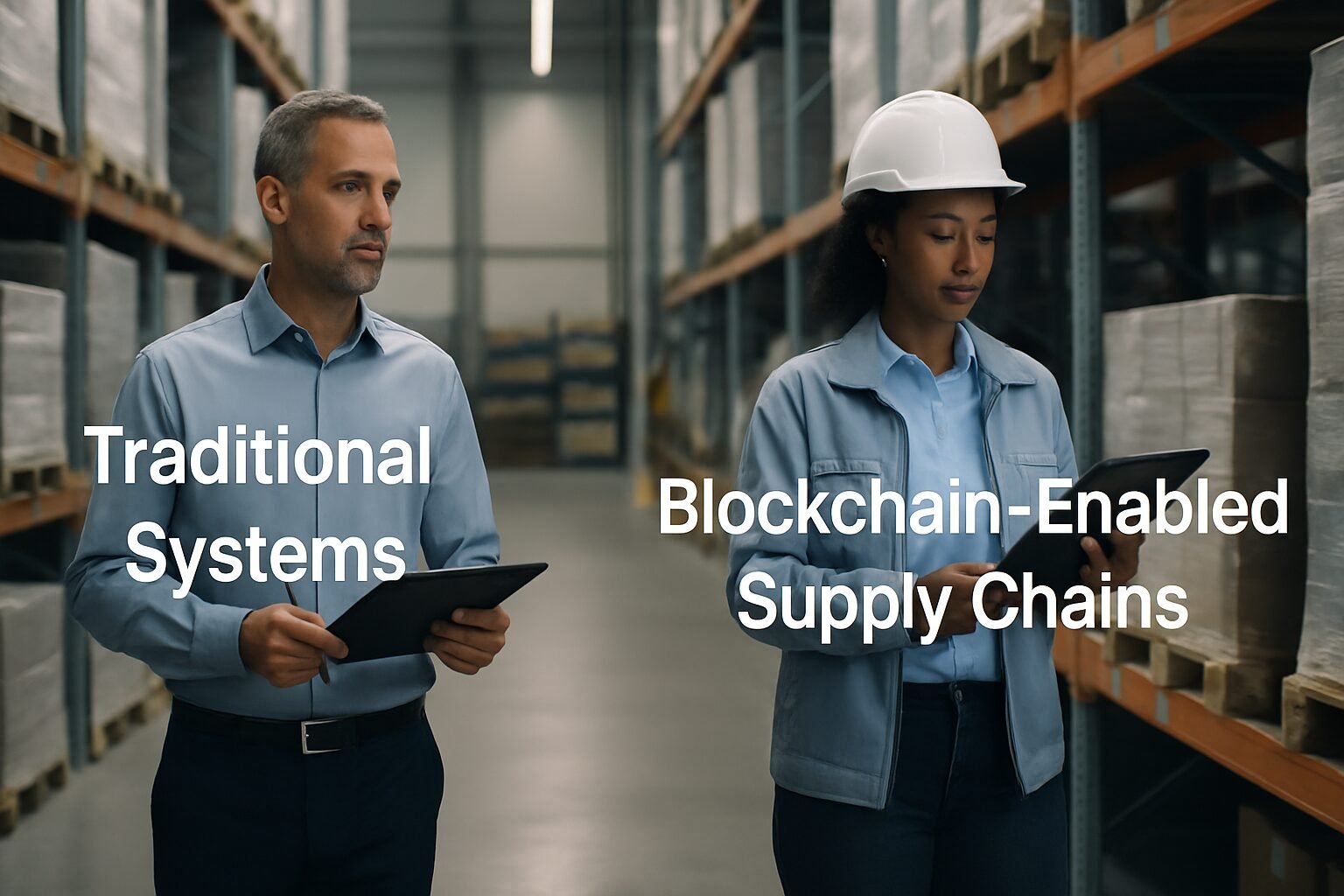
The gap between traditional and blockchain-enabled supply chains isn’t just technical. It’s financial, operational, and increasingly competitive.
The Cost of Siloed Data
Conventional supply chains rely on fragmented databases. Each supplier, freight forwarder, and warehouse maintains its own version of events. Reconciling these records consumes an estimated 20% of logistics costs and leads to disputes, delays, and blind spots. In the UK, competition for warehouse space has grown so intense that some companies are paying 20% above asking price, intensifying the pressure to extract maximum efficiency from every square foot. blockchain technology directly reduces the reconciliation burden that eats into those margins.
Feature-by-Feature Comparison
| Feature | Traditional Supply Chain | Blockchain-Enabled Supply Chain |
|---|---|---|
| Data Storage | Centralized, siloed databases | Decentralized, shared ledger |
| Transparency | Limited; each party controls its own data | Full; authorized parties see real-time updates |
| Security | Vulnerable to single-point failure | Highly secure; cryptographic chaining prevents tampering |
| Cost of Reconciliation | High; manual auditing and disputes | Low; automated verification via consensus |
| Traceability | Difficult; fragmented records | End-to-end, immutable product journey |
| Automation | Paper-heavy, slow approvals | Smart contracts trigger actions instantly |
When Does Blockchain Outperform ERP Alone?
ERP systems like SAP and Oracle excel at optimizing internal processes, but they struggle to share data with external partners in a trust-minimized way. Blockchain acts as a cross-company data backbone that ERP platforms can query. This means you gain external visibility without replacing the WMS or TMS you already rely on. It’s a plug-and-augment architecture, not a rip-and-replace project. That distinction matters enormously for budget conversations and change management.
Challenges of Implementing Blockchain in Warehouse Operations
Blockchain technology in warehouse management and supply chain is not a frictionless deployment. These are the real obstacles I see teams hit, and how the industry is addressing them.
Scalability and Throughput Limits
Public blockchains like Ethereum process roughly 15-30 TPS, far below the demands of a busy fulfillment center. Layer-2 solutions such as Polygon and Optimism address this by bundling transactions and can handle 7,000 or more TPS, while enterprise frameworks like Hyperledger Fabric are engineered specifically for high throughput in permissioned environments. The six-fold market growth expected by 2029 is partly driven by these rapid infrastructure improvements making enterprise deployment more practical every quarter.
Integrating Legacy Systems
Most warehouses rely on WMS and ERP platforms that are years or decades old. Blockchain can function as an add-on trust layer, but connecting the two requires middleware, APIs, and data-format alignment. As Deloitte notes, “blockchain does not displace a company’s legacy systems; it serves as an add-on enterprise solution.” This gradual integration path reduces risk but demands careful change management and honest internal conversations about technical debt.
Workforce Skills and Change Management
Technology is only half the challenge. Warehouse teams accustomed to paper-based or ERP-only workflows need training on new data entry protocols, exception handling, and the logic behind smart contract triggers. Based on my experience building systems that touch operational teams, the change management work typically takes longer than the technical integration. Budget for it explicitly. The organizations that treat blockchain as a people project as much as a technology project are the ones that see adoption stick.
Regulatory and Interoperability Hurdles
With only 11.3% of blockchain firms currently focused on logistics, the industry is still in its early adopter phase. Standards like ISO 2020 and GS1’s EPCIS are being adapted for blockchain, yet cross-border data governance remains inconsistent. The MHI Annual Industry Report projects that 68% of logistics companies will adopt blockchain within five years, signaling confidence that these regulatory and technical gaps will close. But right now, interoperability between different blockchain networks remains a genuine friction point for multi-partner deployments.
“The question for supply chain leaders is no longer whether distributed ledger technology belongs in logistics operations, but which implementation path creates the fastest path to verified, shared data.” – MHI Annual Industry Report perspective on enterprise blockchain adoption
Steps to Integrate Blockchain into Your Warehouse Operations
Integrating blockchain technology in warehouse management and supply chain works best as a phased approach, starting narrow and expanding once the value is proven internally.
Step 1: Identify Your Highest-Impact Pain Point
Map your supply chain for the use case where trust gaps cost the most: counterfeit risk, slow recalls, invoice disputes, or compliance documentation. Don’t try to solve everything at once. Pick the one problem where a shared, tamper-proof ledger would have the clearest ROI, and build your pilot around that.
Step 2: Choose the Right Platform
Decide between a public chain (Ethereum), private (Hyperledger Fabric), or consortium model. For most warehouses, a permissioned network balances privacy and efficiency. If you’re in pharmaceuticals, look at purpose-built networks like MediLedger. If you’re in food, IBM Food Trust has existing network effects worth joining rather than rebuilding.
Step 3: Pilot with a Single Partner on a Single Lane
Start small. One supplier, one SKU, one shipping lane. Measure transparency gains, time savings, and error reduction before scaling. A contained pilot also gives you the data you need to make the internal business case for broader rollout. Most successful enterprise blockchain deployments I’ve studied started with a 90-day pilot that proved 2-3x improvement on a specific metric before getting budget for phase two.
Step 4: Integrate IoT and AI
Attach IoT sensors for real-time condition data and feed it onto the chain. Pair with AI for predictive analytics including demand forecasting, route optimization, and anomaly detection. This combination turns your warehouse into a smart node in a larger intelligent network. Throughout this process, align with frameworks like ISO 22000 for food safety or the Global Traceability Standard to ensure interoperability with trading partners.
The Future of Blockchain Technology in Warehouse Management and Supply Chain
Blockchain technology in warehouse management and supply chain is crossing from pilot to production, and the next three years will separate the early movers from the laggards.
Growth Projections and Investment Trends
With the market set to grow six-fold by 2029 and 68% of firms planning adoption per MHI data, blockchain is no longer a speculative bet. Early consortia like TradeLens (Maersk and IBM) proved the model at scale, and next-generation networks are attracting venture capital at a pace that signals the infrastructure is maturing. As of 2026, the most active investment areas are pharmaceutical serialization, food traceability, and cross-border trade finance, all of which flow directly through warehouse operations.
Blockchain and the Circular Economy
Sustainability mandates are turning blockchain into the foundation of the circular economy. Digital product passports, which are immutable records of origin, materials, and repair history, enable efficient reuse and recycling at scale. In the UK, where warehouse real estate costs have hit record highs with some operators paying 20% above asking price, blockchain-driven inventory accuracy reduces both space requirements and waste. The EU’s Digital Product Passport regulation makes this infrastructure a compliance necessity, not just a sustainability signal.
The Rising Role of Digital Twins
A digital twin, which is a live virtual replica of a physical warehouse fed by blockchain-verified data, can simulate hundreds of scenarios from peak-season staffing to equipment failures. This convergence of IoT, AI, and blockchain gives operators the ability to predict rather than react. As processing power grows and blockchain scalability improves through Layer-2 infrastructure, the autonomous, self-optimizing warehouse moves from concept to operational reality. I expect we’ll see the first fully autonomous blockchain-native fulfillment centers go live within the next five years.
Pros and Cons of Blockchain in Warehouse and Supply Chain Operations
No technology is a universal solution. Here’s an honest assessment of where blockchain technology in warehouse management and supply chain delivers and where it still has friction.
Pros
- Tamper-proof audit trail: Every transaction is permanently recorded and cryptographically secured, eliminating disputes over what happened and when.
- Real-time multi-party visibility: All authorized participants see the same data simultaneously, removing the reconciliation overhead that consumes up to 20% of logistics costs.
- Smart contract automation: Payment releases, reorder triggers, and compliance checks execute automatically, cutting administrative labor and accelerating cash cycles.
- Regulatory compliance infrastructure: For DSCSA, EU Digital Product Passport, and food safety regulations, blockchain provides the interoperable, verifiable record that regulators require.
- Scalable add-on architecture: Blockchain layers onto existing WMS and ERP systems via APIs, meaning you don’t have to scrap your current stack to get the benefits.
Cons
- High initial integration cost: Connecting blockchain to legacy systems requires middleware development, API work, and data-format alignment that can be expensive and time-consuming.
- Throughput limits on public chains: Ethereum’s 15-30 TPS ceiling is a real constraint for high-volume operations, requiring Layer-2 solutions or permissioned networks to compensate.
- Interoperability gaps: With only 11.3% of blockchain firms focused on logistics, cross-network standards are still maturing, creating friction in multi-partner deployments.
- Change management burden: Operational teams need significant training and process redesign to work effectively with blockchain-based workflows, and this work is consistently underestimated.
- Network dependency: Blockchain’s value scales with the number of participants. A single-company deployment captures only a fraction of the potential benefit.
I’ve seen teams get burned by underestimating the cons, particularly the change management piece. Go in with clear eyes on both sides of this list.
Frequently Asked Questions
What is blockchain technology in warehouse management?
Blockchain technology in warehouse management is a decentralized digital ledger that records every inventory movement, transaction, and condition log as a permanent, tamper-proof entry. All supply chain partners access the same verified version of the data, eliminating reconciliation disputes and reducing fraud risk.
How does blockchain improve supply chain transparency?
By replacing siloed databases with a shared ledger, blockchain gives every authorized participant real-time visibility into the product journey from origin to delivery. This reduces disputes, speeds up recalls, and makes it significantly harder for counterfeit goods to enter the supply chain undetected.
Can blockchain integrate with my existing WMS or ERP?
Yes. Blockchain acts as an add-on trust layer that connects to legacy systems through APIs and middleware, enhancing data sharing without replacing your current technology stack. Deloitte explicitly notes that blockchain does not displace existing enterprise systems but augments them.
What are smart contracts in warehousing?
Smart contracts are self-executing code stored on the blockchain that automatically trigger actions, such as releasing payment upon confirmed delivery or reordering stock when inventory falls below a threshold, when predefined conditions are met. They eliminate manual approval steps and reduce the risk of human error in high-frequency warehouse workflows.
Is blockchain secure from cyberattacks?
The cryptographic linking of blocks and distributed consensus make it extremely difficult to tamper with records on a well-designed blockchain network. While application interfaces and wallets can be vulnerable, the underlying ledger is architecturally designed to be tamper-evident, making it far more resilient than centralized database alternatives.
What does it cost to implement blockchain in a warehouse?
Costs vary significantly based on scale, platform choice, and integration complexity. Piloting with a permissioned chain on a single supplier lane can be relatively contained, and the long-term savings from reduced reconciliation, fraud prevention, and compliance automation typically outweigh the initial investment within 18-36 months based on enterprise case studies.
Enjoyed this article?
Connect with me for collaboration, ventures, or just a good conversation about building things.
Get in Touch